x

Revision notes for AQA GCSE Chemistry Greenhouse gases. Open the guide for explanations and worked examples. Written against the AQA GCSE Chemistry (8462) specification, so the content matches what's examinable rather than general Chemistry background.

Greenhouse gases

What you'll learn

  • Which gases are called greenhouse gases at GCSE.
  • How the greenhouse effect helps keep Earth warm enough for life.
  • The difference between short-wavelength radiation from the Sun and long-wavelength radiation from Earth.
  • How greenhouse gases absorb and re-emit infrared radiation.

The atmosphere and why it matters

The atmosphere is the layer of gases surrounding Earth. It contains mostly nitrogen and oxygen, but it also contains small amounts of gases that have a big effect on temperature.

Earth would be much colder without its atmosphere. Some gases in the atmosphere help keep energy near the surface, making the average temperature high enough to support life.

Definition

Greenhouse gas

A greenhouse gas is a gas in the atmosphere that absorbs long-wavelength infrared radiation emitted by Earth and then re-emits radiation in all directions.

The key greenhouse gases you need for this section are:

  • Water vapour, H₂O
  • Carbon dioxide, CO₂
  • Methane, CH₄
Key Idea

The key GCSE idea

Greenhouse gases do not mainly stop sunlight getting in. They mainly reduce how quickly energy leaves Earth by absorbing and re-emitting outgoing infrared radiation.

Radiation: energy travelling as waves

Radiation is energy transferred by waves. You do not need a medium, so radiation can travel through space.

The Sun transfers energy to Earth mainly by electromagnetic radiation. This includes visible light, ultraviolet radiation and infrared radiation.

Definition

Wavelength

The wavelength of radiation is the distance from one wave peak to the next. Short-wavelength radiation has wave peaks close together; long-wavelength radiation has wave peaks further apart.

At GCSE, the most important comparison is:

  • The Sun emits lots of short-wavelength radiation, including visible light.
  • The Earth, being much cooler than the Sun, emits long-wavelength infrared radiation.

Why wavelength matters

Different types of radiation interact differently with matter.

The atmosphere is mostly transparent to incoming short-wavelength solar radiation, so much of it reaches the Earth’s surface. But greenhouse gases are good at absorbing some of the long-wavelength infrared radiation emitted by Earth.

Common Mistake

Thinking greenhouse gases block all radiation

Greenhouse gases do not simply form a blanket that blocks everything. They allow much incoming short-wavelength radiation through, but absorb and re-emit some outgoing long-wavelength infrared radiation.

The greenhouse effect step by step

The greenhouse effect is the process where greenhouse gases in the atmosphere help keep Earth warmer than it would otherwise be.

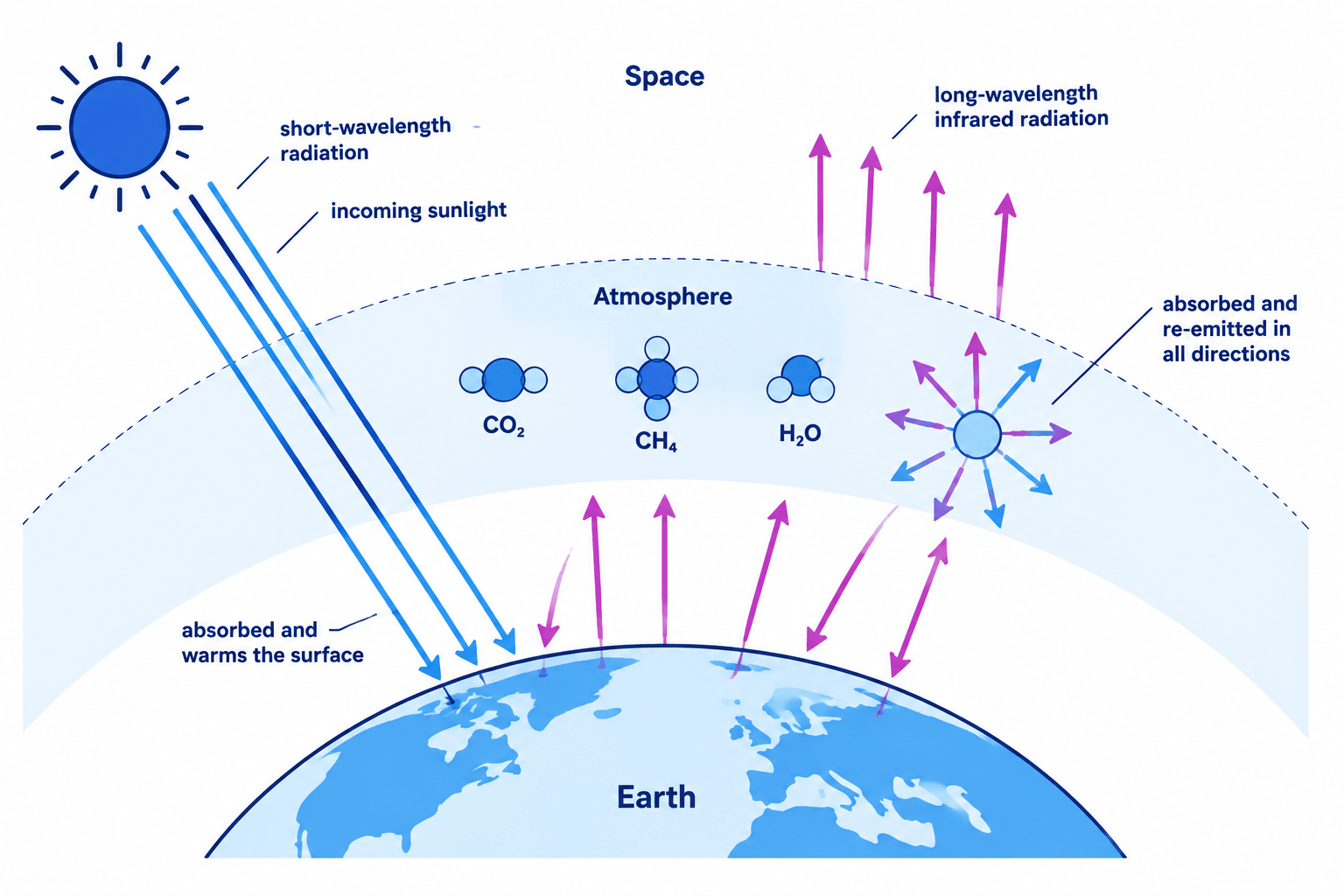
Diagram showing incoming short-wavelength solar radiation, outgoing long-wavelength infrared radiation, and greenhouse gases absorbing and re-emitting infrared radiation

Step 1: short-wavelength radiation enters

The Sun emits short-wavelength radiation. Much of this radiation passes through the atmosphere and reaches Earth’s surface.

Some radiation is reflected back into space by clouds, ice, snow or other pale surfaces, but a lot is absorbed by the ground and oceans.

Step 2: Earth warms up

When Earth’s surface absorbs solar radiation, it warms up.

A warmer object emits radiation. Because Earth is much cooler than the Sun, it emits long-wavelength infrared radiation.

Definition

Infrared radiation

Infrared radiation is electromagnetic radiation that transfers energy as heat. Earth emits long-wavelength infrared radiation after its surface has been warmed by the Sun.

Step 3: greenhouse gases absorb outgoing infrared

Some of the long-wavelength infrared radiation emitted by Earth travels upwards into the atmosphere.

Greenhouse gases such as water vapour, carbon dioxide and methane absorb some of this outgoing infrared radiation.

Step 4: greenhouse gases re-emit radiation

After absorbing infrared radiation, greenhouse gas molecules re-emit radiation in all directions.

Some of this radiation goes out to space, but some is sent back towards Earth’s surface. This means energy leaves Earth more slowly, so the surface and lower atmosphere are warmer.

Definition

Greenhouse effect

The greenhouse effect is the warming of Earth’s surface and lower atmosphere because greenhouse gases absorb some outgoing long-wavelength infrared radiation and re-emit it in all directions.

Example

Tracing energy through the greenhouse effect

A student says: “Sunlight reaches Earth, then heat is trapped by greenhouse gases.” Improve this explanation using radiation and wavelength.

  1. First identify the incoming radiation: the Sun gives out mostly short-wavelength radiation, and much of this passes through the atmosphere.

  2. Next describe what happens at the surface: Earth’s surface absorbs some of this radiation, so it warms up and then emits long-wavelength infrared radiation.

  3. Then explain the role of greenhouse gases: gases such as CO₂, CH₄ and water vapour absorb some of this outgoing infrared radiation.

  4. Finally complete the energy pathway: the gases re-emit radiation in all directions, including back towards Earth, so less energy escapes directly into space.

Why greenhouse gases are useful

The greenhouse effect is a natural process. Without it, Earth would be too cold for many organisms to survive.

So greenhouse gases are not automatically “bad”. In the right amount, they help maintain temperatures on Earth high enough to support life.

Key Idea

Natural greenhouse effect

The natural greenhouse effect is essential for life because it keeps Earth’s temperature higher than it would be without greenhouse gases.

You may later study the enhanced greenhouse effect, where increased amounts of greenhouse gases can lead to additional warming. For this section, focus on the basic mechanism: short-wavelength radiation in, long-wavelength infrared radiation partly absorbed and re-emitted.

The three greenhouse gases you must know

Water vapour, H₂O

Water vapour is water in the gas state. It is a greenhouse gas because it absorbs long-wavelength infrared radiation.

Water vapour levels can vary depending on temperature and weather conditions.

Carbon dioxide, CO₂

Carbon dioxide is present in the atmosphere in small amounts. It is a greenhouse gas because it absorbs outgoing infrared radiation from Earth.

At GCSE, you should be confident naming carbon dioxide as one of the main greenhouse gases.

Methane, CH₄

Methane is also present in the atmosphere in much smaller amounts than carbon dioxide, but it is still an important greenhouse gas.

For this spec point, you only need the idea that methane absorbs long-wavelength infrared radiation and contributes to the greenhouse effect.

Tip

Memory shortcut

Remember the GCSE greenhouse gases as water, carbon, methane: water vapour H₂O, carbon dioxide CO₂ and methane CH₄.

Absorbing and re-emitting: what those words mean

Absorption means taking in energy. When a greenhouse gas absorbs infrared radiation, energy is transferred to the gas molecule.

Emission means giving out energy as radiation. After absorbing energy, the molecule can emit infrared radiation again.

The important bit is that re-emission happens in all directions, not just upwards. That is why some energy is sent back towards Earth.

Example

Deciding whether a gas is a greenhouse gas

A gas in the atmosphere lets most visible light pass through but absorbs infrared radiation emitted from Earth’s surface. Explain whether it acts as a greenhouse gas.

  1. Compare the gas with the definition: a greenhouse gas absorbs long-wavelength infrared radiation emitted by Earth.

  2. Apply the evidence: the gas absorbs infrared radiation from Earth’s surface, so it matches the key behaviour of a greenhouse gas.

  3. Explain the consequence: if it re-emits that radiation in all directions, some energy returns towards Earth, helping to warm the surface and lower atmosphere.

Short-wavelength in, long-wavelength out

This is the most important exam explanation.

Incoming radiation from the Sun is mostly short wavelength and can pass through the atmosphere. The Earth absorbs this energy and warms up. The Earth then emits long-wavelength infrared radiation. Greenhouse gases absorb some of this outgoing infrared radiation and re-emit it in all directions.

Common Mistake

Saying heat is reflected back

In GCSE Chemistry, avoid saying greenhouse gases “reflect heat”. The better explanation is that they absorb and re-emit infrared radiation.

How to write a strong GCSE answer

If a question asks you to “describe the greenhouse effect”, try to include the full chain:

  1. Short-wavelength radiation from the Sun passes through the atmosphere.
  2. Earth’s surface absorbs the radiation and warms up.
  3. Earth emits long-wavelength infrared radiation.
  4. Greenhouse gases absorb some of this infrared radiation.
  5. Greenhouse gases re-emit radiation in all directions, including back towards Earth.
  6. This keeps Earth warmer than it would otherwise be.

You do not need complex equations for this topic. The skill is explaining the energy transfers clearly using the correct radiation words.

Exam technique

In the exam

  1. Use the phrases short-wavelength radiation from the Sun and long-wavelength infrared radiation from Earth.

  2. Name the greenhouse gases from the spec: water vapour, carbon dioxide and methane.

  3. Say greenhouse gases absorb and re-emit infrared radiation; avoid vague wording like “they trap heat” unless you explain what that means.

Self review

Check yourself

  • Why does Earth emit long-wavelength infrared radiation rather than mainly short-wavelength radiation?

  • Name the three greenhouse gases required by the spec.

  • What happens after a greenhouse gas absorbs infrared radiation from Earth?

Carbon dioxide and methane as greenhouse gases

Guide 1 of 4

You've reached the end

Test yourself on this topic, or move on to the next guide.

Next guideHuman activities which contribute to an increase in greenhouse gases in the atmosphereStart

How was this guide?

Greenhouse gases Revision Guide

  1. GCSE
  2. /Chemistry
  3. /Greenhouse gases