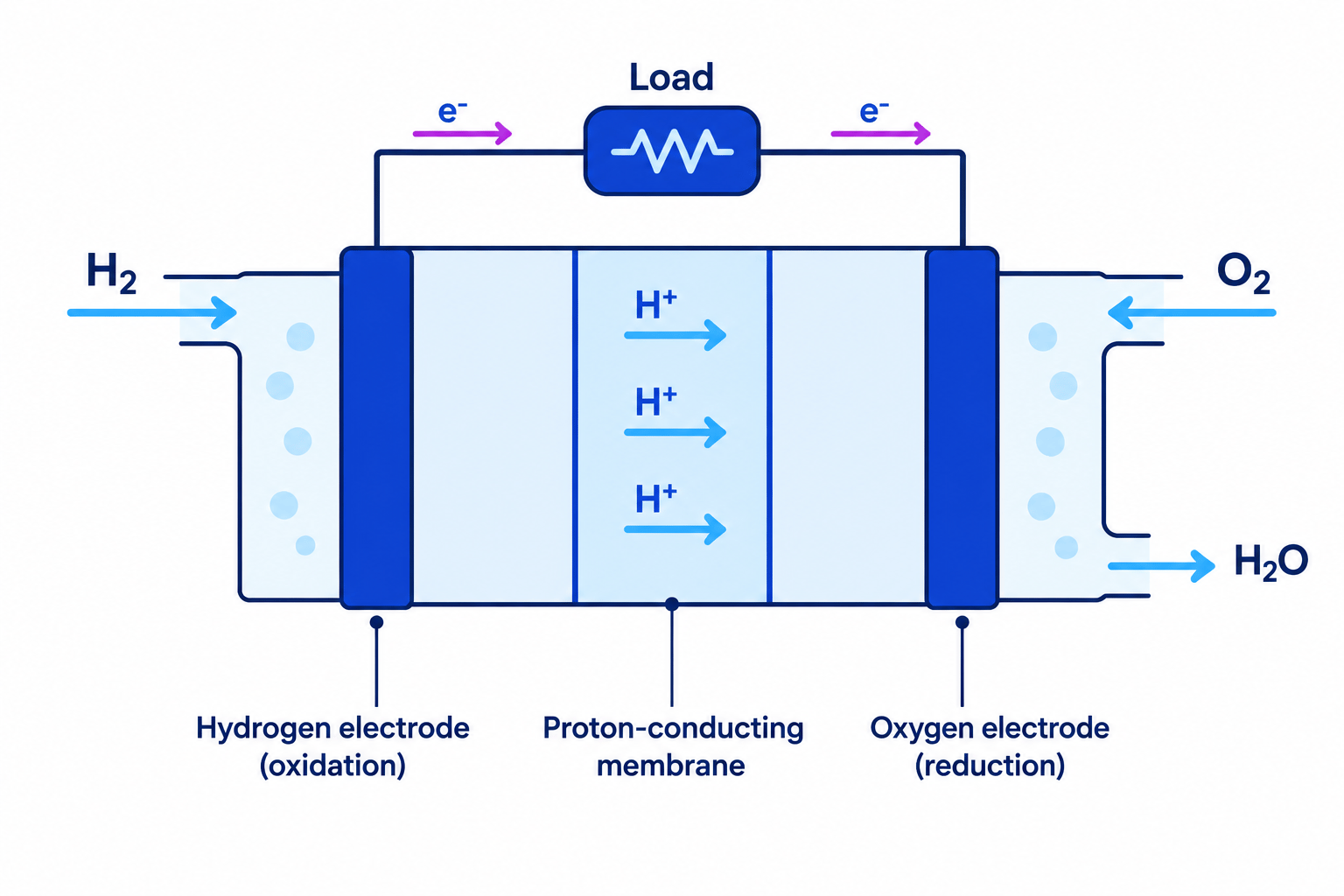
Hydrogen is oxidised at one electrode and oxygen is reduced at the other
Definition
Half equation
An equation that shows the reaction at one electrode, including the electrons that are transferred.
Definition
Electrode
A conducting material through which electrical current enters or leaves a cell, with a simple cell using two different metal electrodes.
- A half equation shows the reaction at one electrode and includes the electrons transferred.
- At the hydrogen electrode, hydrogen atoms lose electrons, so hydrogen is oxidised.
- At the oxygen electrode, oxygen gains electrons, so oxygen is reduced.
- Oxidation is the loss of electrons, while reduction is the gain of electrons.
Key Idea
- Electrons appear on the products side of an oxidation half equation.
- Electrons appear on the reactants side of a reduction half equation.
Balancing the hydrogen half equation puts the electrons on the right
- Start with one hydrogen molecule, H2(g)\text{H}_2\text{(g)}H2(g), which has two hydrogen atoms.
- Write two hydrogen ions on the right to balance the atoms: H2(g)→2H+(aq)\text{H}_2\text{(g)} \rightarrow 2\text{H}^+\text{(aq)}H2(g)→2H+(aq).
- The two hydrogen ions carry a total charge of +2+2+2, while the molecule has no charge.
- Add two electrons to the right so that each side has a total charge of zero.
- The balanced half equation is H2(g)→2H+(aq)+2e−\text{H}_2\text{(g)} \rightarrow 2\text{H}^+\text{(aq)} + 2e^-H2(g)→2H+(aq)+2e−.
Example
- The left side has two hydrogen atoms and a total charge of zero.
- The right side has two hydrogen atoms and a total charge of 2(+1)+2(−1)=02(+1) + 2(-1) = 02(+1)+2(−1)=0.
Balancing the oxygen half equation puts the electrons on the left
- Start with one oxygen molecule and form two water molecules to balance the oxygen: O2(g)→2H2O(l)\text{O}_2\text{(g)} \rightarrow 2\text{H}_2\text{O(l)}O2(g)→2H2O(l).
- Add four hydrogen ions on the left to supply the four hydrogen atoms in the water.
- The four hydrogen ions carry a total charge of +4+4+4, so add four electrons on the left to make the charge zero.
- The balanced half equation is O2(g)+4H+(aq)+4e−→2H2O(l)\text{O}_2\text{(g)} + 4\text{H}^+\text{(aq)} + 4e^- \rightarrow 2\text{H}_2\text{O(l)}O2(g)+4H+(aq)+4e−→2H2O(l).
Common Mistake
- Do not put the electrons on the right of the oxygen half equation; oxygen is reduced, so it gains electrons.
- Check both the number of each atom and the total charge when you balance a half equation.
Matching the electrons lets the half equations combine into the overall reaction
- The hydrogen half equation releases two electrons, while the oxygen half equation uses four.
- Multiply the whole hydrogen half equation by two: 2H2(g)→4H+(aq)+4e−2\text{H}_2\text{(g)} \rightarrow 4\text{H}^+\text{(aq)} + 4e^-2H2(g)→4H+(aq)+4e−.
- Add the two half equations and cancel the four electrons and four hydrogen ions that appear on both sides.
- This gives the overall reaction 2H2(g)+O2(g)→2H2O(l)2\text{H}_2\text{(g)} + \text{O}_2\text{(g)} \rightarrow 2\text{H}_2\text{O(l)}2H2(g)+O2(g)→2H2O(l).
- Electrons must not appear in the overall equation because they are transferred between the electrodes, not created or destroyed.
Exam technique
- Balance the atoms first, then add electrons until the total charge is the same on both sides.
- Put electrons on the products side for the oxidation (hydrogen) and on the reactants side for the reduction (oxygen).
- To combine the half equations, scale them so the electrons match, add them, then cancel the electrons and any H+\text{H}^+H+ on both sides.
Self review
- What does a half equation show?
- On which side do the electrons appear in the hydrogen half equation?
- Write the balanced half equation for the reaction at the hydrogen electrode.
- Write the balanced half equation for the reaction at the oxygen electrode.
- What two things must you check when balancing a half equation?