A fuel cell makes electricity from a fuel supplied from outside
Definition
Potential difference
The difference in electrical energy transferred per unit charge between two points in a circuit.
- A fuel cell changes chemical energy into electrical energy while fuel and oxygen are fed in from outside the cell.
- The oxygen can be supplied as pure oxygen or as part of the air.
- The fuel is oxidised electrochemically inside the cell.
- This controlled reaction sets up a potential difference across the terminals of the cell.
- An electric current flows once the terminals are joined in a complete circuit.
- The cell keeps working for as long as it is supplied with fuel and oxygen.
Key Idea
- A fuel cell never needs recharging because its reactants are fed in continuously from outside.
- It stops producing a potential difference if either the fuel or the oxygen supply stops.
In a hydrogen fuel cell, hydrogen is oxidised to form water
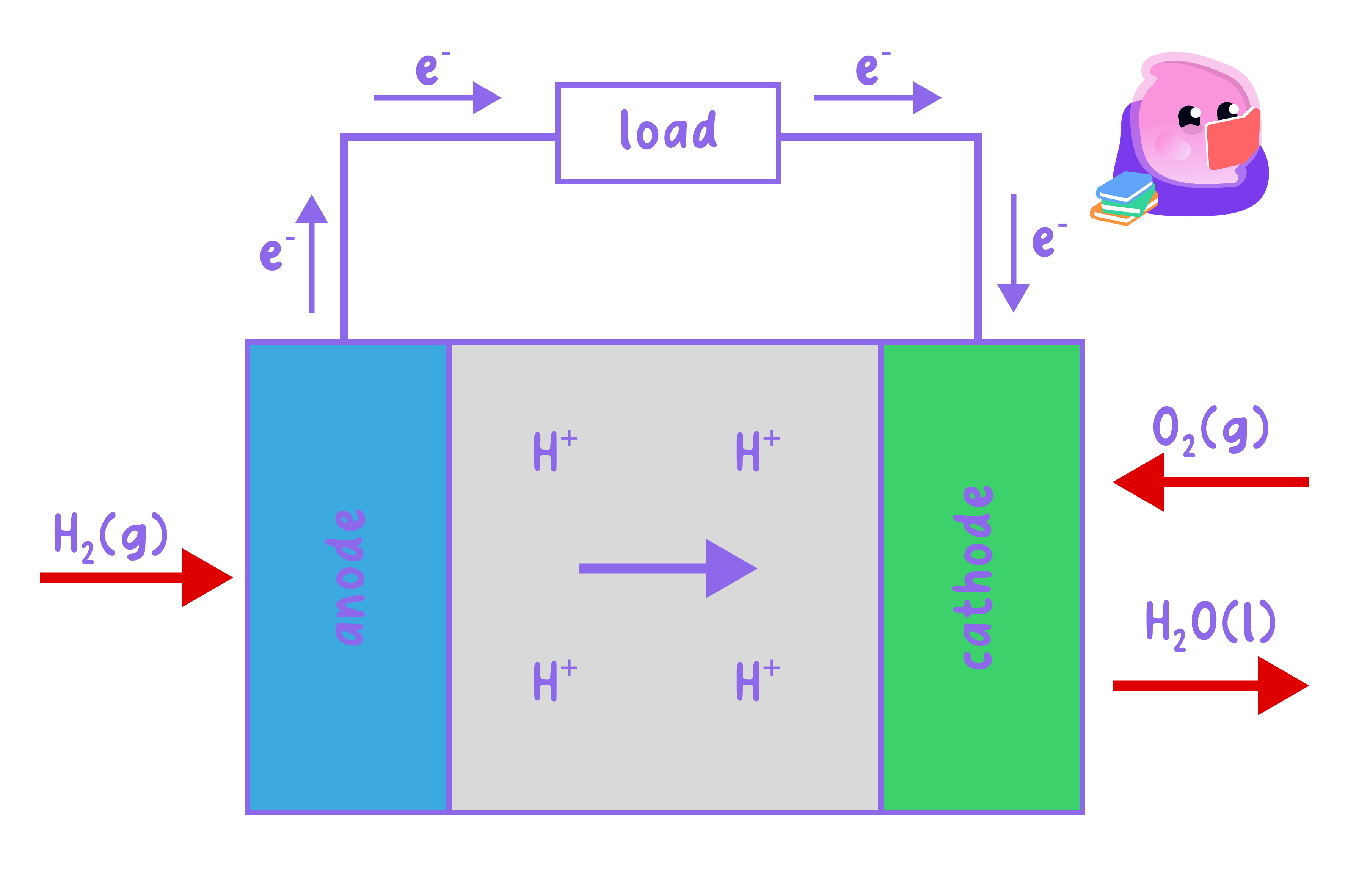
- A hydrogen fuel cell is fed with hydrogen as the fuel and oxygen, usually from the air.
- Hydrogen is oxidised when it reacts with the oxygen.
- The overall reaction is 2H2(g)+O2(g)→2H2O(l)2\text{H}_2\text{(g)} + \text{O}_2\text{(g)} \rightarrow 2\text{H}_2\text{O(l)}2H2(g)+O2(g)→2H2O(l).
- Water is the only chemical product of the overall reaction.
- Hydrogen contains no carbon, so the cell produces no carbon dioxide while it is running.
Common Mistake
- Do not claim that hydrogen fuel cells cause no environmental damage at all.
- The cell makes only water in use, but making and transporting the hydrogen can use energy and release pollutants.
A fuel cell is refuelled, while a rechargeable battery is recharged
Definition
Rechargeable cell
A cell that can be restored by passing an electric current through it so that it can be used again.
- Keeping a device running: a fuel cell runs while fuel and oxygen are supplied, whereas a rechargeable battery holds a fixed amount of chemicals and eventually goes flat.
- Returning it to use: a fuel cell is refilled with hydrogen, while a rechargeable battery must be connected to an electricity supply to charge.
- Time: refilling a hydrogen tank can be quicker than charging a large battery, though charging time depends on the battery and charger.
- Equipment: a fuel cell needs a tank, safe pipes and a hydrogen supply, while a battery needs a charger and access to mains electricity.
Example
- A hydrogen bus can be refuelled quickly and sent straight back into service.
- A battery bus may take longer to charge, but it does not carry a tank of flammable hydrogen.
Neither option is impact-free once you include making and storing the fuel
Definition
Battery
Two or more cells connected together to provide electrical energy.
- Emissions in use: a hydrogen fuel cell gives out only water, and a rechargeable battery gives out no exhaust gases either.
- Making the hydrogen or electricity: producing hydrogen can release carbon dioxide if fossil fuels are used, and charging a battery is only as clean as the electricity used.
- Storage and safety: hydrogen is highly flammable and is often stored under high pressure, needing strong tanks, while batteries avoid this but can be heavy.
- Materials and waste: batteries need extracted raw materials and lose capacity over time, and fuel cell systems also need materials, manufacture and replacement.
- Cost and infrastructure: hydrogen production and refuelling stations can be expensive, whereas batteries can use the existing electricity grid.
Note
- Compare both options against the same criteria: operating time, refuelling or charging time, emissions, safety, cost and waste.
- A claim that fuel cells are cleaner needs evidence about how the hydrogen was produced.
The better power source depends on the job and how the energy is supplied
- An evaluation weighs up the benefits and drawbacks before reaching a conclusion backed by evidence.
- Hydrogen fuel cells can suit vehicles that need long running times and quick refuelling, if hydrogen is available and stored safely.
- Rechargeable batteries can suit devices that are easy to plug into the grid and leave to charge.
- A hydrogen fuel cell has a stronger environmental case when the hydrogen is made without burning fossil fuels.
- Your conclusion should say which option is better for the stated use, not that one option is always better.
Exam technique
- To say why a fuel cell runs longer than a battery, state that fuel and oxygen are supplied continuously from outside the cell.
- In a comparison, judge fuel cells and rechargeable batteries on the same points and reach a decision for the named use.
- Say water is the only product in use, but avoid claiming the fuel cell has zero overall environmental impact.
Self review
- What two reactants must be supplied to a hydrogen fuel cell?
- What happens to the hydrogen inside a hydrogen fuel cell?
- What is the only product of the overall reaction in a hydrogen fuel cell?
- Why can a fuel cell run longer than a rechargeable cell without stopping?
- Why is a hydrogen fuel cell not automatically better for the environment?
