Group 7
What you'll learn
- The physical and chemical properties of the Group 7 elements.
- How the melting points, boiling points, and states of matter change as you go down the group.
- Why reactivity decreases as you go down Group 7.
- How displacement reactions work between different halogens and their salts.
Meet the Halogens
Group 7 elements are located on the right-hand side of the periodic table. They are commonly known as the halogens. The halogens you need to know are fluorine, chlorine, bromine, and iodine.
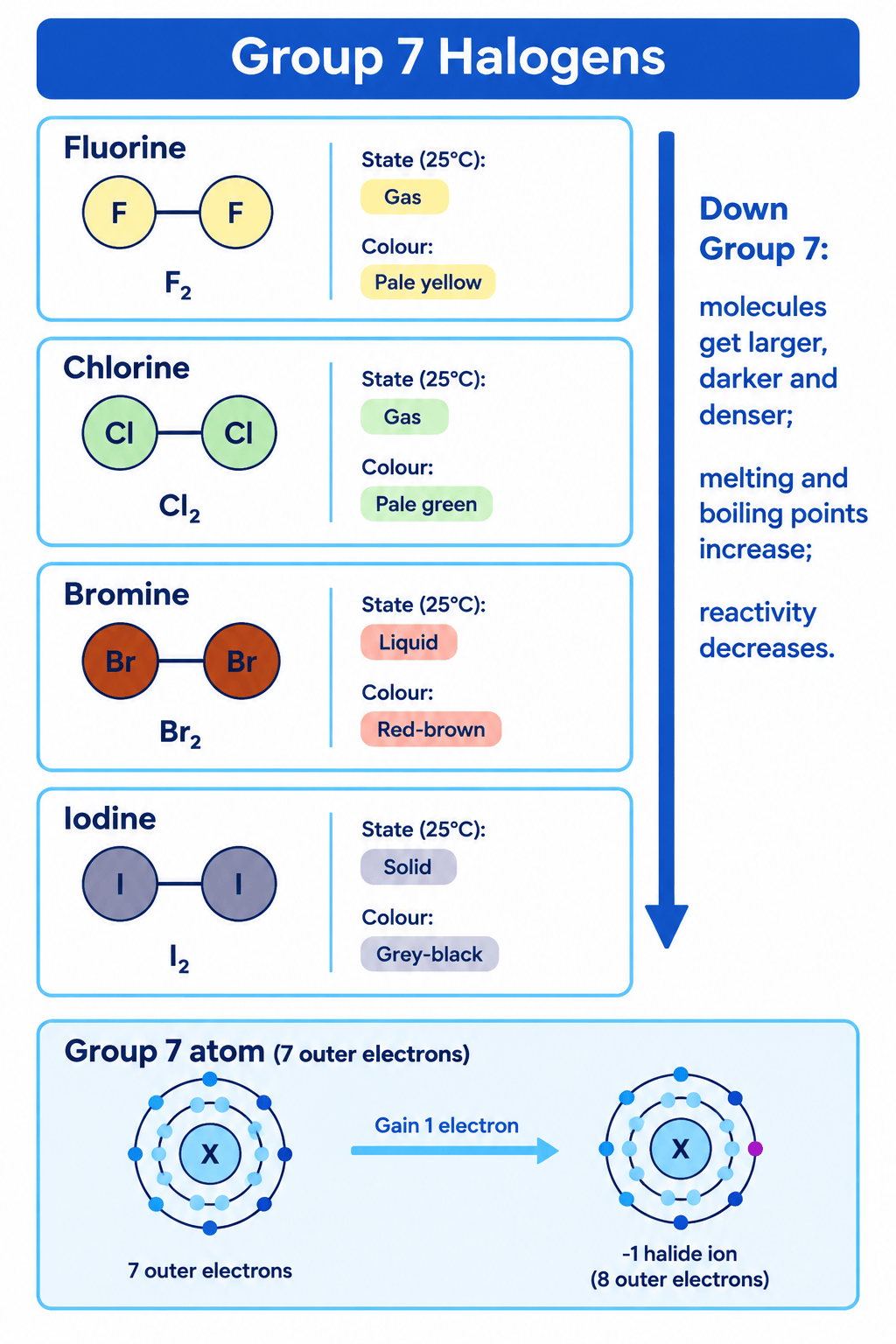
Because they are all in Group 7, every halogen atom has exactly seven electrons in its outermost shell. This gives them very similar chemical properties, as they all react in similar ways to gain the one extra electron they need to achieve a full outer shell.
The halogens are all non-metals. However, you will never find a single, isolated halogen atom floating around in nature. They always travel in pairs.
Diatomic molecule
A molecule made of exactly two atoms covalently bonded together. The halogens naturally exist as diatomic molecules, meaning we write their chemical formulae as F2\text{F}_2F2, Cl2\text{Cl}_2Cl2, Br2\text{Br}_2Br2, and I2\text{I}_2I2.
Physical Trends Down the Group
As you move down Group 7 (from fluorine down to iodine), you will notice several distinct physical trends:
- Relative molecular mass increases: The atoms get larger and have more protons and neutrons.
- Melting and boiling points increase: The intermolecular forces between the larger diatomic molecules are stronger, so it takes more energy to break them apart.
Because the melting and boiling points increase down the group, the halogens exist in different states of matter at room temperature:
- Fluorine (F2\text{F}_2F2): A pale yellow gas.
- Chlorine (Cl2\text{Cl}_2Cl2): A pale green gas.
- Bromine (Br2\text{Br}_2Br2): A red-brown liquid.
- Iodine (I2\text{I}_2I2): A dark grey solid (which gives off a purple vapour when warmed).

Because these properties change so predictably, we can use the trends to guess the properties of elements further down the group that we might not have tested, such as astatine.
Predicting the properties of Astatine
Astatine (At) sits directly below iodine in Group 7. Predict its state at room temperature and compare its boiling point to iodine's.
- Locate astatine on the periodic table to confirm it is below iodine in Group 7.
- Recall the physical trend: melting and boiling points increase as you go down Group 7.
- Since astatine is below iodine, it must have a higher boiling point than iodine.
- Because iodine is already a solid at room temperature, astatine's even higher melting point means it must also be a solid at room temperature.
Reactions with Metals and Non-metals
Because they have seven electrons in their outer shell, halogens are very eager to participate in reactions to get a full outer shell. They can do this in two ways:
Reacting with non-metals
When halogens react with other non-metals, they share electrons to form covalent bonds. This creates simple molecular structures. For example, hydrogen and chlorine react to form hydrogen chloride:
H2(g)+Cl2(g)→2HCl(g) \text{H}_2\text{(g)} + \text{Cl}_2\text{(g)} \to 2\text{HCl}\text{(g)} H2(g)+Cl2(g)→2HCl(g)Reacting with metals
When halogens react with metals, they gain one electron from the metal atom. This forms an ionic compound. The halogen atom becomes a negative ion with a 1−1-1− charge.
For example, sodium reacts with chlorine to form sodium chloride (table salt):
2Na(s)+Cl2(g)→2NaCl(s) 2\text{Na}\text{(s)} + \text{Cl}_2\text{(g)} \to 2\text{NaCl}\text{(s)} 2Na(s)+Cl2(g)→2NaCl(s)Halogen vs Halide
Don't mix up the names! When it is an element, it ends in -ine (chlorine, bromine, iodine). When it has gained an electron to become a negative ion in a compound, the name changes to end in -ide (chloride, bromide, iodide).
The Reactivity Trend
The most important pattern in Group 7 is the reactivity trend: reactivity decreases as you go down the group.
This means fluorine is the most reactive halogen, and astatine is the least reactive. This is the exact opposite of the trend in Group 1! To understand why, we have to look at the atomic structure.
To react, a halogen atom must attract one extra electron into its outer shell. As you go down the group:
- The atoms get larger, meaning the outer electron shell is further away from the positive nucleus.
- There are more inner electron shells between the nucleus and the outer shell. This creates a shielding effect.
- Because the outer shell is further away and heavily shielded, the electrostatic attraction from the nucleus is weaker.
- A weaker attraction makes it much harder for the atom to pull in that final, extra electron.

Explaining Group 7 Reactivity
Down the group, the distance to the outer shell increases and shielding increases. The weaker electrostatic attraction from the nucleus makes it harder to gain an electron, so reactivity decreases.
Displacement Reactions
Because the reactivity of the halogens changes down the group, they can compete with each other in a reaction. A more reactive halogen will always push out—or displace—a less reactive halogen from an aqueous solution of its salt.
For example, chlorine is higher up Group 7 than bromine, making chlorine more reactive. If you bubble chlorine gas through a colourless solution of potassium bromide, the chlorine will "steal" the potassium. It displaces the bromine, leaving bromine on its own.
Here is the word equation: Chlorine + Potassium Bromide →\to→ Potassium Chloride + Bromine
Here is the balanced symbol equation:
Cl2(aq)+2KBr(aq)→2KCl(aq)+Br2(aq) \text{Cl}_2\text{(aq)} + 2\text{KBr}\text{(aq)} \to 2\text{KCl}\text{(aq)} + \text{Br}_2\text{(aq)} Cl2(aq)+2KBr(aq)→2KCl(aq)+Br2(aq)During this reaction, you would see a colour change. The solution starts colourless (potassium bromide), but turns orange as the element bromine (Br2\text{Br}_2Br2) is formed and dissolved in the water.
If you tried the reverse reaction—adding bromine to potassium chloride—nothing would happen. Bromine is less reactive than chlorine, so it isn't strong enough to displace it.
In the exam
- If asked to explain the Group 7 reactivity trend, always mention the electrons. Start by stating that they need to gain one electron.
- Clearly state that atomic radius (distance) and shielding increase down the group.
- Explicitly link the increased distance and shielding to a weaker attraction from the nucleus to the incoming electron.
- If writing displacement equations, always remember the halogens are diatomic (Cl2\text{Cl}_2Cl2, Br2\text{Br}_2Br2) but the halide salts are not (KBr\text{KBr}KBr, NaCl\text{NaCl}NaCl).
Check yourself
- What happens to the boiling points of the halogens as you move down Group 7?
- Why does iodine not displace chlorine from sodium chloride?
- What is the chemical formula for a molecule of fluorine?
- What state of matter is bromine at room temperature?