Revision notes for AQA GCSE Chemistry Graphite. Open the guide for explanations and worked examples. Written against the AQA GCSE Chemistry (8462) specification, so the content matches what's examinable rather than general Chemistry background.
Carbon is an element. Each carbon atom has 4 electrons in its outer shell, so it can form covalent bonds with other atoms.
Covalent bond
A covalent bond is a strong chemical bond formed when two atoms share a pair of electrons.
In many carbon structures, carbon atoms join together by covalent bonds to make very large networks. Graphite is one example.
Giant covalent structure
A giant covalent structure is a huge network of atoms joined together by many strong covalent bonds.
Graphite is made only from carbon atoms, but those atoms are arranged differently from diamond. This different arrangement gives graphite very different properties.
Allotrope
An allotrope is a different structural form of the same element in the same physical state. Graphite and diamond are both allotropes of carbon.
In graphite, each carbon atom forms 3 covalent bonds with 3 other carbon atoms.
This makes flat sheets, or layers, of carbon atoms. Within each layer, the atoms are arranged in hexagonal rings. A hexagon is a 6-sided shape, so each ring has six carbon atoms around it.
There are strong covalent bonds within each layer, but there are no covalent bonds between the layers. Only weak forces act between the layers.
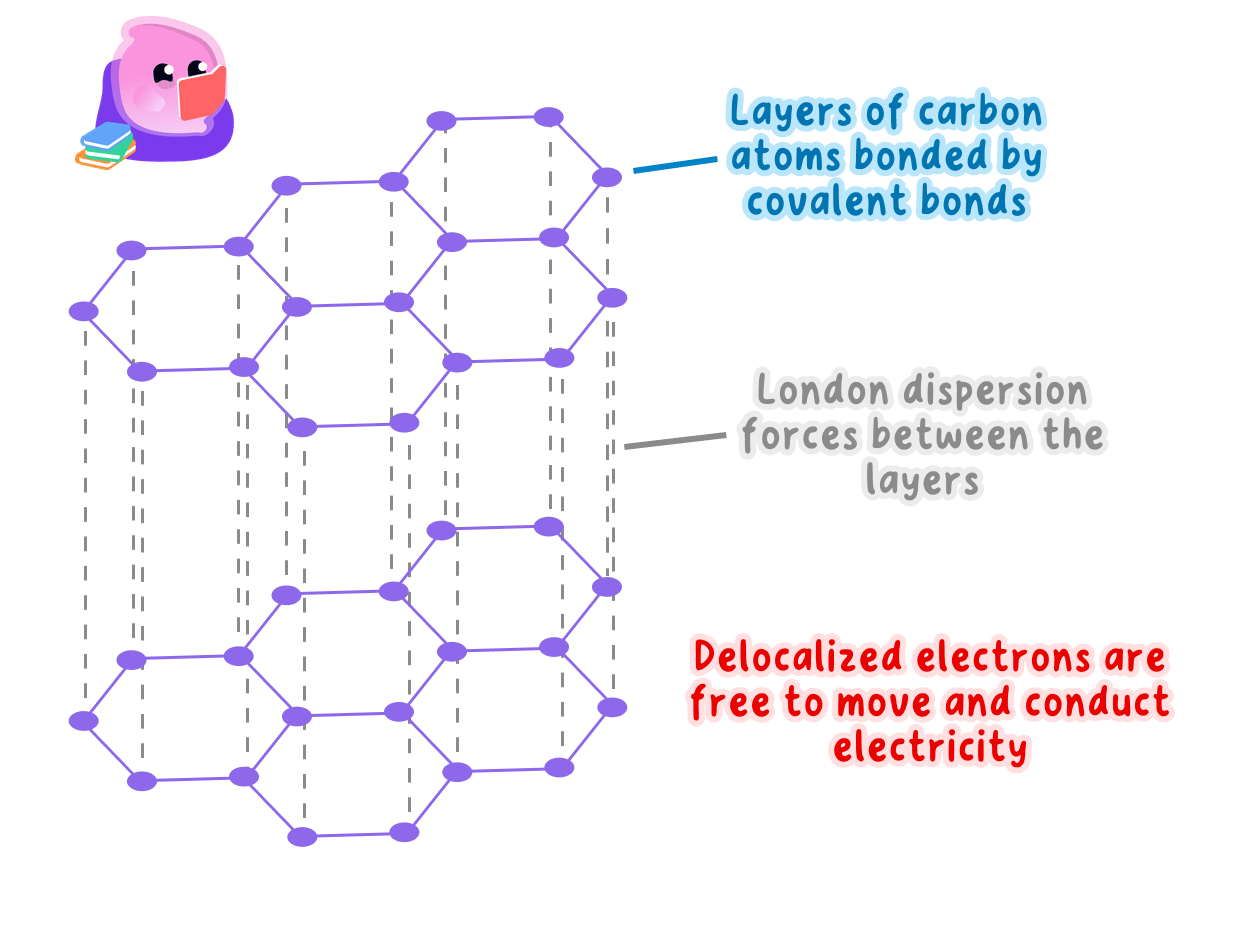
Graphite structure
Graphite is a giant covalent structure made of layers of carbon atoms arranged in hexagonal rings. Each carbon atom forms 3 covalent bonds, leaving one outer electron delocalised.
A carbon atom has 4 outer-shell electrons. In graphite, it uses 3 of these electrons to form covalent bonds with three neighbouring carbon atoms.
That leaves 1 electron from each carbon atom not fixed in one covalent bond. These electrons become delocalised.
Delocalised electron
A delocalised electron is an electron that is not attached to one particular atom or bond and can move through part of a structure.
In graphite, the delocalised electrons can move along the layers. This is the key reason graphite can conduct electricity.
Saying graphite has no covalent bonds
Graphite does have covalent bonds — very strong ones within each layer. The weak forces are only between the layers.
Graphite has a high melting point because it is a giant covalent structure.
To melt graphite, many strong covalent bonds must be overcome. These covalent bonds are found within the layers of carbon atoms.
Even though the forces between layers are weak, the structure still contains a huge network of strong covalent bonds overall. That means lots of energy is needed to break enough bonds for melting.
High melting point
Graphite has a high melting point because many strong covalent bonds must be broken.
Explaining graphite's high melting point
A question asks: “Explain why graphite has a high melting point.”
Graphite is soft because its layers can slide over each other.
Within each layer, the carbon atoms are strongly bonded. But between the layers, there are only weak forces and no covalent bonds. These weak forces are easy to overcome, so the layers can move past one another.
This is why graphite can be used in pencil “lead”. When you write, tiny layers of graphite slide off onto the paper.
Graphite can also be used as a lubricant, especially in situations where oils might not be suitable. A lubricant is a substance that reduces friction between surfaces.
Layers slide
Graphite is soft and slippery because weak forces between its layers allow the layers to slide over each other.
Linking graphite to use as a lubricant
A question asks: “Graphite can be used as a lubricant. Explain why.”
Structure first, property second
For graphite explanations, start with the structure: layers, strong covalent bonds within layers, weak forces between layers, and delocalised electrons. Then link these to the property asked about.
Graphite conducts electricity because it contains delocalised electrons.
For a substance to conduct electricity, it needs charged particles that can move. In metals, these moving charged particles are delocalised electrons. Graphite is similar to metals in this way: it also has delocalised electrons.
In graphite, one electron from each carbon atom is delocalised. These electrons can move along the layers and carry electrical charge.
Electrical conductor
An electrical conductor is a material that allows electrical charge to flow through it.
This is unusual for a giant covalent substance. Diamond, for example, does not conduct electricity because all 4 outer electrons of each carbon atom are used in covalent bonds, so there are no delocalised electrons to move.
Why graphite conducts
Graphite conducts electricity because one electron from each carbon atom is delocalised and can move along the layers.
Explaining electrical conductivity
A question asks: “Explain why graphite conducts electricity.”
Forgetting moving charged particles
Do not just say “graphite has electrons”. All substances contain electrons. To explain conductivity, you must say the electrons are delocalised and can move.
Graphite is not a metal — it is made of carbon, which is a non-metal element.
However, graphite is similar to metals because it contains delocalised electrons. In metals, delocalised electrons move through the metal lattice. In graphite, delocalised electrons move along the layers.
This explains why both metals and graphite can conduct electricity.
| Feature | Graphite | Metals |
|---|---|---|
| Main particles | Carbon atoms | Metal ions and delocalised electrons |
| Bonding | Strong covalent bonds within layers | Metallic bonding |
| Mobile charged particles | Delocalised electrons | Delocalised electrons |
| Conducts electricity? | Yes | Yes |
Graphite is not metallically bonded
Graphite conducts electricity like a metal, but it does not have metallic bonding. Its atoms are joined by covalent bonds in layers.
Graphite questions usually test whether you can connect structure and bonding to properties.
A good explanation should not be a list of memorised facts. It should make a clear chain:
Structure → bonding → property
For example:
Or:
Use the property in the question
If the question asks about softness, talk about layers sliding. If it asks about conductivity, talk about delocalised electrons moving. If it asks about melting point, talk about strong covalent bonds needing lots of energy to overcome.
Graphite is a giant covalent structure made from carbon atoms. Each carbon atom forms 3 covalent bonds with 3 other carbon atoms, creating layers of hexagonal rings.
The layers have strong covalent bonds within them, but only weak forces between them. This means the layers can slide over each other, making graphite soft and slippery.
One electron from each carbon atom is delocalised. These delocalised electrons can move along the layers, so graphite conducts electricity. This makes graphite similar to metals, even though graphite is not a metal.
In the exam
Check yourself
Structure and bonding of carbon
Guide 2 of 3
Test yourself on this topic, or move on to the next guide.
How was this guide?
