Carbon sheets, cages and tubes: how the arrangement of atoms controls the properties of graphene and fullerenes
Definition
Covalent bond
A covalent bond is a strong electrostatic attraction between a shared pair of electrons and the nuclei of the bonded atoms.
- Both graphene and fullerenes are structures made only from carbon atoms.
- In each one the atoms are held together by strong covalent bonds, but they are arranged into very different shapes.
- Graphene is a single flat layer of carbon atoms.
- Fullerenes are hollow molecules shaped as cages or tubes.
- The way the carbon atoms are arranged and bonded controls each structure's properties and uses.
Key Idea
- Graphene forms a flat sheet, while fullerenes form closed cages or tubes.
- Strong covalent bonds give these carbon structures high strength.
- Mobile delocalised electrons let graphene and carbon nanotubes conduct electricity.
Graphene: strong bonds and mobile electrons make one thin sheet useful
Definition
Delocalised electron
A delocalised electron is an electron that is not tied to one atom or bond and can move through part or all of a structure.
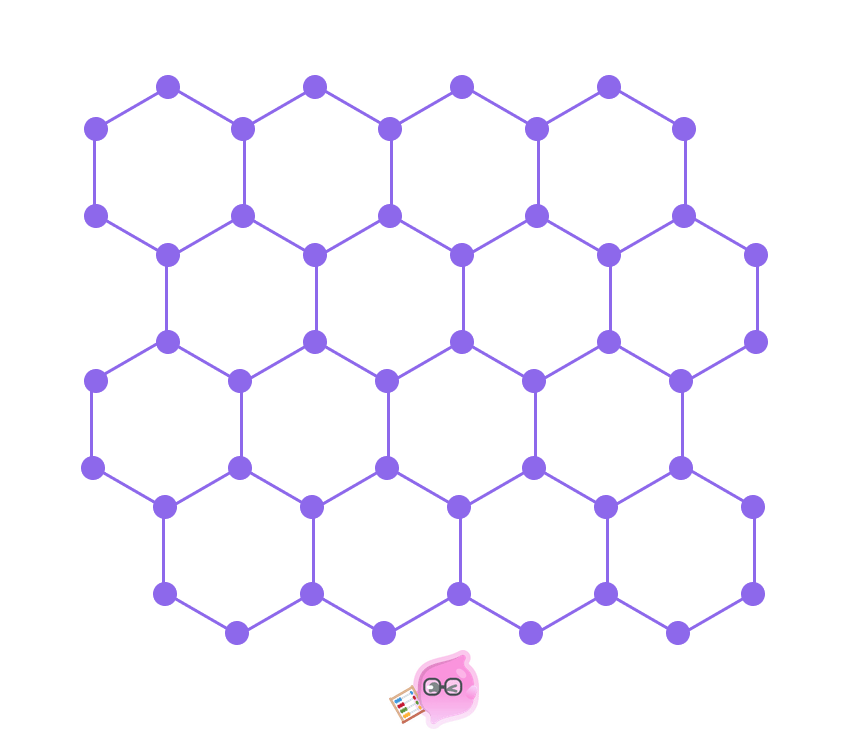
- Graphene is a single layer of graphite that is only one carbon atom thick.
- Its carbon atoms are joined in a flat pattern of hexagonal rings.
- Each carbon atom forms three strong covalent bonds to three neighbouring carbon atoms.
- These covalent bonds run right through the whole sheet, forming one giant covalent structure.
- This gives graphene a very high tensile strength, so it resists being stretched or pulled apart.
- Each carbon atom has four outer electrons but uses only three in bonding, leaving one delocalised electron.
- These delocalised electrons are free to move across the whole sheet and carry electrical charge.
- Graphene is therefore a good conductor of electricity, even though it contains no metal.
- Graphene is also very thin, flexible and almost transparent.
- These properties make it useful in electronic circuits, touchscreens and sensors.
- Adding strong, low-mass graphene to another material can make a composite with improved strength.
Common Mistake
- Do not call graphene several layers of graphite, because it is one layer only.
- Do not call graphene a small molecule, because its atoms form one continuous giant covalent structure.
- Always link a property to structure: covalent bonds explain strength, delocalised electrons explain conductivity.
Fullerenes: rings of carbon close up to form hollow molecules
Definition
Catalyst
A substance that increases reaction rate without being used up by providing an alternative pathway with lower activation energy.
- Fullerenes are molecules made entirely of carbon atoms with hollow shapes.
- Their structure is based on hexagonal rings of carbon atoms.
- They may also contain rings of five or seven carbon atoms.
- These five- and seven-membered rings let the surface curve round and close into a cage or tube.
- Buckminsterfullerene, formula C60\text{C}_{60}C60, was the first fullerene to be discovered.
- It contains 60 carbon atoms arranged in a roughly spherical cage.
- Its mix of pentagons and hexagons gives it a shape like a football.
Example
- Drug delivery: a fullerene can carry a drug inside its hollow cage to a target part of the body.
- Lubricants: roughly spherical fullerene molecules can roll past each other and reduce friction.
- Catalysts: their large surface area lets some fullerenes act as catalysts for reactions.
Carbon nanotubes: long, strong cylinders that reinforce materials and carry charge
Definition
Composite
A composite is a material made by combining two or more different materials to produce useful properties.
- Carbon nanotubes are cylindrical fullerenes whose carbon atoms are bonded into a hollow tube.
- They have a very high length-to-diameter ratio, meaning they are extremely long compared with how wide they are.
- Strong covalent bonds between the carbon atoms give nanotubes very high tensile strength.
- This lets nanotubes reinforce composite materials without adding much mass.
- They are useful wherever a material must be both strong and light.
- Delocalised electrons can move along a nanotube, so it conducts electricity.
- Their tiny size and conductivity make nanotubes useful in electronics and nanotechnology.
- Nanotubes also conduct thermal energy well, helping to move heat through a material.
Note
- In explanation questions, match property to use: tensile strength for materials, conductivity for electronics.
- A carbon nanotube is a hollow cylinder, not a solid carbon rod.
- Picturing it as a rolled-up sheet is fine, but it is a bonded cylindrical structure, not a sheet physically rolled up.
Reading diagrams: telling a sheet, a cage and a tube apart
- Recognise graphene as one flat sheet of joined hexagonal rings, one atom thick.
- Recognise a fullerene as a separate hollow cage or tube of carbon rings.
- Recognise Buckminsterfullerene as a roughly spherical cage of 60 carbon atoms.
- Recognise a carbon nanotube as a long, narrow, hollow cylinder much longer than it is wide.
- Hexagonal rings alone do not make a structure graphene, because a closed cage or cylinder is a fullerene.
- So use the overall shape as well as the ring pattern when you name a structure.
Self review
- What is graphene, and how many layers of carbon atoms does it contain?
- Why is graphene both strong and able to conduct electricity?
- What shapes can fullerenes form, and which sizes of carbon ring may they contain?
- What is the formula and shape of Buckminsterfullerene?
- Which two properties make carbon nanotubes useful in composites and electronics?
