x

Fractional distillation and petrochemicals

What you'll learn

  • What crude oil is, and why it contains many different hydrocarbons.
  • How fractional distillation separates crude oil into useful fractions.
  • Why evaporation and condensation happen at different heights in the column.
  • How fractions are used as fuels and as feedstock for the petrochemical industry.

1. Crude oil: the starting mixture

Crude oil is a dark, thick liquid found underground. It formed over millions of years from the remains of ancient organisms, so it is a fossil fuel: a fuel made from the remains of living things over geological time.

Definition

Crude oil

Crude oil is a mixture of many different hydrocarbons. A hydrocarbon is a compound containing hydrogen and carbon atoms only.

A mixture contains different substances that are not chemically bonded to each other. This matters because crude oil does not need chemical reactions to be separated at first — its hydrocarbons can be separated by their physical properties.

Many of the hydrocarbons in crude oil are alkanes, which are a family of saturated hydrocarbons. For this sub-topic, the key point is not the formula — it is that crude oil contains hydrocarbon molecules of different sizes.

2. Carbon makes many families of compounds

Carbon atoms are unusually useful in chemistry because each carbon atom can form four covalent bonds. This means carbon atoms can join to other carbon atoms to make chains, branches and rings.

That is why there is a huge variety of natural and synthetic carbon compounds. A synthetic compound is one made by humans, often in industry.

A family of compounds is a group of compounds with similar structures and similar chemical properties. In crude oil, hydrocarbons with similar numbers of carbon atoms tend to behave in similar ways.

Key Idea

Why carbon chemistry is so varied

Carbon atoms can bond to each other in many different arrangements, so they form large families of similar compounds with a wide range of useful properties.

3. Boiling point: the property used for separation

A boiling point is the temperature at which a liquid changes into a gas throughout the liquid.

Two changes of state are especially important here:

  • Evaporation: a liquid changes into a gas.
  • Condensation: a gas changes into a liquid when it cools.

Different hydrocarbons in crude oil have different boiling points. Smaller hydrocarbon molecules usually have lower boiling points, so they evaporate more easily. Larger hydrocarbon molecules usually have higher boiling points, so they need higher temperatures to evaporate.

Key Idea

The separation idea

Fractional distillation works because different hydrocarbons in crude oil have different boiling points.

4. What is a fraction?

A fraction is not usually a single pure compound. It is a group of hydrocarbons with similar boiling points.

Definition

Fraction

A fraction is a mixture of hydrocarbon molecules with a similar number of carbon atoms and similar boiling points.

This is why the process does not separate crude oil into every individual molecule. Instead, it separates crude oil into useful groups.

For example, one fraction might contain relatively small molecules that are useful as petrol, while another contains larger molecules used in diesel oil or heavy fuel oil.

Common Mistake

Fraction does not mean pure substance

A fraction is still a mixture. It contains molecules with similar sizes and boiling points, not one single hydrocarbon.

5. Fractional distillation: the full technique

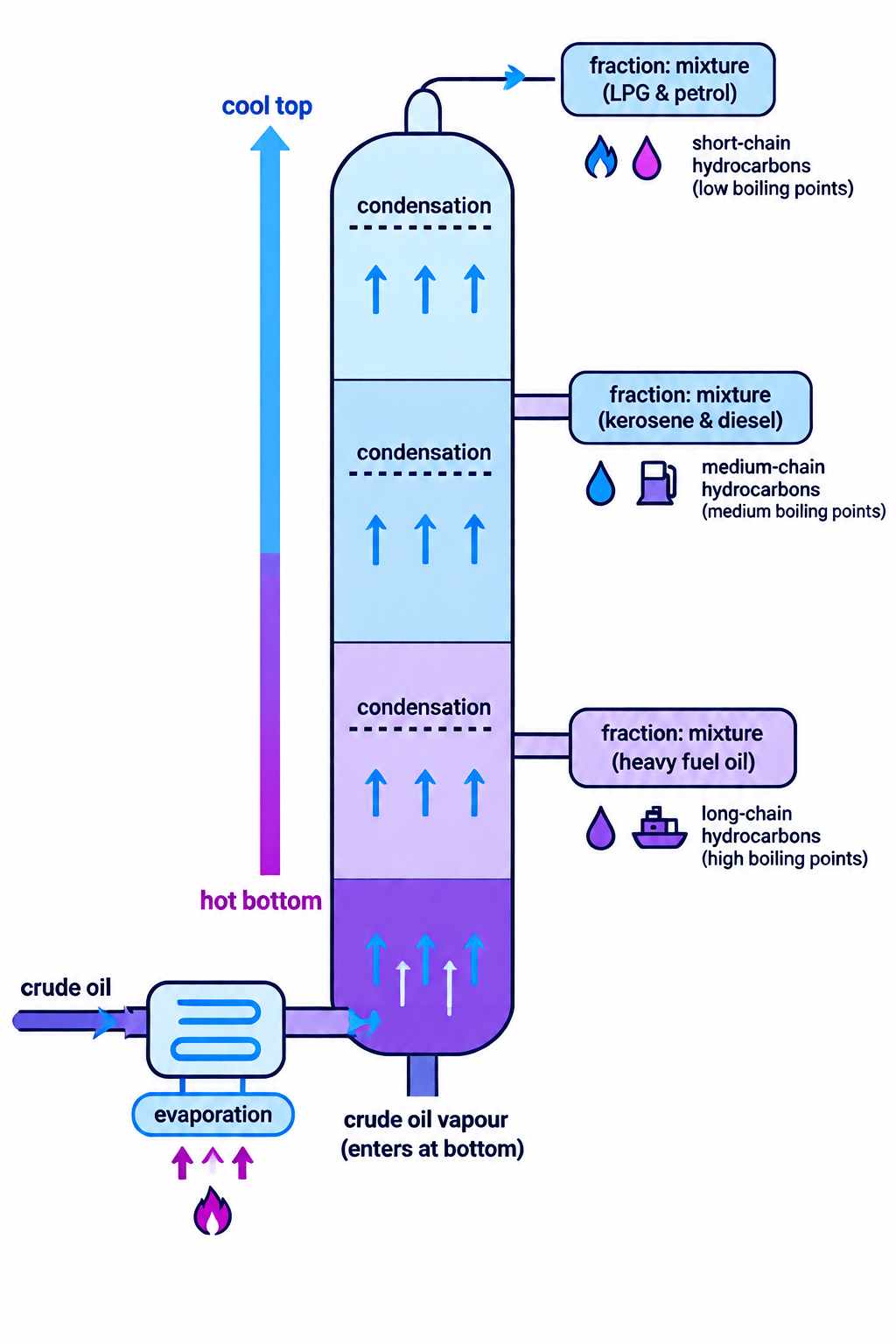
Fractional distillation is the process used to separate crude oil into fractions. It happens in a tall industrial tower called a fractionating column.

The column is very hot at the bottom and cooler at the top. This temperature difference is essential.

Labelled cross-section of a fractional distillation column showing hot crude oil entering, vapours rising, and fractions condensing at different heights

Step-by-step: how it works

  1. Crude oil is heated in a furnace, which is a high-temperature industrial heater.
  2. Many of the hydrocarbons evaporate and become gases.
  3. The hot hydrocarbon vapours enter the fractionating column near the bottom.
  4. The vapours rise up the column.
  5. The column is hottest at the bottom and cooler towards the top.
  6. When each hydrocarbon reaches a part of the column that is below its boiling point, it condenses back into a liquid.
  7. Liquids are collected from different levels as different fractions.

Small molecules with low boiling points rise higher before they condense. Larger molecules with higher boiling points condense lower down.

Example

Predicting where vapours condense

A fractionating column is 350 °C near the bottom and 40 °C near the top. Hydrocarbon A has a boiling point of 70 °C. Hydrocarbon B has a boiling point of 260 °C. Which hydrocarbon condenses higher up the column?

  1. A vapour condenses when it reaches a part of the column where the temperature is below its boiling point. If the column is still hotter than its boiling point, it can remain as a gas.
  2. Hydrocarbon A has the lower boiling point, 70 °C, so it stays gaseous through most of the hot column and condenses near the cool top.
  3. Hydrocarbon B has the higher boiling point, 260 °C, so it condenses lower down, where the column first becomes cool enough for it to turn back into a liquid.
  4. Therefore, hydrocarbon A condenses higher up the column than hydrocarbon B.

6. The main fractions and fuels

Many fuels used in modern life come from crude oil. A fuel is a substance that releases energy when it burns.

Important crude oil fuels include:

  • Liquefied petroleum gases, often called LPG, used as fuel in heating and cooking.
  • Petrol, used in cars.
  • Kerosene, used as aircraft fuel.
  • Diesel oil, used in some cars, lorries, buses and trains.
  • Heavy fuel oil, used in ships and some power stations.

You do not need to memorise lots of extra fraction names for this specification. Focus on the idea that different fractions contain molecules of different sizes and boiling points.

Tip

A quick height check

In the column: low boiling point → condenses high up; high boiling point → condenses low down.

7. Fractions as feedstock

Crude oil fractions are not only used as fuels. Some are processed to make new substances.

Definition

Feedstock

A feedstock is a raw material used to make other chemicals in industry.

The petrochemical industry is the industry that uses crude oil fractions to make useful chemicals and materials.

Important petrochemical products include:

  • Solvents: liquids that dissolve substances, such as in paints and cleaning products.
  • Lubricants: substances that reduce friction between moving parts.
  • Polymers: very large molecules made from many repeating units, used to make plastics.
  • Detergents: cleaning substances that help water remove grease and dirt.

This is why crude oil is described as both a source of fuels and a source of chemical feedstock.

8. Fractional distillation separates — it does not crack

Later, you may learn about cracking, which breaks large hydrocarbon molecules into smaller ones. Fractional distillation is different.

Fractional distillation is a physical separation process. The molecules are not broken apart. They are simply sorted into fractions according to boiling point.

Common Mistake

Distillation is not cracking

Fractional distillation separates existing hydrocarbons by boiling point. It does not make smaller molecules by breaking chemical bonds.

9. How to explain it clearly

A strong GCSE answer should link the process to both changes of state:

  • The crude oil is heated so hydrocarbons evaporate.
  • The vapours rise up a column with a temperature gradient.
  • The column is cooler at the top than at the bottom.
  • Hydrocarbons condense when they reach a part of the column below their boiling point.
  • Fractions are collected at different levels.
Exam technique

In the exam

  1. If asked how fractional distillation works, always mention evaporation and condensation — these are the key changes of state.
  2. Link boiling point to position in the column: lower boiling point fractions condense higher up; higher boiling point fractions condense lower down.
  3. If asked about uses, separate your answer into fuels and feedstock for petrochemicals.
Self review

Check yourself

  • Why is crude oil described as a mixture rather than a compound?
  • Why do different fractions condense at different heights in the column?
  • Give two examples of products made by the petrochemical industry.
PreviousNext

How was this guide?

Fractional distillation and petrochemicals Revision Guide

  1. GCSE
  2. /Chemistry
  3. /Fractional distillation and petrochemicals