x

Revision notes for AQA GCSE Chemistry Properties of hydrocarbons. Open the guide for explanations and worked examples. Written against the AQA GCSE Chemistry (8462) specification, so the content matches what's examinable rather than general Chemistry background.

Properties of hydrocarbons

What you'll learn

  • What hydrocarbons are and what “molecular size” means.
  • How boiling point, viscosity and flammability change as hydrocarbon molecules get larger.
  • Why these property trends affect how hydrocarbons are used as fuels.
  • How to write balanced equations for the complete combustion of hydrocarbons.

Starting point: what is a hydrocarbon?

A compound is a substance made from atoms of two or more different elements chemically bonded together. Many fuels, such as petrol, diesel and natural gas, are mixtures of compounds called hydrocarbons.

Definition

Hydrocarbon

A hydrocarbon is a compound made from carbon and hydrogen atoms only. A molecule is a group of atoms chemically bonded together; in this topic, a larger hydrocarbon molecule usually means a longer carbon chain.

For example, methane is a small hydrocarbon with formula CH₄. Octane, C₈H₁₈, is larger because it contains more carbon and hydrogen atoms.

Molecular size and the key property trends

A trend is a pattern in how something changes. For hydrocarbons, the important GCSE trend is what happens as the molecules get larger.

Key Idea

The size trend

As hydrocarbon molecules get larger: boiling point increases, viscosity increases, and flammability decreases.

The diagram below summarises the main trend as hydrocarbon molecules get larger.

Diagram comparing short-chain and long-chain hydrocarbons: boiling point, viscosity and flammability trends

Boiling point

The boiling point is the temperature at which a liquid changes into a gas.

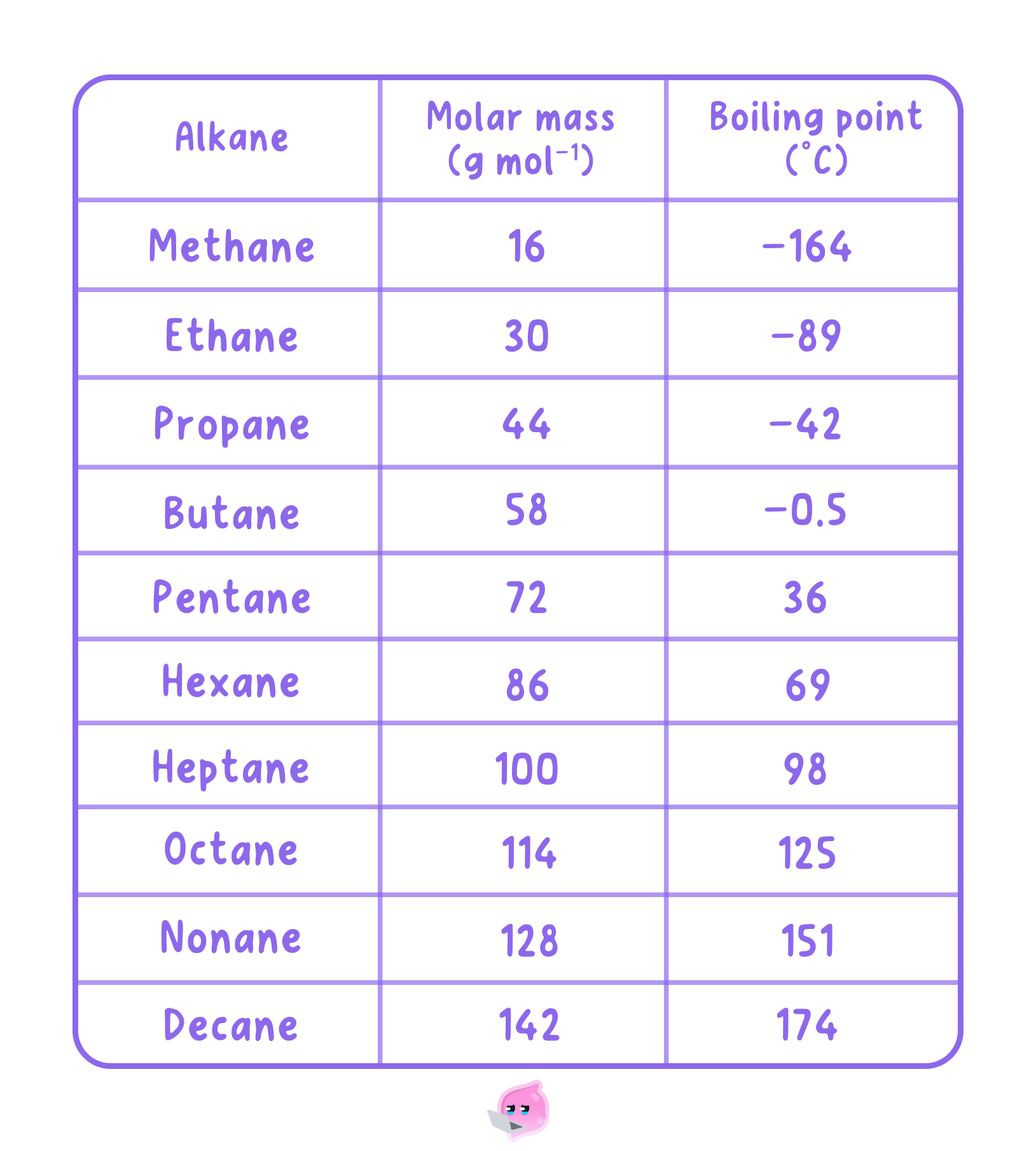
Larger hydrocarbon molecules have stronger attractions between their molecules. These attractions are called intermolecular forces: forces between separate molecules. More energy is needed to overcome these forces, so larger hydrocarbons have higher boiling points.

Common Mistake

Boiling does not break covalent bonds

When a hydrocarbon boils, the molecules separate from each other. The covalent bonds inside each molecule do not break during boiling.

Viscosity

Viscosity means how resistant a liquid is to flowing. A low-viscosity liquid is runny. A high-viscosity liquid is thick and flows slowly.

Larger hydrocarbons are more viscous because their molecules attract each other more strongly and can become more tangled, so they do not slide past each other as easily.

Flammability

Flammability means how easily a substance catches fire and burns.

Smaller hydrocarbons are more flammable because they have lower boiling points, so they evaporate more easily and mix with oxygen in the air. A substance that evaporates easily is called volatile.

Larger hydrocarbons are less flammable because they do not evaporate as easily, so they are harder to ignite.

Common Mistake

Less flammable does not mean non-flammable

Longer-chain hydrocarbons are generally harder to ignite, but they can still burn and release energy if enough oxygen and heat are supplied.

Example

Predicting properties from chain length

Hexane is C₆H₁₄ and decane is C₁₀H₂₂. Predict which one has the higher boiling point, higher viscosity and lower flammability.

  1. Compare the molecular sizes: hexane has 6 carbon atoms, while decane has 10, so decane has the larger molecules.
  2. Apply the size trend for boiling point and viscosity: larger molecules have stronger attractions between molecules, so decane has the higher boiling point and higher viscosity.
  3. Apply the size trend for flammability: larger molecules are harder to ignite, so decane has the lower flammability.

How these properties affect fuel uses

Hydrocarbons are useful as fuels because they release energy when they burn. Different fuels need different properties.

Short-chain hydrocarbons have low boiling points, low viscosity and high flammability. This makes them useful when a fuel needs to vaporise and ignite easily, such as in gas fuels and petrol.

Longer-chain hydrocarbons have higher boiling points and higher viscosity. They are thicker, less volatile and less easy to ignite. These are more suitable for uses where a heavier fuel is acceptable, such as fuel oil for ships or large heating systems.

Example

Choosing a suitable fuel

A fuel needs to flow easily through narrow pipes and ignite quickly. Should it be a shorter-chain or longer-chain hydrocarbon?

  1. Flowing easily means the fuel should have low viscosity, so smaller hydrocarbon molecules are better.
  2. Igniting quickly means the fuel should be more flammable, which also points to smaller hydrocarbon molecules.
  3. Therefore, a shorter-chain hydrocarbon would be more suitable than a long-chain hydrocarbon.

Investigating hydrocarbon properties

You may be asked to describe or interpret an investigation comparing different hydrocarbons.

To make it a fair test, only the hydrocarbon should change. Other variables, such as the volume used, temperature, container shape and method of heating or timing, should be kept the same.

You could compare:

  • Boiling point: heat samples carefully and record the temperature when each boils.
  • Viscosity: time how long equal volumes take to flow through the same tube or down the same slope.
  • Flammability: compare how easily small samples ignite, using very small quantities and proper safety precautions.
Tip

Interpreting viscosity results

If a liquid takes longer to flow through the same apparatus, it has a higher viscosity.

Combustion of hydrocarbons

Combustion means burning in oxygen. Hydrocarbon fuels release energy when they combust, so combustion is an exothermic reaction: it transfers energy to the surroundings.

During combustion, the carbon and hydrogen atoms in the hydrocarbon react with oxygen.

Definition

Complete combustion

Complete combustion happens when a hydrocarbon burns in a plentiful supply of oxygen. The only chemical products are carbon dioxide and water.

The word equation is:

hydrocarbon + oxygen → carbon dioxide + water

For methane, the balanced chemical equation is:

CH₄(g) + 2O₂(g) → CO₂(g) + 2H₂O(g)

Definition

Oxidation in combustion

In this topic, oxidation means reacting with oxygen. In complete combustion, carbon is oxidised to carbon dioxide and hydrogen is oxidised to water.

Common Mistake

Complete combustion needs enough oxygen

If oxygen is limited, incomplete combustion can happen and carbon monoxide or soot may form. For this section, when the question says complete combustion, use carbon dioxide and water as the products.

Balancing complete combustion equations

A coefficient is the large number placed in front of a formula in a balanced equation. For example, in 2O₂, the coefficient is 2.

A subscript is the small number in a chemical formula, such as the 2 in O₂. When balancing equations, you change coefficients, not subscripts.

Common Mistake

Do not change the formula

When balancing, change only the big numbers in front of formulas. Do not change H₂O into H₂O₂ or CO₂ into CO, because that changes the substance.

For complete combustion:

  1. Write the hydrocarbon and oxygen on the left.
  2. Write carbon dioxide and water on the right.
  3. Balance carbon atoms first.
  4. Balance hydrogen atoms second.
  5. Balance oxygen atoms last.
Example

Balancing complete combustion of ethane

Ethane has formula C₂H₆. Write a balanced equation for its complete combustion.

  1. Start with the correct reactants and products: C₂H₆(g) + O₂(g) → CO₂(g) + H₂O(g).
  2. Balance carbon: C₂H₆ contains 2 carbon atoms, so place 2 in front of CO₂: C₂H₆(g) + O₂(g) → 2CO₂(g) + H₂O(g).
  3. Balance hydrogen: C₂H₆ contains 6 hydrogen atoms, so place 3 in front of H₂O: C₂H₆(g) + O₂(g) → 2CO₂(g) + 3H₂O(g).
  4. Balance oxygen last: the products contain 4 oxygen atoms in 2CO₂ and 3 oxygen atoms in 3H₂O, making 7 oxygen atoms in total, so the oxygen coefficient is 72\frac{7}{2}27​.
  5. Remove the fraction by multiplying every coefficient by 2: 2C₂H₆(g) + 7O₂(g) → 4CO₂(g) + 6H₂O(g).
Tip

Oxygen is usually balanced last

In hydrocarbon combustion equations, carbon appears in CO₂, hydrogen appears in H₂O, but oxygen appears in both products. That is why oxygen is easiest to balance last.

Exam technique

In the exam

  1. For property trends, write the full pattern: as hydrocarbon size increases, boiling point increases, viscosity increases and flammability decreases.
  2. For explanation questions, link the trend to attractions between molecules or to how easily the fuel evaporates and ignites.
  3. For combustion equations, always use carbon dioxide and water for complete combustion, then balance carbon, hydrogen and oxygen in that order.
Self review

Check yourself

  • What happens to boiling point, viscosity and flammability as hydrocarbon molecules get larger?
  • Why are shorter-chain hydrocarbons usually easier to ignite?
  • Write the balanced equation for the complete combustion of propane, C₃H₈.
You've reached the end

Test yourself on this topic, or move on to the next guide.

FlashcardsSelf-test with active recall
Cracking and alkenesUp next

How was this guide?

Properties of hydrocarbons Revision Guide

  1. GCSE
  2. /Chemistry
  3. /Properties of hydrocarbons