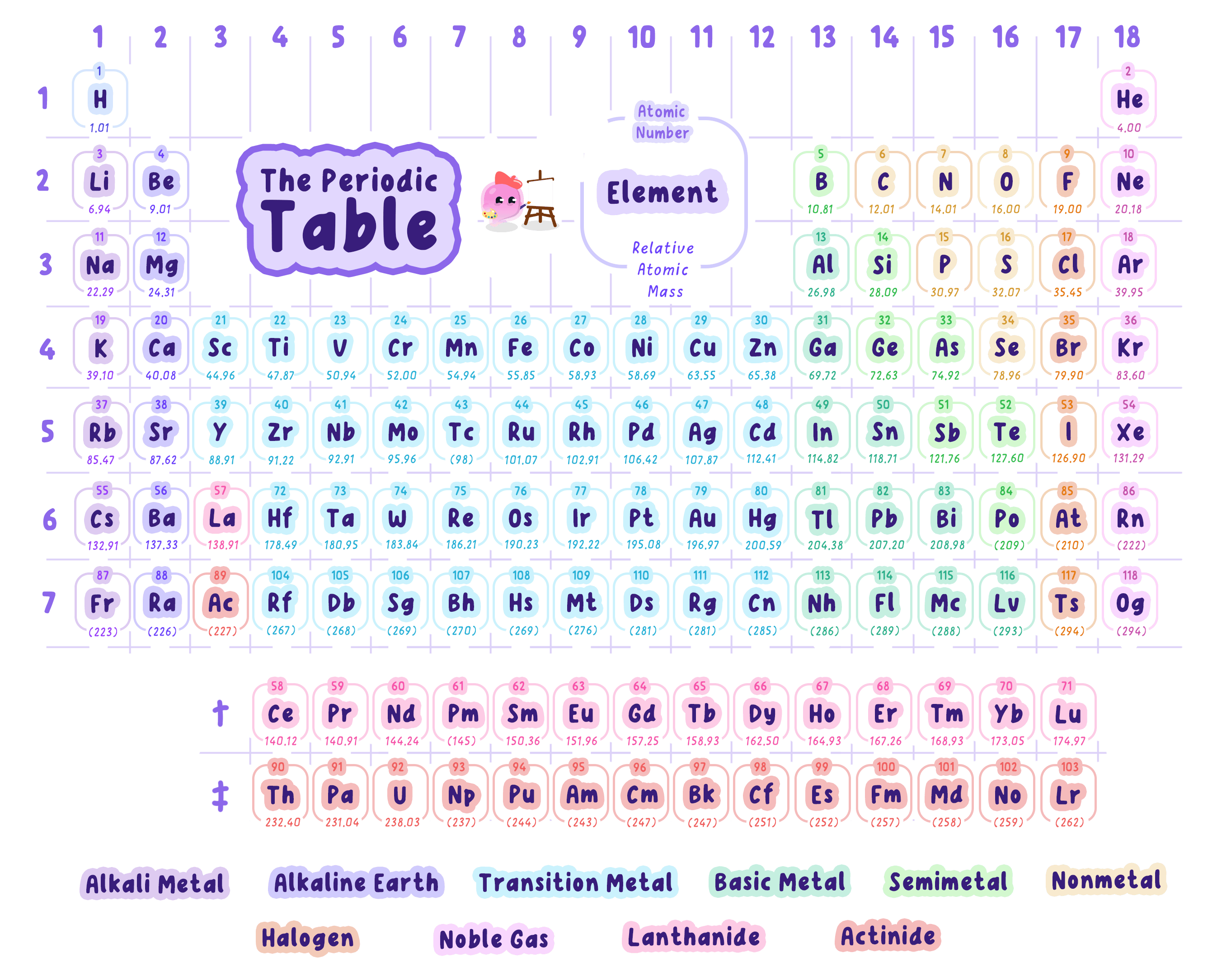
- How elements are arranged in the periodic table.
- What groups and periods tell you about atoms.
- How an element’s electron arrangement links to its position.
- How to make simple predictions about reactions and reactivity from the table.
An element is a substance made from only one type of atom. For example, pure copper contains only copper atoms, and pure oxygen contains only oxygen atoms.
An atom contains a tiny central nucleus, with protons and neutrons inside it. Electrons move around the nucleus in shells, also called energy levels.
The most important number for the periodic table is the atomic number.
Atomic (proton) number
The atomic number is the number of protons in the nucleus of an atom. It is also called the proton number.
Every atom of the same element has the same number of protons. That means the atomic number identifies the element. For example, any atom with 6 protons is carbon; any atom with 11 protons is sodium.
In a neutral atom, the number of electrons is equal to the number of protons. So if an atom has atomic number 11, it has 11 protons and 11 electrons.
Atomic number, not mass number
The periodic table is arranged in order of atomic number, not mass number. Atomic number counts protons; mass number counts protons plus neutrons.
The elements in the periodic table are arranged in order of increasing atomic number. As you move from left to right across a row, the atomic number increases by 1 each time.
The table is not just a long list, though. It is arranged so that elements with similar chemical properties line up in vertical columns.

Groups and periods
A group is a vertical column in the periodic table. A period is a horizontal row in the periodic table.
The table is called a periodic table because similar properties occur at regular intervals. In other words, as atomic number increases, patterns repeat.
For example, lithium, sodium and potassium are all in Group 1. They are not identical, but they have similar chemical properties. Fluorine, chlorine and bromine are all in Group 7, so they also form a chemical family.
Why the table is periodic
The periodic table shows repeating patterns because elements with similar outer electron arrangements are placed in the same group.
Electrons are arranged in shells around the nucleus. The first shell is closest to the nucleus, then the second shell, then the third shell, and so on.
For GCSE Chemistry, you usually write electron arrangements as numbers separated by commas. For example, sodium has the electron arrangement 2,8,1.
That means:
- 2 electrons in the first shell
- 8 electrons in the second shell
- 1 electron in the third shell
Outer shell electrons
Outer shell electrons are the electrons in the highest occupied electron shell. They are also called outer electrons.
The outer shell electrons are especially important because they control many chemical reactions.

For the first 20 elements, you can use this GCSE shell pattern:
- The first shell holds up to 2 electrons.
- The second shell holds up to 8 electrons.
- The third shell is filled as 8 electrons before the fourth shell starts, for the simple GCSE model.
For the main groups you meet at GCSE:
- The period number tells you the number of occupied electron shells.
- The group number tells you the number of outer shell electrons for Groups 1 to 7.
- Group 0 elements have full outer shells.
So an element in Period 3, Group 2 has three occupied shells and two electrons in its outer shell.
Group 0 does not mean zero outer electrons
Group 0 elements do not have zero outer electrons. They have full outer shells. Helium has 2 outer electrons; the other Group 0 elements you meet usually have 8 outer electrons.
Finding the position of chlorine
Chlorine has atomic number 17. Work out its electron arrangement, group and period.
-
A neutral chlorine atom has 17 electrons, because its atomic number is 17 and neutral atoms have the same number of electrons as protons.
-
Fill the shells using the GCSE pattern: 2 electrons go in the first shell, 8 in the second shell, leaving 7 in the third shell. So the electron arrangement is 2,8,7.
-
There are three occupied shells, so chlorine is in Period 3.
-
There are 7 electrons in the outer shell, so chlorine is in Group 7.
-
Because chlorine is in Group 7, you can predict that it has similar chemical properties to other Group 7 elements, such as fluorine and bromine.
Working back from position
An element is in Period 3 and Group 2. Predict its electron arrangement and atomic number.
-
Period 3 means the atom has three occupied electron shells.
-
Group 2 means it has 2 electrons in its outer shell.
-
The inner shells fill first, so the arrangement is 2,8,2.
-
Add the electrons: 2 plus 8 plus 2 gives 12 electrons in a neutral atom.
-
A neutral atom with 12 electrons has 12 protons, so its atomic number is 12. The element is magnesium.
A chemical property describes how a substance reacts. For example, whether it reacts with water, oxygen, acids, or other elements.
Elements in the same group have similar chemical properties because they have the same number of outer shell electrons. During reactions, atoms often lose, gain or share electrons from their outer shell.
Outer electrons control reactions
Elements in the same group have the same number of outer shell electrons, so they often react in similar ways.
For example:
- Group 1 metals have 1 outer electron.
- Group 2 metals have 2 outer electrons.
- Group 7 non-metals have 7 outer electrons.
- Group 0 gases have full outer shells, so they are very unreactive.
This is why position in the periodic table is so useful: it lets you predict behaviour even for an element you have not studied in detail.
Reactivity means how easily or vigorously a substance reacts.
You can often make a good prediction by asking two questions:
- Which group is the element in?
- Where is it in that group?
For the groups you commonly meet at GCSE:
- Group 1 metals become more reactive as you go down the group.
- Group 7 non-metals become less reactive as you go down the group.
- Group 0 elements are very unreactive because they have full outer shells.
Prediction sentence frame
A strong prediction often sounds like this: “These elements are in the same group, so they have the same number of outer shell electrons and should react in a similar way. Since this element is lower/higher in the group, it is likely to be more/less reactive.”
Comparing probable reactivity
Compare sodium and potassium reacting with water.
-
Sodium and potassium are both in Group 1, so they both have 1 electron in their outer shell and react with water in a similar way.
-
Group 1 metals react with water to form a metal hydroxide and hydrogen gas. For sodium: 2Na(s) + 2H₂O(l) → 2NaOH(aq) + H₂(g).
-
Potassium is below sodium in Group 1. For Group 1 metals, reactivity increases down the group.
-
Therefore potassium is predicted to react more vigorously with water than sodium. Its reaction is: 2K(s) + 2H₂O(l) → 2KOH(aq) + H₂(g).
At GCSE, a prediction from the periodic table is usually about a pattern, not a random guess. If you know one Group 1 metal reacts with chlorine to form a chloride, you can predict that another Group 1 metal is likely to do something similar.
For example, sodium reacts with chlorine to form sodium chloride:
2Na(s) + Cl₂(g) → 2NaCl(s)
Potassium is also in Group 1, so you can predict that potassium reacts with chlorine to form potassium chloride:
2K(s) + Cl₂(g) → 2KCl(s)
You are using the group pattern: same outer electron number, similar chemical properties.
In the exam
-
If you are given an atomic number, first work out the number of electrons in a neutral atom, then write the electron arrangement.
-
To explain similar properties, do not just say “they are in the same group”. Add: “they have the same number of outer shell electrons.”
-
For prediction questions, name the group pattern and then apply the element’s position, such as “reactivity increases down Group 1” or “reactivity decreases down Group 7.”
Check yourself
- Why do lithium and sodium have similar chemical properties?
- An element has atomic number 12. What is its electron arrangement, group and period?
- In Group 7, which is more reactive: chlorine or iodine? How does the periodic table show this?