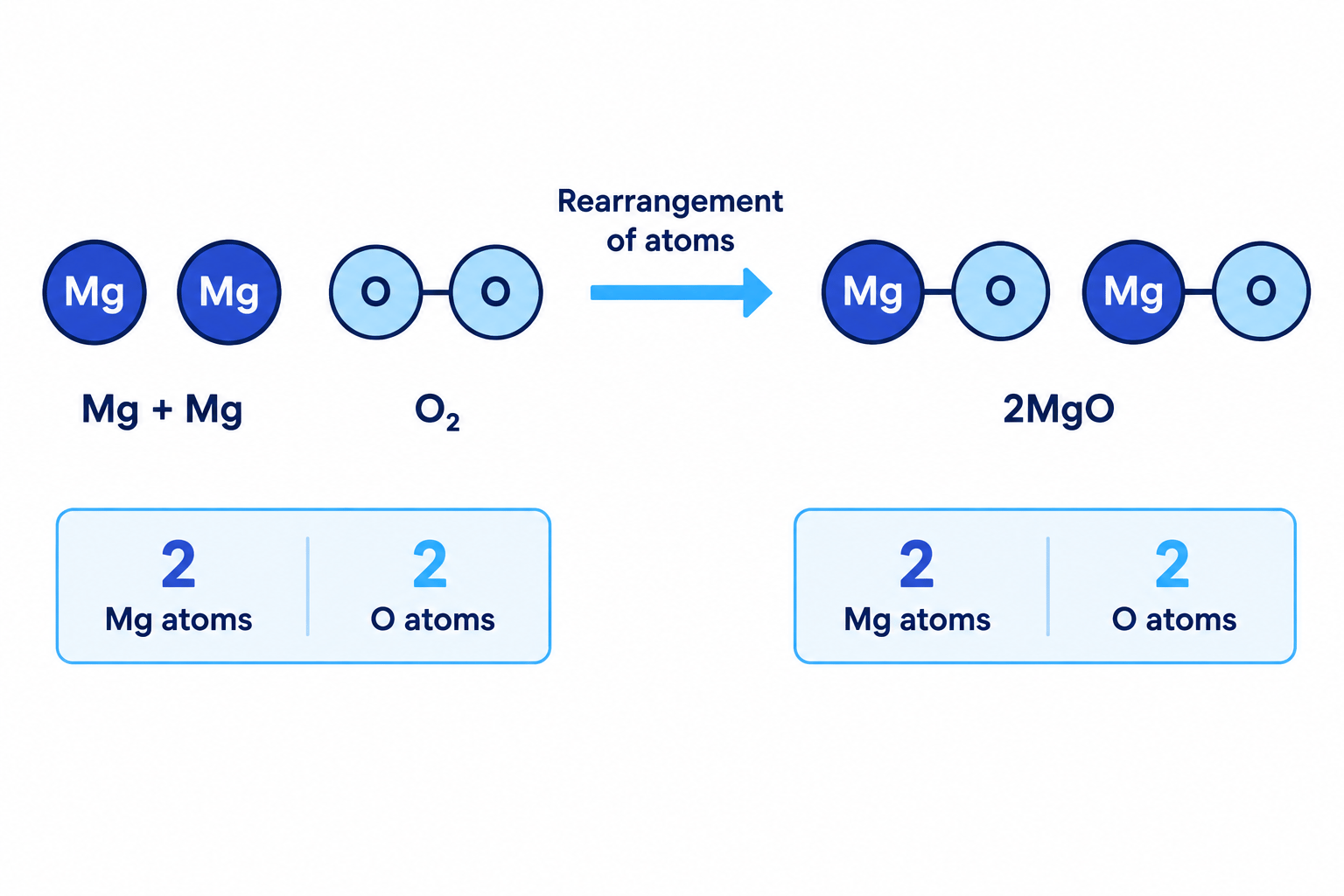
Conservation of mass: atoms are rearranged, never created or destroyed
Definition
Atom
The smallest part of an element that can exist while retaining the chemical properties of that element.
- The law of conservation of mass states that the total mass of the products equals the total mass of the reactants.
- No atoms are created and no atoms are destroyed during a chemical reaction.
- The reaction only rearranges the existing atoms into new substances.
- The mass stays the same because every atom present at the start is still present at the end, just joined together differently.
- Burning 48 g of magnesium in 32 g of oxygen produces exactly 80 g of magnesium oxide.
Key Idea
- A chemical reaction shuffles atoms into new combinations without changing how many of each atom there are.
- Because the atoms are the same before and after, the total mass cannot change.
Symbol equations: the same atoms appear on both sides of the arrow
Definition
Element
A substance made of atoms that all have the same number of protons.
- A symbol equation shows the reactants and products using their chemical formulae.
- The reactants go on the left of the arrow and the products go on the right.
- An equation is balanced when each element has the same number of atoms on both sides.
- The balanced equation for magnesium burning is 2Mg+O2→2MgO2\text{Mg} + \text{O}_2 \rightarrow 2\text{MgO}2Mg+O2→2MgO.
Example
In 2Mg+O2→2MgO2\text{Mg} + \text{O}_2 \rightarrow 2\text{MgO}2Mg+O2→2MgO the left side has two magnesium atoms and two oxygen atoms, and the right side has two magnesium atoms and two oxygen atoms, so every element matches.
Multipliers and subscripts: two numbers that count very different things
Definition
Chemical formula
A combination of element symbols and numbers that shows which elements are present in a substance and their relative numbers of atoms.
- A multiplier is the full-size number written in front of a formula, and it multiplies every atom in that whole formula.
- A formula written with no multiplier counts as one.
- A subscript is the small number inside a formula, and it counts only the atoms of the element written immediately before it.
- An element symbol with no subscript counts as one atom.
- So 3H2O3\text{H}_2\text{O}3H2O means three water molecules, which is six hydrogen atoms and three oxygen atoms in total.
Common Mistake
- Never change a subscript to balance an equation, because that turns the substance into something else entirely.
- Changing H2O\text{H}_2\text{O}H2O to H2O2\text{H}_2\text{O}_2H2O2 swaps water for hydrogen peroxide, which is a different chemical.
- Only the multipliers in front of formulae may be changed when you balance.
Balancing an equation: adjust the multipliers, then count again
Definition
Reactant
A reactant is a substance that is changed or used up during a chemical reaction.
- Write the correct chemical formula for every reactant and product first.
- Count the atoms of each element on both sides.
- Put whole-number multipliers in front of formulae until each element matches on both sides.
- Count every element one last time to confirm the equation balances.
Example
- Start from the unbalanced CH4+O2→CO2+H2O\text{CH}_4 + \text{O}_2 \rightarrow \text{CO}_2 + \text{H}_2\text{O}CH4+O2→CO2+H2O.
- Put a multiplier of two before H2O\text{H}_2\text{O}H2O so there are four hydrogen atoms on each side.
- Put a multiplier of two before O2\text{O}_2O2 so there are four oxygen atoms on each side.
- The balanced equation is CH4+2O2→CO2+2H2O\text{CH}_4 + 2\text{O}_2 \rightarrow \text{CO}_2 + 2\text{H}_2\text{O}CH4+2O2→CO2+2H2O.
Checking your answer: count each element separately, every time
Definition
Product
A product is a substance formed during a chemical reaction.
- Count each element on its own, because matching the total number of atoms is not enough.
- Multiply every subscript in a formula by the multiplier in front of it to get the true atom count.
- If one element does not match, change a multiplier and then recheck the whole equation from the start.
Exam technique
- Balance carbon first, then hydrogen, and leave oxygen until last, because oxygen appears in the most formulae.
- A formula written incorrectly loses the mark even if the equation looks balanced, so check every formula before you count.
State symbols show the physical state of each substance
- You can add state symbols in brackets after each formula to show its physical state.
- (s)\text{(s)}(s) is solid, (l)\text{(l)}(l) is liquid and (g)\text{(g)}(g) is gas.
- (aq)\text{(aq)}(aq) means aqueous, which is a substance dissolved in water.
- Adding state symbols does not change the balancing, as it only describes each substance.
Self review
- What does the law of conservation of mass state?
- Why can you change multipliers but never subscripts when balancing?
- How many carbon and oxygen atoms are shown by 4CO24\text{CO}_24CO2?
- Balance the equation N2+H2→NH3\text{N}_2 + \text{H}_2 \rightarrow \text{NH}_3N2+H2→NH3.
- What does the state symbol (aq)\text{(aq)}(aq) tell you about a substance?