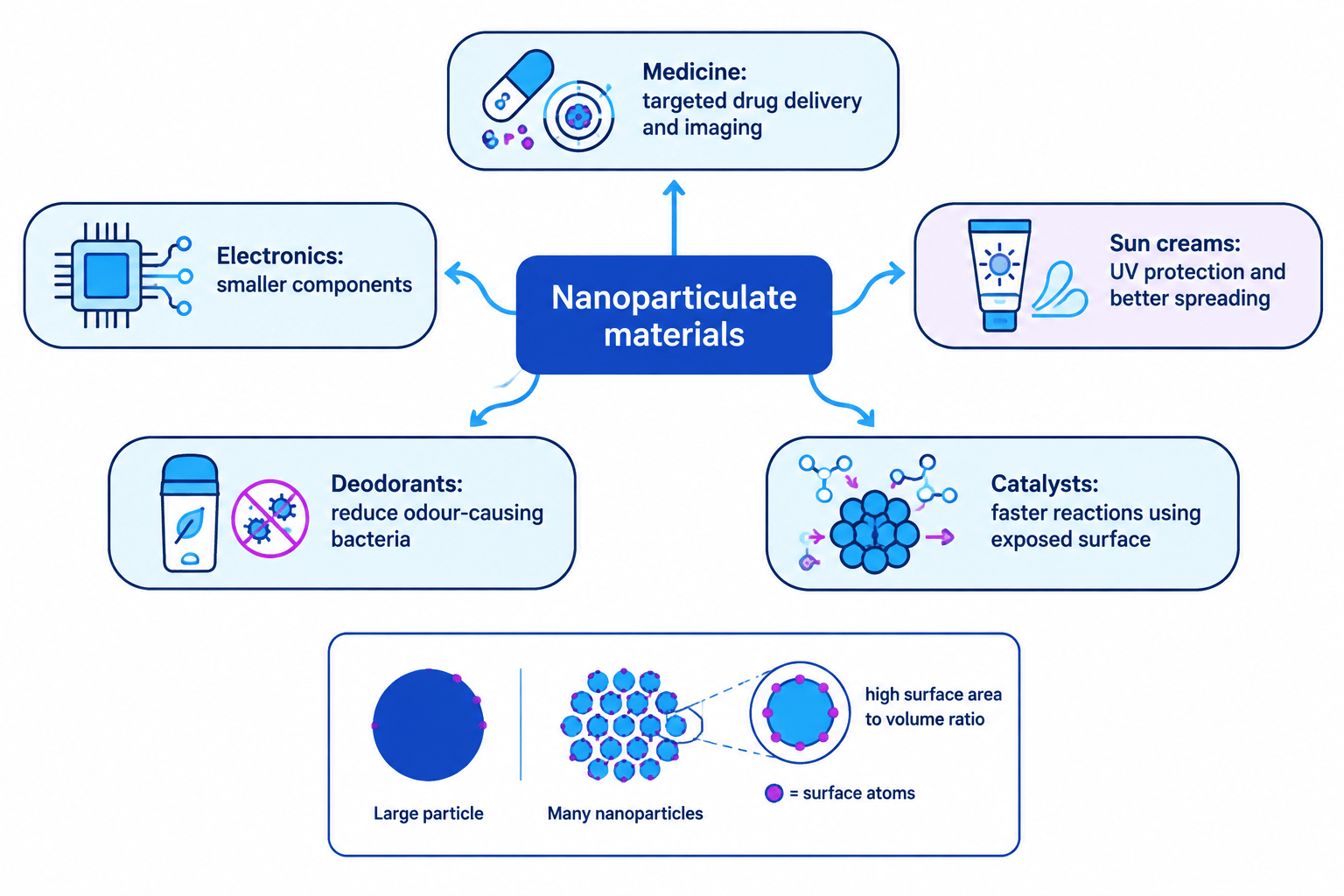
Nanoparticle applications: the same material can do very different jobs
Definition
Nanoparticle
A particle between 1 nm1\ \text{nm}1 nm and 100 nm100\ \text{nm}100 nm in size.
Definition
Nanoparticulate material
A material made from or containing nanoparticles.
- A nanoparticle is a tiny particle, roughly 1 nm1\ \text{nm}1 nm to 100 nm100\ \text{nm}100 nm across (about 1×10⁻⁹ m1 \times 10^{-9}\ \text{m}1×10⁻⁹ m to 1×10⁻⁷ m1 \times 10^{-7}\ \text{m}1×10⁻⁷ m), so it behaves very differently from larger particles of the same substance.
- This means a nanoparticle can be well suited to a task that larger particles or other materials would do less effectively.
- Their very high surface area to volume ratio is the property behind many of these uses.
- A large fraction of their atoms sit on the surface, which is where reactions and interactions take place.
- A nanoparticulate material has useful applications in medicine, electronics, cosmetics and sun creams, deodorants and catalysts.
- Medicine
- Nanoparticles can help deliver drugs to particular cells and can be used in medical tests and imaging.
- Electronics
- Their tiny size lets manufacturers build very small electronic components and pack more into a device.
- Cosmetics and sun creams
- Nanoparticles can improve how a sun cream spreads and how well it blocks ultraviolet light without leaving a thick white layer.
- Deodorants
- Some nanoparticles act as active ingredients that reduce the bacteria responsible for body odour.
- Catalysts
- Nanoparticle catalysts speed up reactions, and because so much of the material is exposed surface, only a small mass is needed.
Note
- This is separate (triple) chemistry only and is not needed for the Combined Science course.
- You do not need to memorise named nanoparticles or detailed properties for these applications.
Advantages: a benefit only counts when it fits the purpose
Definition
Catalyst
A substance that increases reaction rate without being used up by providing an alternative pathway with lower activation energy.
- An advantage must explain how the nanoparticle helps to meet the stated purpose.
- Supplied information may show that a nanoparticle improves performance, reduces the amount of material needed, or allows a smaller product to be made.
- A nanoparticle catalyst can increase the rate of reaction, which can make an industrial process faster or cheaper.
- Because so many of the atoms lie on the surface, a small mass provides a large number of active sites.
- Other information may reveal disadvantages, such as a higher cost or limited evidence about safety.
- The most useful property depends on the purpose, so nanoparticles are not automatically the best choice.
Example
- Given information: a nanoparticle sun cream gives longer-lasting protection using less material, but costs more and its effects on aquatic organisms are uncertain.
- Supported judgement: it has clear performance advantages, but more evidence about environmental risk is needed before calling it the better choice.
Possible risks: small particles may open new routes to harm
Definition
Risk
The possibility that something will cause harm, together with how serious that harm could be.
- Using nanoparticles may carry both health risks and environmental risks.
- Some nanoparticles can enter the body if they are breathed in or swallowed.
- Once inside, they may interact with cells and tissues differently from larger particles of the same material.
- Their long-term effects are often uncertain because many nanoparticle applications are still relatively new.
- Nanoparticles released into the environment could enter water or soil and affect living organisms.
- The level of risk depends on the material, the amount present and the type of exposure.
- Different nanoparticles have different properties, so evidence about one cannot be assumed to apply to all of them.
Common Mistake
- Do not claim that all nanoparticles are dangerous, because a risk is a possibility of harm, not proof that harm will happen.
- Explain a possible route to harm, such as inhalation followed by contact with body cells, rather than just writing that nanoparticles are unsafe.
Evaluation: a justified judgement balances evidence and uncertainty
Definition
Evaluate
To use evidence to consider advantages, disadvantages and uncertainty before reaching a supported judgement.
- Identify the purpose
- State clearly what the nanoparticulate material must do.
- Select relevant evidence
- Use the supplied information about performance, cost, safety and environmental effects.
- Compare advantages and disadvantages
- Explain how each piece of evidence supports or challenges the proposed use.
- Consider uncertainty
- Check whether the evidence about short-term and long-term risks is reliable.
- Reach a judgement
- Decide whether the advantages outweigh the disadvantages for the specified purpose.
- Support the conclusion with evidence from the information provided.
Note
- In an evaluate question, use evidence for both advantages and disadvantages before reaching a supported conclusion.
- Avoid a memorised answer, because the best judgement depends on the purpose and the information in the question.
Research: new applications need performance and safety testing
- New applications for nanoparticulate materials are an important area of research.
- Research can test whether a nanoparticle actually performs its proposed job effectively.
- It can also investigate possible effects on human health and the environment.
- A useful application may still have disadvantages, so both performance and risk must be considered together.
- Conclusions may change as researchers collect more evidence about long-term effects.
Self review
- Name four areas in which nanoparticles have applications.
- What makes an advantage relevant when you evaluate a nanoparticle application?
- Explain one possible health risk associated with nanoparticles.
- What should a supported conclusion in an evaluation compare?
- Why is further research needed into new nanoparticle applications?