Ionic bonding: electrons transfer from metals to non-metals
Definition
Outer shell
The highest occupied electron shell of an atom, containing the electrons involved when the atom forms an ion.
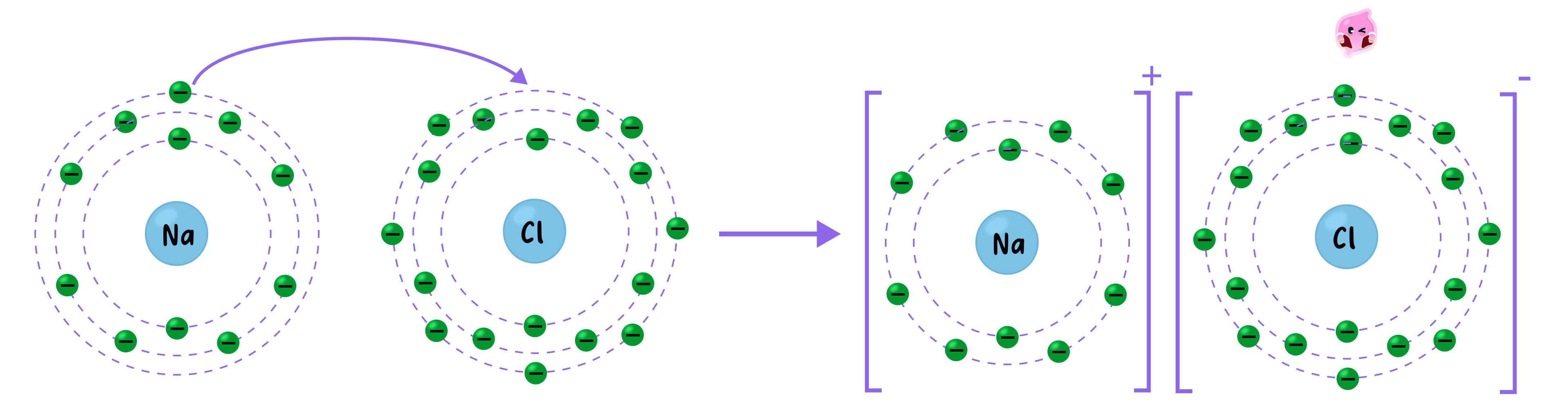
- An ionic bond forms when a metal atom reacts with a non-metal atom.
- An ion is a charged particle formed when an atom gains or loses electrons.
- The metal atom loses the electrons in its outer shell and becomes a positively charged ion.
- The non-metal atom gains those transferred electrons and becomes a negatively charged ion.
- The number of protons never changes, so the charge comes only from the electrons gained or lost.
- For example, sodium loses one electron to form Na+\text{Na}^{+}Na+ while chlorine gains one to form Cl−\text{Cl}^{-}Cl−.
Key Idea
- Metals lose electrons and form positive ions.
- Non-metals gain electrons and form negative ions.
- Electrons are transferred, not shared, during ionic bonding.
Group number: it predicts the charge on each ion
- Group 1 metals
- A Group 1 atom has one electron in its outer shell.
- It loses one electron and forms an ion with a charge of 1+1+1+, such as Na+\text{Na}^{+}Na+.
- Group 2 metals
- A Group 2 atom has two electrons in its outer shell.
- It loses two electrons and forms an ion with a charge of 2+2+2+, such as Mg2+\text{Mg}^{2+}Mg2+.
- Group 6 non-metals
- A Group 6 atom has six electrons in its outer shell.
- It gains two electrons and forms an ion with a charge of 2−2-2−, such as O2−\text{O}^{2-}O2−.
- Group 7 non-metals
- A Group 7 atom has seven electrons in its outer shell.
- It gains one electron and forms an ion with a charge of 1−1-1−, such as Cl−\text{Cl}^{-}Cl−.
- For Group 1 and Group 2 metals, the positive charge equals the group number.
- For Group 6 and Group 7 non-metals, subtract the group number from eight to find the size of the negative charge.
Common Mistake
- Do not give a Group 6 ion a charge of 6−6-6− or a Group 7 ion a charge of 7−7-7−.
- The charge shows the number of electrons gained or lost, not the number of outer-shell electrons in the original atom.
- Write the charge as Mg2+\text{Mg}^{2+}Mg2+ rather than Mg+2\text{Mg}^{+2}Mg+2.
Noble-gas structures: electron transfer produces full outer shells
Definition
Electronic structure
The arrangement of electrons in the electron shells of an atom or ion.
- The noble gases in Group 0 have full outer electron shells, which makes them very stable.
- Ions formed by Group 1, 2, 6 and 7 elements end up with the electronic structure of a noble gas.
- A Group 1 or Group 2 atom reaches this structure by losing its incomplete outer shell.
- A Group 6 or Group 7 atom reaches this structure by gaining enough electrons to fill its outer shell.
- The element does not turn into a noble gas, because its number of protons stays the same.
Example
- Sodium changes from 2,8,12,8,12,8,1 to 2,82,82,8 when it forms Na+\text{Na}^{+}Na+, giving it the electronic structure of neon.
- Chlorine changes from 2,8,72,8,72,8,7 to 2,8,82,8,82,8,8 when it forms Cl−\text{Cl}^{-}Cl−, giving it the electronic structure of argon.
- Magnesium changes from 2,8,22,8,22,8,2 to 2,82,82,8 when it forms Mg2+\text{Mg}^{2+}Mg2+.
- Oxygen changes from 2,62,62,6 to 2,82,82,8 when it forms O2−\text{O}^{2-}O2−.
Dot-and-cross diagrams: they show where each outer electron came from
Definition
Dot-and-cross diagram
A diagram that uses dots and crosses to show the outer-shell electrons from different atoms and any electrons transferred between them.
- Begin by drawing the correct number of outer-shell electrons for each metal atom and non-metal atom.
- Use dots for one element and crosses for the other so you can track where each electron started.
- Transfer the metal atom's outer-shell electrons to the non-metal atom.
- Check that every metal atom loses the correct number of electrons and every non-metal atom gains the correct number.
- Draw each resulting ion inside square brackets.
- Write the ion's charge outside the brackets at the top right.
- Finally, check that the non-metal ion has a full outer shell and that every transferred electron appears only once.
Common Mistake
- Dots and crosses show the source of each electron, not whether an ion is positive or negative.
- You may swap which element uses dots and which uses crosses, but you must use the symbols consistently.
- Do not leave the transferred electron on the metal atom or draw the same electron on both ions.
- Do not omit the square brackets or ion charges from the completed diagram.
Four group pairings: the same charge rules build every required diagram
Definition
Ionic compound
A compound formed from positively charged ions and negatively charged ions with no overall electrical charge.
- Group 1 metal with Group 7 non-metal, such as NaCl\text{NaCl}NaCl
- One metal atom transfers one electron to one non-metal atom, giving one 1+1+1+ ion and one 1−1-1− ion.
- Group 1 metal with Group 6 non-metal, such as Na2O\text{Na}_2\text{O}Na2O
- Two metal atoms each transfer one electron to one non-metal atom, giving two 1+1+1+ ions and one 2−2-2− ion.
- Group 2 metal with Group 7 non-metal, such as MgCl2\text{MgCl}_2MgCl2
- One metal atom transfers one electron to each of two non-metal atoms, giving one 2+2+2+ ion and two 1−1-1− ions.
- Group 2 metal with Group 6 non-metal, such as MgO\text{MgO}MgO
- One metal atom transfers two electrons to one non-metal atom, giving one 2+2+2+ ion and one 2−2-2− ion.
- In every ionic compound the positive and negative charges balance to give no overall charge.
- You only need dot-and-cross diagrams for Group 1 and 2 metals combined with Group 6 and 7 non-metals at this level.
Self review
- What happens to the outer-shell electrons when a metal atom reacts with a non-metal atom?
- What charges are formed by elements in Groups 1, 2, 6 and 7?
- Why do the resulting ions have the electronic structures of noble gases?
- What must you include around each ion in a completed dot-and-cross diagram?
- Why are two chloride ions needed for each magnesium ion in MgCl2\text{MgCl}_2MgCl2?
