Alcohols: the -OH\text{-OH}-OH functional group defines the homologous series
Definition
Alcohol
An organic compound containing the hydroxyl functional group, -OH\text{-OH}-OH.
- Alcohols contain the functional group -OH\text{-OH}-OH, which gives them their characteristic reactions.
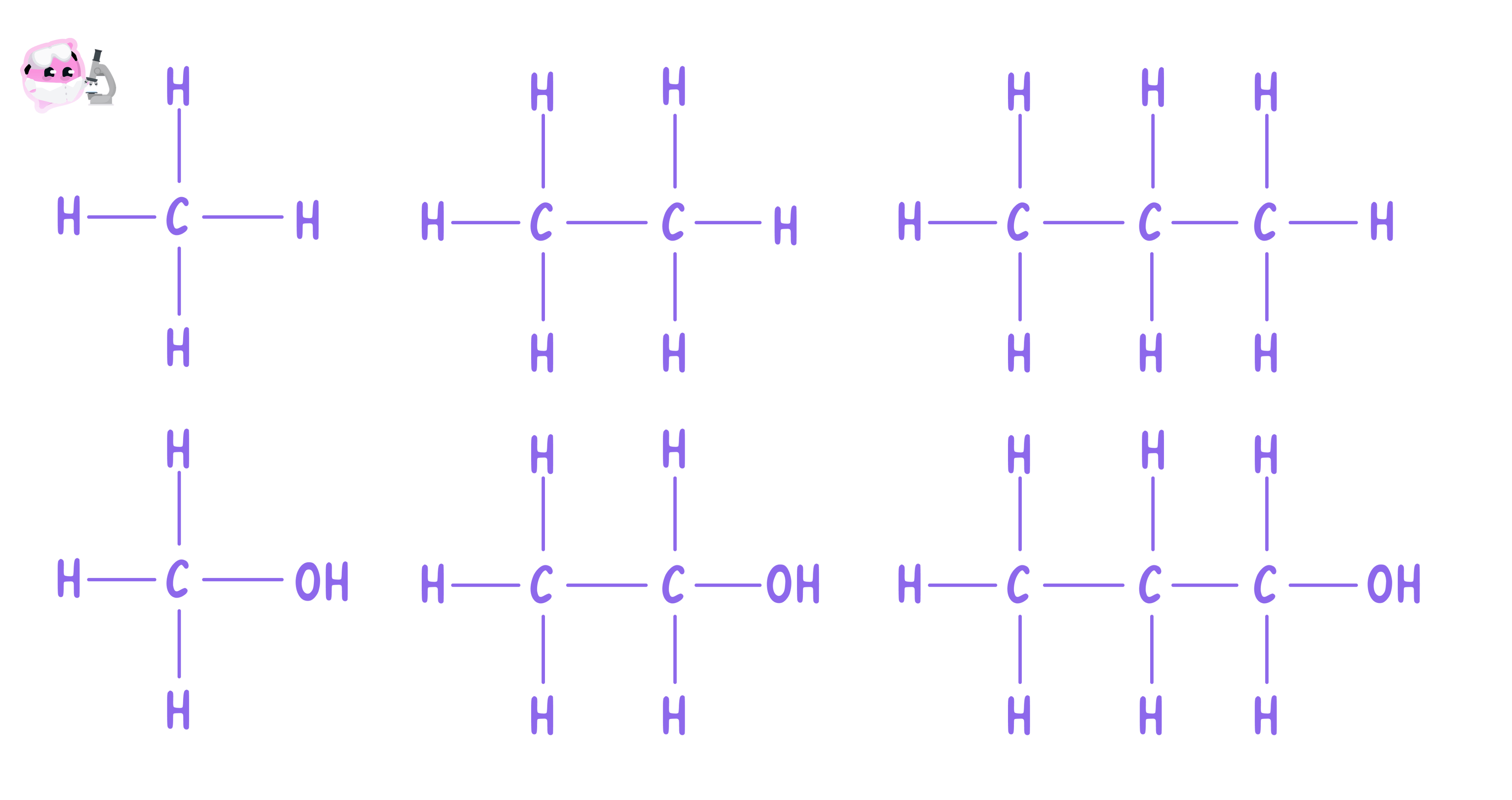
- Methanol, ethanol, propanol and butanol are the first four members of one homologous series.
- Each member has one more CH2\text{CH}_2CH2 unit than the one before it.
- Alcohol names end in -ol, which helps you spot them.
- A condensed structural formula groups atoms together but still shows the -OH\text{-OH}-OH group.
- Methanol is CH3OH\text{CH}_3\text{OH}CH3OH.
- Ethanol is CH3CH2OH\text{CH}_3\text{CH}_2\text{OH}CH3CH2OH.
- Propanol is CH3CH2CH2OH\text{CH}_3\text{CH}_2\text{CH}_2\text{OH}CH3CH2CH2OH.
- Butanol is CH3CH2CH2CH2OH\text{CH}_3\text{CH}_2\text{CH}_2\text{CH}_2\text{OH}CH3CH2CH2CH2OH.
Key Idea
- The prefix gives the carbon count: meth- one, eth- two, prop- three, but- four.
- To recognise an alcohol, look for an -OH\text{-OH}-OH group on a carbon chain, or a name ending in -ol.
The first four alcohols dissolve in water and work as fuels and solvents
Definition
Aqueous solution
A mixture formed when a substance is dissolved in water.
- The first four alcohols are soluble in water, though less dissolves as the carbon chain gets longer.
- Their aqueous solutions are neutral.
- They can be used as fuels, because they release energy when they burn.
- They can be used as solvents in products such as perfumes and cleaning fluids.
- Ethanol is the alcohol found in alcoholic drinks.
Example
- Ethanol is blended with petrol and burned as a fuel.
- Ethanol dissolves fragrance chemicals when it is used as a solvent in perfume.
- Methanol is poisonous, so not every alcohol is safe to drink.
Alcohols fizz with sodium and burn to release energy
- Any of the first four alcohols reacts with sodium, fizzing as it releases hydrogen gas.
- Any of them burns in air and transfers energy to the surroundings, so combustion is exothermic.
- Complete combustion gives carbon dioxide and water.
- 2CH3OH(l)+3O2(g)→2CO2(g)+4H2O(l)2\text{CH}_3\text{OH}(l) + 3\text{O}_2(g) \rightarrow 2\text{CO}_2(g) + 4\text{H}_2\text{O}(l)2CH3OH(l)+3O2(g)→2CO2(g)+4H2O(l)
- CH3CH2OH(l)+3O2(g)→2CO2(g)+3H2O(l)\text{CH}_3\text{CH}_2\text{OH}(l) + 3\text{O}_2(g) \rightarrow 2\text{CO}_2(g) + 3\text{H}_2\text{O}(l)CH3CH2OH(l)+3O2(g)→2CO2(g)+3H2O(l)
- 2CH3CH2CH2OH(l)+9O2(g)→6CO2(g)+8H2O(l)2\text{CH}_3\text{CH}_2\text{CH}_2\text{OH}(l) + 9\text{O}_2(g) \rightarrow 6\text{CO}_2(g) + 8\text{H}_2\text{O}(l)2CH3CH2CH2OH(l)+9O2(g)→6CO2(g)+8H2O(l)
- CH3CH2CH2CH2OH(l)+6O2(g)→4CO2(g)+5H2O(l)\text{CH}_3\text{CH}_2\text{CH}_2\text{CH}_2\text{OH}(l) + 6\text{O}_2(g) \rightarrow 4\text{CO}_2(g) + 5\text{H}_2\text{O}(l)CH3CH2CH2CH2OH(l)+6O2(g)→4CO2(g)+5H2O(l)
Exam technique
- You need balanced equations for combustion only, not for the reactions with sodium or oxidising agents.
- Balance by changing the coefficients in front of formulae, never the alcohol's formula, and write oxygen as O2\text{O}_2O2.
Oxidising agents turn alcohols into carboxylic acids
Definition
Oxidising agent
A substance that causes another substance to gain oxygen.
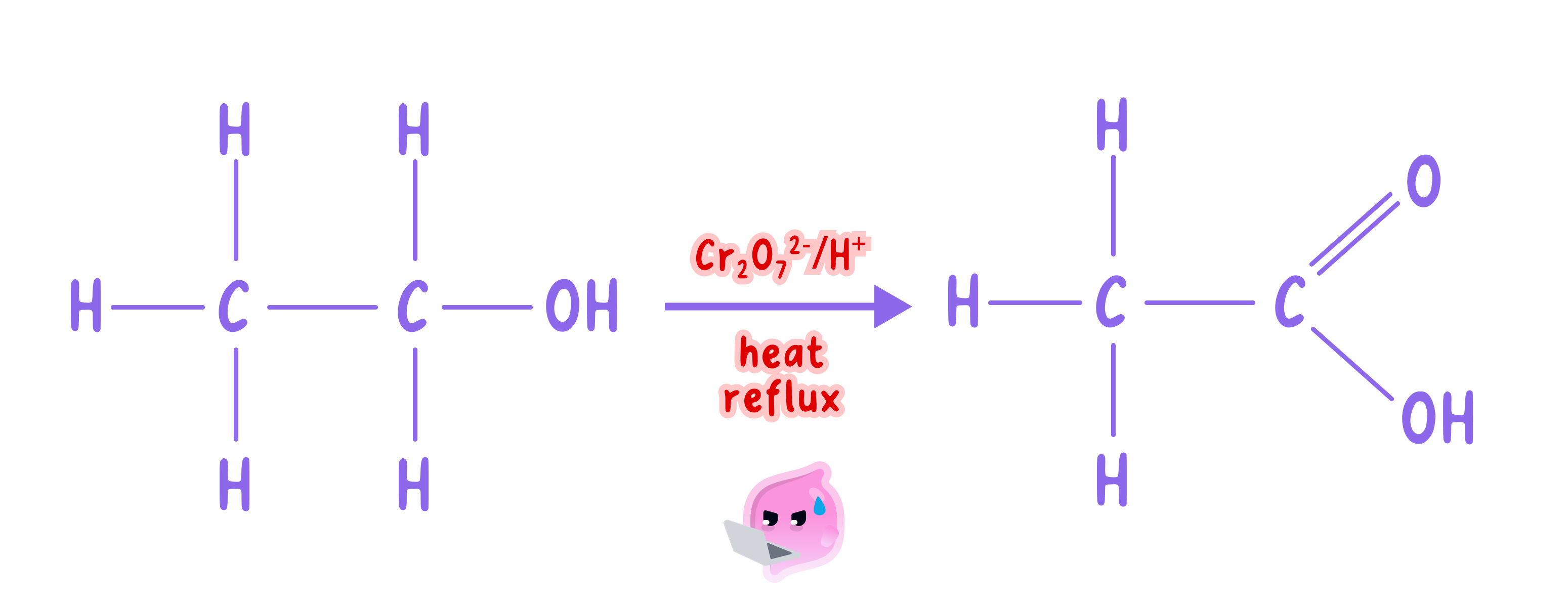
- An oxidising agent adds oxygen to an alcohol, turning it into a carboxylic acid.
- The alcohol is said to be oxidised.
- Methanol becomes methanoic acid, ethanol becomes ethanoic acid, propanol becomes propanoic acid and butanol becomes butanoic acid.
- Acidified potassium dichromate(VI) is a common oxidising agent that turns from orange to green as the alcohol is oxidised.
Example
- If acidified potassium dichromate(VI) turns from orange to green when warmed with ethanol, the ethanol has been oxidised to ethanoic acid.
- In general, oxidising an alcohol gives a carboxylic acid.
Fermenting sugar with yeast makes aqueous ethanol
Definition
Yeast
A microorganism whose enzymes can convert sugar into ethanol and carbon dioxide during fermentation.
- Fermentation uses yeast to turn sugar into ethanol and carbon dioxide.
- Sugar solution: glucose is dissolved in water.
- Yeast: enzymes in the yeast carry out the reaction.
- Temperature: kept warm at about 30∘C30^\circ\text{C}30∘C; too cold is slow and too hot kills the yeast.
- No oxygen: air is kept out so fermentation happens without oxygen.
- The word equation is glucose →\rightarrow→ ethanol + carbon dioxide.
- The product is an aqueous solution of ethanol, because the ethanol stays mixed with water.
Self review
- What functional group is present in every alcohol?
- Give the names and condensed formulae of the first four alcohols.
- Which gas forms when an alcohol reacts with sodium?
- What are the products of the complete combustion of an alcohol?
- What conditions are needed to ferment sugar solution with yeast?
