Alkenes: the C=C\text{C}=\text{C}C=C group gives the whole family one reaction pattern
Definition
Functional group
The atom or group of atoms in a molecule that is responsible for its characteristic chemical reactions.
- Alkenes are hydrocarbons that contain the carbon–carbon double bond, C=C\text{C}=\text{C}C=C.
- A hydrocarbon contains carbon and hydrogen atoms only.
- The C=C\text{C}=\text{C}C=C bond is the functional group: the part of the molecule that gives it its characteristic reactions.
- Alkenes of different chain lengths react in the same ways, because they share the same functional group.
Key Idea
Changing the length of the carbon chain changes the size of the product, but not the type of reaction, because the functional group is the same.
Alkenes burn with smoky flames because of incomplete combustion
- Alkenes react with oxygen in combustion reactions like other hydrocarbons.
- Complete combustion needs plenty of oxygen and gives carbon dioxide and water.
- C2H4(g)+3O2(g)→2CO2(g)+2H2O(g)\text{C}_2\text{H}_4\text{(g)} + 3\text{O}_2\text{(g)} \rightarrow 2\text{CO}_2\text{(g)} + 2\text{H}_2\text{O(g)}C2H4(g)+3O2(g)→2CO2(g)+2H2O(g)
- Incomplete combustion happens when oxygen is limited and can give carbon monoxide, carbon particles or both, plus water.
- Alkenes tend to burn with smoky flames, because their higher carbon-to-hydrogen ratio makes soot form easily.
Common Mistake
- Do not describe a smoky flame as complete combustion; the soot shows carbon was not fully oxidised.
- Do not say incomplete combustion makes only carbon monoxide; solid carbon can form as well.
Displayed formulae of the first four alkenes keep one C=C\text{C}=\text{C}C=C bond
- A displayed formula shows every atom and every covalent bond.
- Ethene has two carbons: HH∣∣H−C=C−H\begin{array}{ccccc} & \text{H} & & \text{H} & \\ & | & & | & \\ \text{H}- & \text{C} & = & \text{C} & -\text{H} \end{array}H−H∣C=H∣C−H
- Propene has three carbons: HHH∣∣∣H−C=C−C−H∣H\begin{array}{ccccccc} & \text{H} & & \text{H} & & \text{H} & \\ & | & & | & & | & \\ \text{H}- & \text{C} & = & \text{C} & - & \text{C} & -\text{H} \\ & & & & & | & \\ & & & & & \text{H} & \end{array}H−H∣C=H∣C−H∣C∣H−H
- Butene has four carbons: HHHH∣∣∣∣H−C=C−C−C−H∣∣HH\begin{array}{ccccccccc} & \text{H} & & \text{H} & & \text{H} & & \text{H} & \\ & | & & | & & | & & | & \\ \text{H}- & \text{C} & = & \text{C} & - & \text{C} & - & \text{C} & -\text{H} \\ & & & & & | & & | & \\ & & & & & \text{H} & & \text{H} & \end{array}H−H∣C=H∣C−H∣C∣H−H∣C∣H−H
- Pentene has five carbons: HHHHH∣∣∣∣∣H−C=C−C−C−C−H∣∣∣HHH\begin{array}{ccccccccccc} & \text{H} & & \text{H} & & \text{H} & & \text{H} & & \text{H} & \\ & | & & | & & | & & | & & | & \\ \text{H}- & \text{C} & = & \text{C} & - & \text{C} & - & \text{C} & - & \text{C} & -\text{H} \\ & & & & & | & & | & & | & \\ & & & & & \text{H} & & \text{H} & & \text{H} & \end{array}H−H∣C=H∣C−H∣C∣H−H∣C∣H−H∣C∣H−H
- Every carbon must have exactly four bonds in a correct displayed formula.
Note
- A shorthand like CH2=CH2\text{CH}_2{=}\text{CH}_2CH2=CH2 is useful but is not fully displayed, because it hides some carbon–hydrogen bonds.
- After drawing or changing a structure, check every carbon has four bonds.
Addition reactions turn the double bond into a single bond
Definition
Addition reaction
A reaction in which atoms or groups add across a carbon–carbon double bond, turning it into a single bond, with no atoms left over.
- Alkenes react with hydrogen, water and the halogens in addition reactions.
- During addition, the C=C\text{C}=\text{C}C=C double bond becomes a C−C\text{C}-\text{C}C−C single bond.
- Two atoms or groups from the added substance bond to the two carbons of the old double bond.
- No carbons are lost, so the product keeps the same carbon chain as the alkene.
- The general change is C=C+A−B→A−C−C−B\text{C}=\text{C} + \text{A}-\text{B} \rightarrow \text{A}-\text{C}-\text{C}-\text{B}C=C+A−B→A−C−C−B.
Exam technique
- To draw an addition product, copy the carbon chain, change C=C\text{C}=\text{C}C=C to C−C\text{C}-\text{C}C−C, and add the two new atoms or groups to those two carbons.
- Finish by checking every carbon has four bonds and no C=C\text{C}=\text{C}C=C is left.
Adding hydrogen over a nickel catalyst makes an alkane
Definition
Catalyst
A substance that increases reaction rate without being used up by providing an alternative pathway with lower activation energy.
- Alkenes react with hydrogen gas, H2\text{H}_2H2, to form alkanes.
- This addition is called hydrogenation.
- It uses a nickel catalyst and is usually heated.
- One hydrogen atom bonds to each carbon of the old double bond.
- Ethene forms ethane: C2H4(g)+H2(g)→C2H6(g)\text{C}_2\text{H}_4\text{(g)} + \text{H}_2\text{(g)} \rightarrow \text{C}_2\text{H}_6\text{(g)}C2H4(g)+H2(g)→C2H6(g), drawn as HH∣∣H−C−C−H∣∣HH\begin{array}{ccccc} & \text{H} & & \text{H} & \\ & | & & | & \\ \text{H}- & \text{C} & - & \text{C} & -\text{H} \\ & | & & | & \\ & \text{H} & & \text{H} & \end{array}H−H∣C∣H−H∣C∣H−H
- The same change turns propene into propane, butene into butane and pentene into pentane.
Example
- For ethene, change C=C\text{C}=\text{C}C=C to C−C\text{C}-\text{C}C−C and add one hydrogen to each carbon.
- The product is ethane, in which every carbon has four single bonds.
- The nickel speeds up the reaction but is not part of the product.
Adding steam over a phosphoric acid catalyst makes an alcohol
Definition
Alcohol
An organic compound containing the hydroxyl functional group, -OH\text{-OH}-OH.
- Alkenes react with water as steam to form alcohols.
- This addition is called hydration.
- The conditions are steam, a phosphoric acid catalyst, a high temperature and a high pressure.
- Water adds as an H atom and an OH group across the double bond.
- Ethene forms ethanol: C2H4(g)+H2O(g)→C2H5OH(g)\text{C}_2\text{H}_4\text{(g)} + \text{H}_2\text{O(g)} \rightarrow \text{C}_2\text{H}_5\text{OH(g)}C2H4(g)+H2O(g)→C2H5OH(g), drawn as HH∣∣H−C−C−O−H∣∣HH\begin{array}{ccccccc} & \text{H} & & \text{H} & & & \\ & | & & | & & & \\ \text{H}- & \text{C} & - & \text{C} & - & \text{O} & -\text{H} \\ & | & & | & & & \\ & \text{H} & & \text{H} & & & \end{array}H−H∣C∣H−H∣C∣H−O−H
- The same change turns propene into propanol, butene into butanol and pentene into pentanol.
Note
- Do not add an extra carbon when drawing the alcohol; hydration keeps the carbon chain.
- You do not need exact temperature or pressure values, but you must know steam and a phosphoric acid catalyst are used.
Adding a halogen puts one halogen atom on each double-bond carbon
Definition
Halogen
An element in Group 7 of the periodic table, including chlorine, bromine and iodine.
- Alkenes react with the halogens chlorine, bromine and iodine.
- Halogen molecules are diatomic: Cl2\text{Cl}_2Cl2, Br2\text{Br}_2Br2 and I2\text{I}_2I2.
- These reactions happen at room temperature with no catalyst and no ultraviolet light.
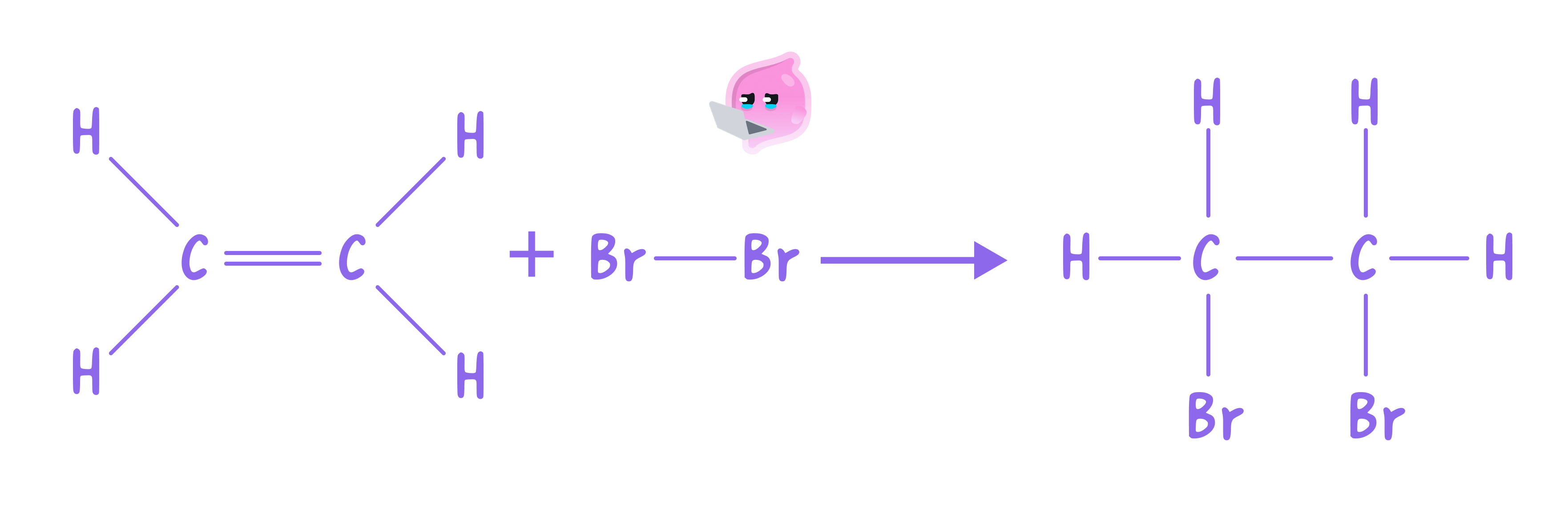
- The halogen molecule adds across the double bond, which becomes a single bond.
- One halogen atom bonds to each carbon of the old double bond.
- Using X\text{X}X for Cl\text{Cl}Cl, Br\text{Br}Br or I\text{I}I, ethene gives HH∣∣X−C−C−X∣∣HH\begin{array}{ccccc} & \text{H} & & \text{H} & \\ & | & & | & \\ \text{X}- & \text{C} & - & \text{C} & -\text{X} \\ & | & & | & \\ & \text{H} & & \text{H} & \end{array}X−H∣C∣H−H∣C∣H−X
- For propene, butene or pentene, keep the longer chain and make the same change at the two C=C\text{C}=\text{C}C=C carbons.
Self review
- What functional group is present in every alkene?
- Why do alkenes tend to burn with smoky flames?
- What happens to the C=C\text{C}=\text{C}C=C bond during an addition reaction?
- Which catalyst is used to add hydrogen to an alkene, and what type of product forms?
- Which atom and group from steam add across the double bond, and what is the product called?
