The national minimum wage and national living wage
Definition
National minimum wage: the lowest hourly rate an employer is allowed by law to pay a worker.
National living wage: the higher legal minimum hourly rate that applies to older workers.
- The rate is set by the government and reviewed every year, so a business has to budget for an increase each April.
- Older workers must be paid the higher national living wage rate, while younger workers and apprentices have their own lower legal minimums.
- Because it is a rate per hour, the total cost to the employer depends on hours worked as well as on the rate itself.
- Every employer is covered whatever its size, and each one must keep pay records proving that each worker received at least the legal rate.
Example
- Retailers, care homes, cafes and cleaning companies employ many staff at or near the legal minimum, so every rise feeds straight into their costs.
- A care home paying 60 staff an extra 50p an hour for a 35-hour week adds 60×35×52×£0.50=£54,60060 \times 35 \times 52 \times \pounds0.50 = \pounds54{,}60060×35×52×£0.50=£54,600 to its wage bill for the year.
- Its fees are fixed by contracts with families and councils, so it often cannot pass the cost on and its profit falls instead.
How wage laws affect the business
- A higher wage bill: the effect is largest in labour-intensive businesses, where wages are the biggest single cost and most of the team is paid close to the minimum.
- Supervisors and experienced staff usually expect to stay above the minimum, so a rise pushes pay up further along the scale as well.
- Ways of covering the cost: a business can raise prices, cut hours and overtime, employ fewer staff, or invest in equipment such as the self-service tills now standard at Tesco.
- Cutting hours leaves the remaining team stretched, so service can get worse at the same moment prices go up.
- Better motivation: staff who feel fairly paid tend to work harder and treat customers better, which supports sales.
- Lower staff turnover: fewer people leave, so the business spends less on advertising jobs, interviewing and training replacements, and keeps more experienced staff.
- Underpaying is expensive. HMRC can order the employer to repay everything it owes, charge a penalty on top and publish the firm's name, which damages its reputation with customers and future recruits.
Common Mistake
- Do not write that a wage rise always causes job losses, because a business may instead raise prices, accept a thinner margin or gain enough from better retention to cover it.
- The size of the effect depends on how much of the workforce sits at the legal minimum, so use that detail when the case gives it.
The Equality Act 2010
Definition
Equality Act 2010: the law that makes it unlawful to treat a person less favourably because of a characteristic such as age, sex, race, disability, religion or belief.
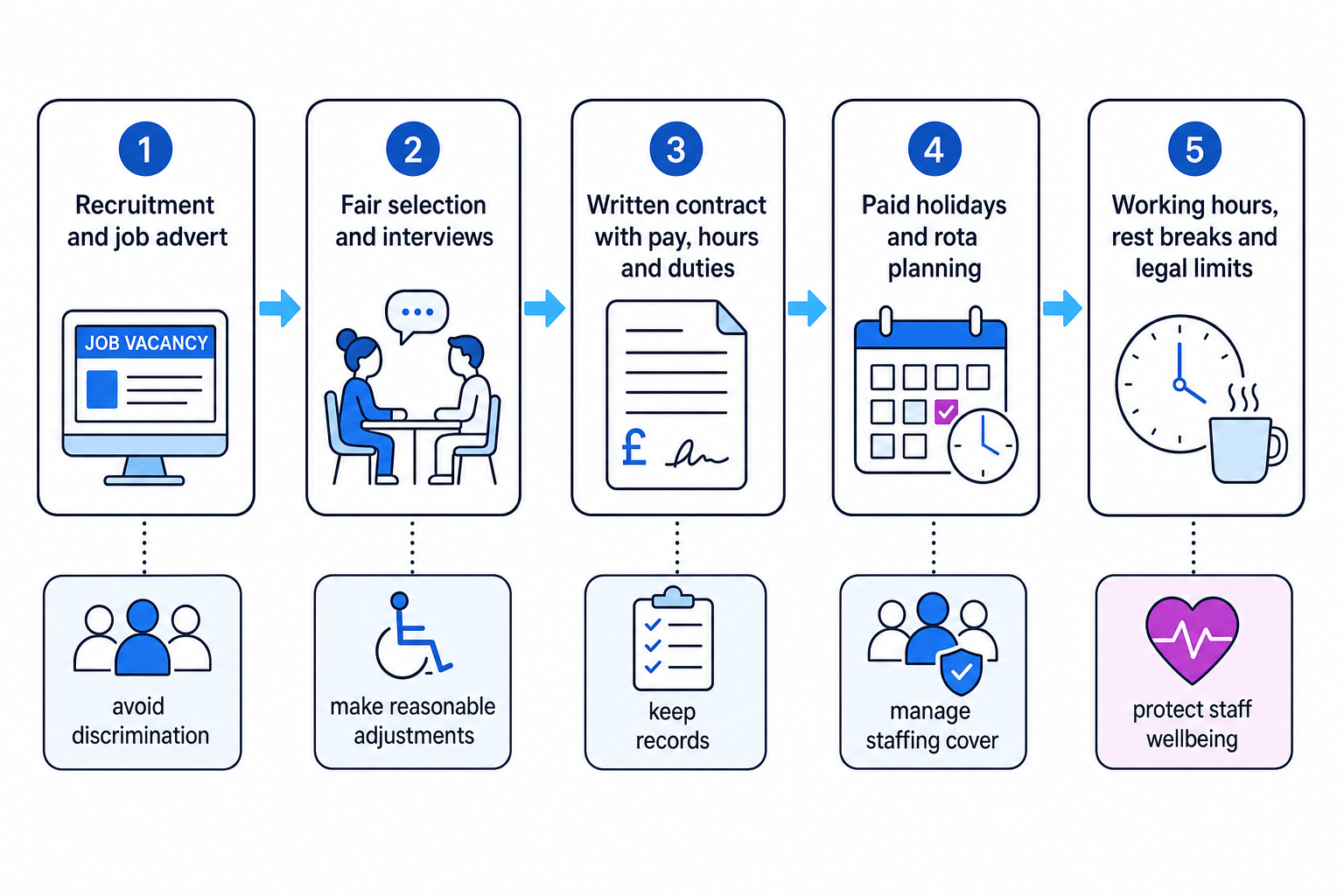
- It covers the whole working relationship: job adverts, interviews, pay, promotion, training, discipline and dismissal.
- Men and women doing the same job must be paid equally, so a business cannot justify a lower rate for one sex.
- An employer must make reasonable adjustments for disabled workers, such as adapted equipment, a ground-floor workstation or altered hours.
- Customers are protected as well, so a shop or restaurant cannot refuse to serve someone because of their race, religion or disability.
Example
- A distribution firm advertises for a "young, energetic warehouse team" and turns down every applicant over 50.
- Both the wording and the decision discriminate on grounds of age, so a rejected applicant can bring a claim against the firm.
- Rewriting the advert around what the job actually needs, such as lifting to a stated weight, is lawful and widens the pool of applicants.
How the Equality Act affects the business
- Fair recruitment procedures: adverts have to be checked for wording that would put a group off, every candidate is asked the same questions, and the reason for choosing the successful one is written down.
- Training: interviewers and supervisors need training on what counts as discrimination and on how to deal with a complaint from a member of staff.
- Costs: training, workplace adjustments, extra record keeping and management time all have to be paid for out of profit.
- Benefits: hiring from the widest possible pool brings in better recruits, and a reputation as a fair employer improves morale, retention and how customers see the business.
- Consequences of a breach: a worker or applicant can take the business to an employment tribunal, which can order compensation, and the case brings legal costs and publicity that puts off customers and future applicants.
Note
- Written notes on why a candidate was chosen protect the business, because they are the evidence it uses to answer a claim.
- Discrimination is often unintentional, which is why training and set procedures matter as much as good intentions.
Exam technique
- A frequent task is analyse the effect on this business of an increase in the national living wage, so work through the wage bill, then prices or profit, then hours and staffing.
- When the case gives staff numbers and hours, multiply the rise out so your answer is about this employer rather than employers in general.
- On the Equality Act 2010, write about recruitment, pay, promotion and training, because that is where the law changes what a business does.
- Do not drift into other statutes; the wage laws and the Equality Act 2010 are the employment laws you need.
Self review
- What is the difference between the national minimum wage and the national living wage?
- Which kind of business is hit hardest by a rise in the legal minimum hourly rate, and why?
- Name three areas of working life that the Equality Act 2010 applies to.
- What can happen to a business that discriminates against a job applicant?
- Give one way in which paying staff well can save a business money.