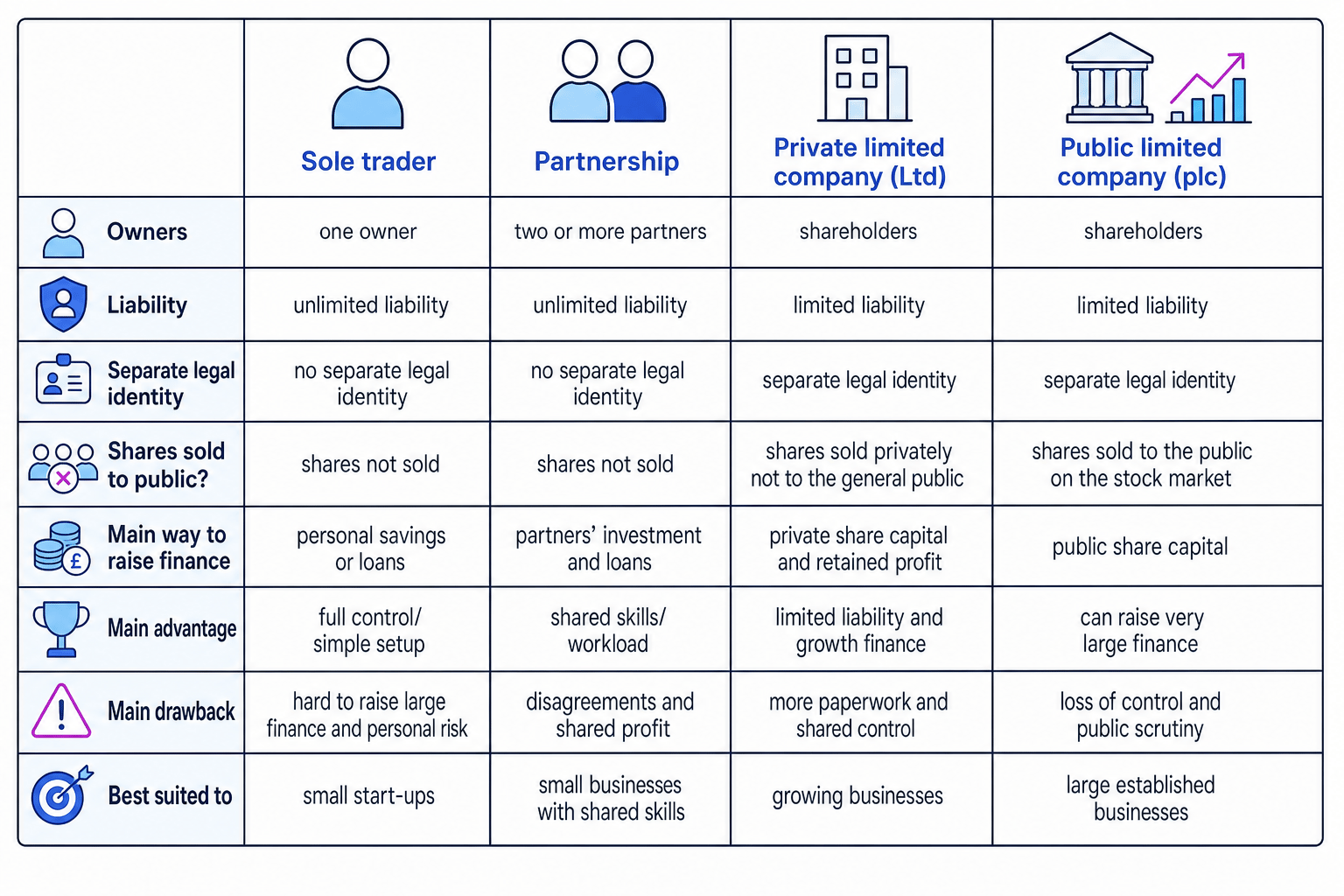
1.2.1 Unincorporated businesses
Unincorporated businesses
Unincorporated business: a business with no separate legal identity from its owner, so in law the owner and the business are one and the same.
- The two unincorporated structures are the sole trader and the partnership, and between them they account for most UK businesses.
- Because there is no legal separation, the money the business owes is money the owner personally owes, which is unlimited liability.
Sole traders
Sole trader: a business owned and controlled by one person, who keeps all the profit and carries all the risk.
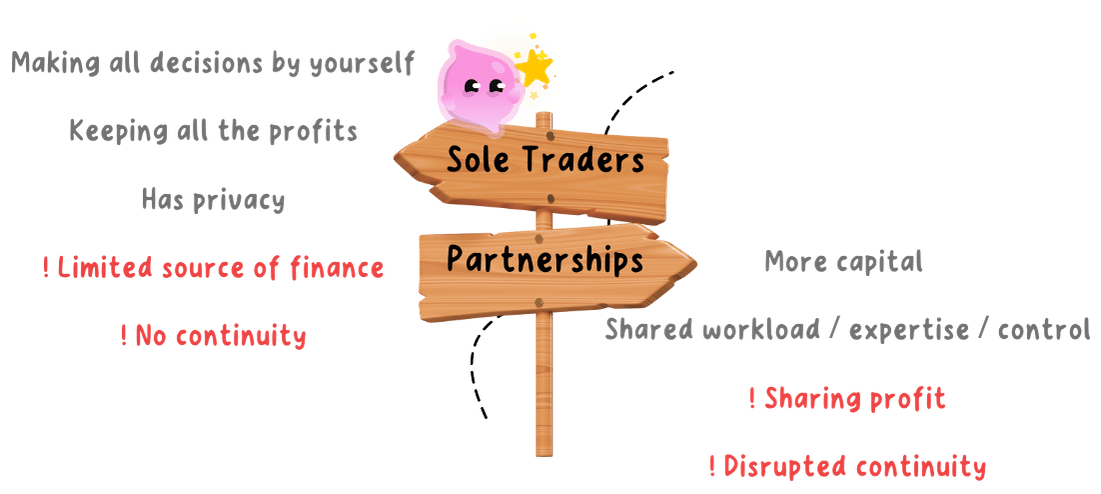
- Easy and cheap to set up: the owner registers with HMRC and can start trading within days, with low start-up costs.
- Greggs started this way in 1939, when John Gregg delivered eggs and yeast to homes around Newcastle by bicycle as a one-man business.
- Makes all the decisions: one person decides everything, so the business reacts quickly, but there is nobody to share the workload or challenge a bad decision.
- Keeps all the profit: there are no partners or shareholders to share it with, so every pound of profit after tax belongs to the owner.
- Flexible working hours: the owner sets their own hours, which is why this structure suits somebody fitting work around family commitments.
- Privacy: accounts are not published, so competitors cannot look up what the business earns.
- Limited sources of finance: a sole trader cannot sell shares, so money comes from savings, family, a bank loan, an overdraft or retained profit.
- Banks lend cautiously because the business owns few assets to offer as security.
- Unlimited liability: personal possessions such as the owner's car or home can be sold to pay business debts.
- No continuity: the business has no legal life of its own, so it ends when the owner retires, sells up or dies.
- Do not write that a sole trader works on their own or has no employees.
- Sole means one owner, not one person in the building.
- A corner shop with four staff behind the till is still a sole trader if one person owns it.
Partnerships
Partnership: a business owned by two or more people who share the decisions, the profits and the risk.
Deed of partnership: a written agreement setting out what the partners have agreed between them.
- More capital: every partner can invest, so a partnership usually starts with more money than a sole trader could raise alone.
- Shared workload and expertise: partners bring different specialisms and can cover for each other, so the business can offer more than one person could.
- Shared control: decisions have to be agreed, which slows them down, and partners who disagree can stall the business with no boss to break the tie.
- Shared profit: profit is split between the partners, so each owner earns less from the same total than a sole trader would.
- Unlimited liability, shared: debts run up by one partner can be claimed from the others, which makes choosing a partner a financial decision as much as a personal one.
- Disrupted continuity: if a partner leaves or dies the partnership normally has to be dissolved and reformed, which can interrupt trading.
What a deed of partnership covers
- How profits are shared between the partners, and what salary each one takes.
- How much capital each partner has invested, and how liability is shared.
- Voting rights, and who decides important matters such as which products to sell.
- How the workload is divided, and the rules for admitting a new partner or for a partner retiring.
- A deed is not compulsory, but without one a disagreement over money has nothing to settle it.
- A high street dental practice run by three dentists is a typical partnership, and most NHS GP surgeries are owned the same way, by the doctors who run them.
- Pooling their savings paid for equipment none of them could have afforded alone.
- Each brings a different specialism, so the practice offers more treatments than a single dentist could.
- If one partner borrows heavily against the practice and it fails, the other two can be pursued for the debt.
Deciding whether to take on a partner
- Ask first whether the partner brings capital, because a partner who invests money solves a finance problem that a bank loan would otherwise have to solve.
- A partner who brings no money is a much weaker case, because they take a share of the profit for doing work a paid employee could have done.
- Weigh the shared workload and specialist skills against slower decisions, possible conflict and the loss of sole control.
- Then judge it against how profitable the business already is, because giving away half of a healthy profit costs far more than giving away half of a struggling one.
- Short questions here include explain one detail that could be agreed between partners in a partnership, which is asking for a clause of the deed of partnership.
- The longest question asks you to recommend whether X should form a partnership with Y, and there you must actually decide rather than list both sides and stop.
- Look in the item for whether the proposed partner has money to invest, since that single fact usually decides the answer.
- Use the word unincorporated when a question asks what sole traders and partnerships have in common.
- What does unincorporated mean?
- Can a sole trader employ staff? Explain your answer.
- Give three details that could be set out in a deed of partnership.
- State two advantages of a partnership over a sole trader.
- Why does it matter whether a proposed partner can invest capital?
1.2.1b Incorporated and not-for-profit organisations
Incorporated businesses
Incorporated business: a business with its own legal identity, separate from the people who own it.
Shareholder: a person or organisation that owns shares in a company and therefore owns part of it.
Dividend: a share of a company's profit paid to shareholders, usually in proportion to how many shares they hold.
- An incorporated business can own property, borrow money and be taken to court in its own name, separately from its owners.
- Because the company owes its own debts, shareholders have limited liability and can only lose the money they invested.
- The company also carries on trading even when owners sell their shares or die, which a sole trader cannot do.
- The cost is more paperwork and less privacy, because a company files annual accounts that anybody, including a competitor, can look up.
Private limited companies
Private limited company (Ltd): an incorporated business whose shares are sold privately to invited people and cannot be advertised to the general public.
- Owned by a few shareholders: shares go to family, friends and invited investors, and existing shareholders normally have to agree before anybody sells theirs on.
- Control is maintained. Because shares cannot be sold to just anybody, the founding owners keep decision-making inside the group.
- More finance than a sole trader: selling shares raises money the owner could not raise alone, and banks lend more readily to a company.
- Limited liability: a failure costs shareholders their investment rather than their home.
- Profit is shared as dividends. Shareholders receive a dividend in proportion to the shares they hold, but because there are few of them more profit can be kept back to fund growth than in a plc.
- Accounts are not private. Unlike a sole trader, a company must publish its accounts, and there are set-up and accountancy costs to meet.
- Warburtons, the Bolton bakery, is one of the UK's largest food producers and has stayed a private limited company for five generations.
- Staying Ltd means the family keeps control and can invest for the long term.
- The trade-off is that it cannot raise money by selling shares to the public, so growth is funded from profit and borrowing.
Public limited companies
Public limited company (plc): an incorporated business whose shares can be bought and sold by anybody on a stock exchange.
- It can issue shares to the public. Selling shares on a stock exchange such as the London Stock Exchange raises sums no other structure can reach.
- Limited liability: a shareholder in a plc risks only what they paid for their shares, which is what persuades thousands of strangers to put money into a business they will never run.
- Borrowing is easier. Lenders can see the company's value and its published accounts, so loans are larger and cheaper.
- Control can be lost. Anybody can buy the shares, so the original owners can be outvoted and a rival can mount a takeover.
- Shareholders expect dividends. Profit is spread across many shareholders who want a payout each year, which can push the board towards short-term decisions.
- Scrutiny and cost: detailed accounts are published and reported on, and floating on a stock exchange is expensive in legal and advisory fees.
- A plc is not owned by the government, because public means the shares are sold to the general public.
- A private limited company has shareholders and pays dividends, but it cannot advertise its shares to the public.
- Both Ltd and plc have limited liability, so any statement giving a company unlimited liability is wrong.
Not-for-profit organisations
Not-for-profit organisation: an organisation set up to achieve a social, community or environmental aim, where any surplus is reinvested in the cause instead of paid to owners.
Social enterprise: a business that trades like any other but exists to serve a social purpose, reinvesting most of its profit in that purpose.
- Aims: success is measured by the difference made rather than by profit, such as meals served, habitat protected or people housed.
- Control: charities and similar bodies are run by trustees or a committee rather than by owners taking profit out, so decisions are made in the interest of the cause.
- Finance: the money comes from donations, grants, fundraising and legacies alongside revenue from trading.
- That mix can be less reliable than sales, because donations fall when household incomes are squeezed and grants can be withdrawn.
- Distribution of any surplus: nothing is paid out to owners, because the surplus goes back into the work the organisation exists to do.
- The commercial reality: it still has to cover its costs and still closes if the money runs out, so the National Trust charges for entry and runs shops and cafés to fund its conservation work.
- Not-for-profit describes what happens to the surplus, not whether the organisation makes one.
- A charity that takes in more than it spends is doing exactly what it should, because that surplus funds next year's work.
- Expect a multiple choice question worded as which of the following is true for a public limited company?, and a short explain one benefit to a business of being a plc rather than a ltd.
- A longer version reads using Item C, explain one advantage to X ltd of being a private limited company, where the advantage you choose has to be one the item's own facts support.
- Say shareholders rather than owners once a business is incorporated, since that is the precise term.
- What does it mean to say a company is incorporated?
- State two differences between a private limited company and a public limited company.
- What is a dividend?
- Why is it wrong to say a plc is owned by the government?
- Where does a not-for-profit organisation get its money, and what happens to any surplus?
1.2.2 Benefits and drawbacks of legal structures
The four issues every structure is compared on
- Management and control, meaning who makes the decisions and how quickly they can be made.
- Sources of finance available, meaning where the money to start and grow the business can come from.
- Liability, meaning how much of their own money the owners stand to lose if the business fails.
- Distribution of profits, meaning who the profit is shared between and how much each owner keeps.
- One pattern runs through all four, because as ownership spreads across more people the business can raise more money but each owner controls less of it and keeps a smaller share.
The five structures side by side
| Structure | Control | Finance | Liability | Profits |
|---|---|---|---|---|
| Sole trader | One owner decides | Savings, loan, overdraft, retained profit | Unlimited | Owner keeps all |
| Partnership | Shared, so slower | Partners' capital, loan, overdraft | Unlimited, shared | Split by the deed |
| Private limited (Ltd) | Invited shareholders, often family | Private share sale, easier borrowing | Limited | Dividends to a few |
| Public limited (plc) | Founders can be outvoted | Public share sale on a stock exchange | Limited | Dividends to many |
| Not-for-profit | Trustees or a committee | Donations, grants, fundraising | Varies by form | None, surplus reinvested |
Management and control
- A sole trader has total control, so a decision to change prices on Monday can be in force by Tuesday, but there is nobody to share the load or challenge a bad call.
- In a partnership control is shared, which brings in more skills but makes agreement slower and disagreement possible.
- In a private limited company the shares are held by people the owners invited, so the business can raise money without handing control to strangers.
- In a public limited company anybody can buy shares, so the founders can be outvoted and a rival with enough money can take the company over.
- In a not-for-profit, trustees or a committee decide, and they are bound to act in the interest of the cause rather than of any owner.
- Warburtons and Dyson are large enough to float on the stock market but have chosen to stay private limited companies.
- Staying Ltd keeps decisions with the founders, who can invest in projects that take a decade to pay back.
- The price is a lower ceiling on finance, so growth has to come from profit and borrowing.
Sources of finance
- A sole trader is limited to savings, family, a bank loan, an overdraft and retained profit, and lenders are cautious because the business owns few assets to offer as security.
- A partnership can draw capital from every partner, which is why professional practices needing expensive equipment often take this form.
- A private limited company can sell shares to invited investors and borrows more easily, because it has a separate legal identity and published accounts a bank can check.
- A public limited company can raise sums no other structure can reach, and unlike a loan that share capital never has to be repaid.
- A not-for-profit draws on donations, grants and fundraising as well as trading, which brings in money no ordinary firm could ask for but is less predictable than sales.
- Finance is usually what forces a change of structure, because a business normally changes form when it cannot fund the next step any other way.
Liability and distribution of profits
- Sole traders and partnerships have unlimited liability, so a failed business can take the owner's savings, car and home with it.
- Private and public limited companies have limited liability, so a shareholder who put in £5,000 can lose £5,000 and no more.
- Liability changes behaviour as well as risk, because an owner whose home is at stake turns down contracts that a company would take on.
- On profit, a sole trader keeps everything after tax, partners split it as the deed sets out, and shareholders receive dividends in proportion to their holding.
- A plc spreads dividends across thousands of shareholders who expect a payout each year, which leaves less profit to reinvest than a family-owned Ltd can keep back.
- A not-for-profit distributes nothing, because the surplus is reinvested in the cause the organisation exists to serve.
- The full treatment of limited and unlimited liability is in the article on limited liability and choosing a structure.
- That article also owns the judgement about which structure suits a new start-up and which suits a large established business.
- The common stems are analyse one benefit to X of operating as a sole trader and analyse one disadvantage to X of being a public limited company.
- The commonest weakness is listing features of a structure instead of comparing two structures on the same one of the four issues.
- Name the four issues used to compare legal structures.
- Why can a plc raise more finance than a sole trader?
- How are profits distributed in a partnership, and in a not-for-profit?
- Why might a plc reinvest less of its profit than a private limited company?
- Which structure gives an owner the most control, and which gives the most access to finance?
1.2.3 Limited liability and choosing a structure
Unlimited liability
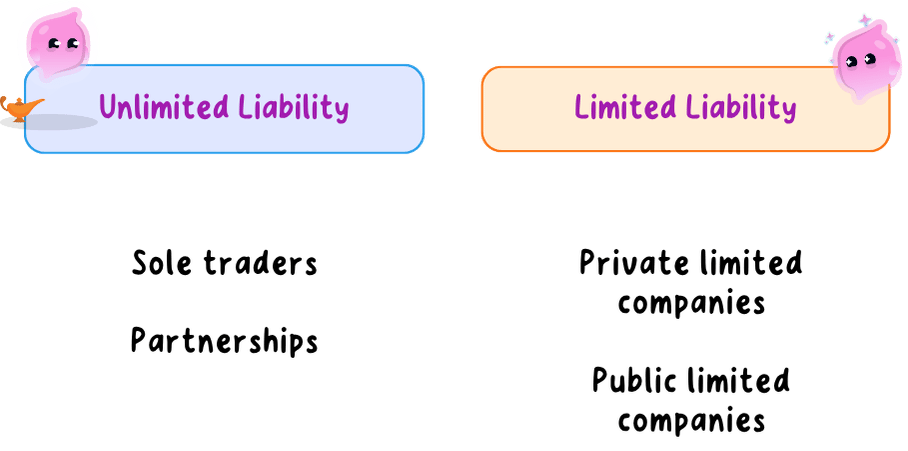
Unlimited liability: the owner is personally responsible for all the debts of the business, with no limit, so personal possessions can be sold to pay them.
- An unincorporated business has no legal identity of its own, so its debts are simply the owner's debts.
- If the business cannot pay, a court can order the owner's savings, car and even their home to be sold to settle what is owed.
- It applies to sole traders and partnerships, and in a partnership debts run up by one partner can be recovered from the others.
- The effect on behaviour is real, because an owner whose house is at stake turns down the risky contract and grows more slowly than they otherwise might.
- A sole trader builder in Bristol buys £40,000 of materials on trade credit for a large extension.
- The customer runs out of money halfway through, so no final payment ever arrives.
- The £40,000 is still owed to the merchant, and because he has unlimited liability the debt is his personally.
- His savings can be taken to cover it, and if they fall short his house can be sold.
Limited liability
Limited liability: the owners of a company can only lose the money they invested in it, because the company is a separate legal person and the debts belong to the company.
- It applies to private limited companies and public limited companies, the two incorporated structures.
- Shareholders' personal possessions are protected, because they are not liable for the debts of the business.
- There is a guaranteed limit to their losses, since only the amount paid for the shares can be lost.
- Knowing the worst case in advance is what makes outside investment possible, because somebody will risk £5,000 on a stranger's business when they would never risk their house on it.
- The people who carry the risk instead are the suppliers and lenders, who may go unpaid when a limited company fails.
- Limited liability does not mean the business has a limited amount of money.
- It means the shareholders' losses are limited to what they invested, and some of the largest companies in the UK have it.
- It also does not mean the debts disappear, because the company still owes the money and its own assets are still sold to pay what it can.
Choosing a structure for a new start-up
- Most new businesses start as sole traders, because it is quick, cheap, private and needs no accounts to be published.
- That suits a start-up whose risks and costs are small, such as a private tutor or a freelance designer, where the worst case is a few hundred pounds of unsold time.
- A partnership makes sense when the start-up needs more capital or skills than one person has, though joint unlimited liability means the partners must trust each other.
- Incorporating from day one is worth the extra cost when the business will borrow heavily or work in a sector where a single mistake is expensive, such as food manufacturing or construction.
- So for a start-up the decision turns on how much could go wrong and how much money is needed, not on how ambitious the owner feels.
Choosing a structure for a large established business
- A large business almost always needs limited liability, because the sums it owes at any moment are far beyond what any individual could cover.
- A private limited company suits an established firm that wants the protection and the extra finance while keeping decisions inside the family.
- A public limited company suits a firm that needs sums only the stock market can supply, and whose owners accept outside shareholders as the price.
- The drawbacks of floating are real, since the founders can be outvoted, a rival can mount a takeover, the accounts are public, and floating itself costs a large sum in fees.
- Greggs shows the whole journey in one business.
- It began in 1939 as a small family bakery in Newcastle.
- It floated on the stock market in 1984, raising the finance to expand well beyond the North East.
- As a plc it now runs more than two thousand shops, a scale no family could have funded from profit alone.
- The trade-off is visible in every set of results, because the board now answers to thousands of shareholders rather than to one family.
Recommending a structure
- When you are asked to advise a business on changing structure, build the answer on four things rather than listing every feature you know.
- Control and decision making, because moving from sole trader to Ltd means sharing decisions that used to be one person's.
- Liability, because incorporating protects the owner's home and that protection is worth more the riskier the sector is.
- Finance and access to capital, because share capital does not have to be repaid whereas a loan does.
- Growth potential, because the structure has to fit where the business is trying to get to, not just where it is now.
- Then weigh the loss of control against the ability to raise finance that never has to be repaid, and commit to an answer rather than leaving both sides open.
- The short stem to have ready is explain one benefit to shareholders of limited liability, which has appeared word for word in more than one series.
- The answer wanted is the guaranteed limit to their losses, since only the amount the shareholder paid for their shares can be lost.
- The long one reads X is considering changing the legal structure from a sole trader to a private limited company, advise X whether this is a good idea, where the four headings above give you the shape of the answer.
- Define limited liability.
- Which two legal structures have unlimited liability?
- Explain one benefit to shareholders of limited liability.
- Give one reason a low-risk start-up might stay a sole trader.
- Name the four things to build a recommendation on legal structure around.