3.1.1 Methods of production
Job production
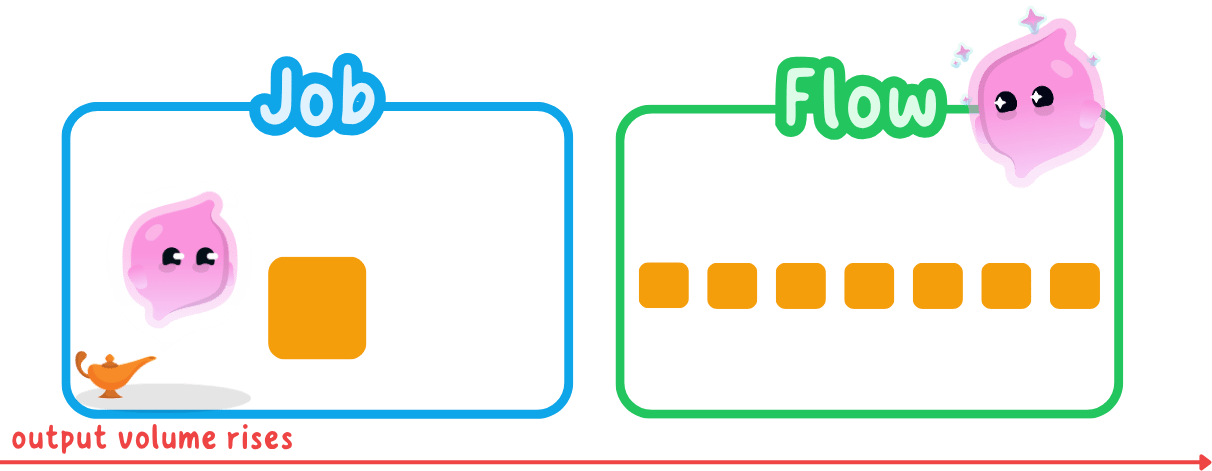
Job production: making one item, or a very small number of items, to a customer's own specification before the next order is started.
- One-off orders: each product is made to what one customer has asked for, so no two jobs are identical and the work starts again from scratch each time.
- Labour-intensive: skilled staff do most of the work using general tools, rather than a machine line built for one design.
- A bespoke kitchen is measured, built and fitted by joiners for one house, so the same design is never repeated.
- High unit cost: skilled wages and the hours each item takes are carried by a single unit, so the cost of each unit is high and the selling price has to be high too.
- Very flexible: size, materials and design can change with every order, so the business can take on unusual work that a production line could not handle.
- Motivating work: staff use a range of skills and see a finished product they can take pride in, which helps a small firm keep experienced workers.
- JCB builds machines to order, fitting the attachments and cab a particular buyer needs for the site the machine will work on.
- A tailored suit is cut to one person's measurements, and a wedding cake is designed for one couple.
Flow production
Flow production: making large quantities of identical products that move continuously along a production line, with the same task added at each stage.
- Continuous and standardised: the product never stops moving, and every worker or machine repeats one task on every unit that passes, so each unit comes out the same.
- Capital-intensive: machinery and automation do most of the work, so fewer workers are needed, but the cost of setting up the line runs into millions of pounds.
- Low unit cost: the cost of the line is spread across a very large output and materials are bought in bulk, so each unit costs little to make.
- Needs high and steady demand: if sales fall, the line runs below capacity, the set-up cost is spread over fewer units and the cost of each unit rises sharply.
- Repetitive for staff: doing one short task all day is boring, which can lead to mistakes, absence and staff leaving.
- Expensive to change: retooling the line for a new design costs a great deal and stops output while it happens, and one breakdown halts every stage at once.
- Nissan's Sunderland plant builds hundreds of thousands of cars a year on a moving line, so each car costs far less to build than a hand-made one.
- Warburtons mixes, proves, bakes, slices and bags loaves in one continuous run, turning out identical loaves by the thousand.
When job production suits a business
- Job production suits a business whose customers each want something different, because the specification changes with every order.
- It suits low volumes, where demand is far too small to repay the cost of building a production line.
- It suits products customers will pay a premium price for, since the high unit cost has to be covered somehow.
- A made-to-measure suit sells for hundreds of pounds more than an off-the-peg one because the fit is cut for one body.
- It suits a business competing on skill, quality and reputation rather than on price, such as a bespoke furniture maker.
When flow production suits a business
- Flow production suits a business selling one standard product in very large numbers, where every customer is happy to receive the same thing.
- It suits demand that is high and predictable, because the line has to run near capacity for its set-up cost to be worth paying.
- It suits a business competing on price, because the low unit cost allows a low selling price and still leaves a profit on each unit.
- It needs a business with the finance to buy the machinery in the first place, which a new start-up rarely has.
Once a method is chosen, a business can raise output from the same resources using lean production and just in time, which the article on efficiency in production covers.
- For recommend whether the business should use job or flow production, actually decide, and base the decision on how large and how varied the demand is.
- The mistake to avoid is calling flow production cheaper without saying that this only holds at high output, because a half-empty line is expensive per unit.
- AQA names job and flow production only, so do not write about batch or cell production.
- What is job production?
- Why is the unit cost of job production high?
- Why does flow production need high and steady demand?
- Give one drawback of flow production for the workers on the line.
- Which method suits a maker of made-to-measure curtains, and why?
3.1.2 Efficiency in production
What efficiency means in production
- Efficiency means getting a given amount of output from as few resources as possible, so very little of what the business pays for is wasted.
- A more efficient factory turns the same workers, machines, materials and floor space into more finished goods.
- That matters because the money already spent on wages, rent and machinery is then carried by more units, so the cost of each unit falls.
- AQA names two ways of raising efficiency in production: lean production, and just in time as one of the techniques inside it.
Lean production
Lean production: an approach to operations that cuts waste of every kind, so the same output is produced using fewer resources.
- Lean production starts by looking at every step in the process and asking whether that step adds anything the customer would pay for.
- Steps that add nothing are redesigned or removed, and the workers who do the job are usually the ones who spot them.
- It is a continuous habit rather than a one-off project, so small improvements are made week after week.
- Lean production does not mean cutting jobs, and it does not mean cutting the quality or the features customers are paying for.
- It means removing the waste inside the process, so the same staff produce more with less scrap, less waiting and less walking about.
The waste lean production removes
- Wasted time: workers and machines standing idle while they wait for parts, instructions or a slower stage to catch up.
- Wasted materials: offcuts, spillage, and faulty units that have to be scrapped or reworked, all of which were bought and paid for.
- Wasted space: floor space and warehousing filled with stock and half-finished work, which the business is paying rent, heating and insurance on.
- Wasted movement: parts and people travelling further than they need to, because machines and benches are laid out in the wrong order.
- Wasted effort: checks, forms and handling repeated at more than one stage, and making more units than there are orders for.
- A Greggs shop that moves the ovens, trays and till into the order the work actually flows cuts the steps each member of staff walks in a shift.
- The same staff serve more customers per hour, so the wage cost carried by each sandwich falls.
How less waste lowers the unit cost
- Waste is money the business has already spent and will get nothing back for, so removing it lowers total costs while output stays the same.
- The cost of each unit is the total cost spread across the units made, so a lower total cost across the same output gives a lower unit cost.
- A Warburtons bakery makes 10,000 loaves a week at a total cost of £12,000.
- Cutting scrapped dough and idle oven time takes the weekly cost to £10,800 for the same 10,000 loaves.
- Each loaf now costs 12p less to make, which the bakery can take as extra profit on every loaf or use to undercut a rival's price.
- A lower unit cost also gives room to survive a fall in the selling price, because there is more distance between the cost of a unit and its price.
Just in time
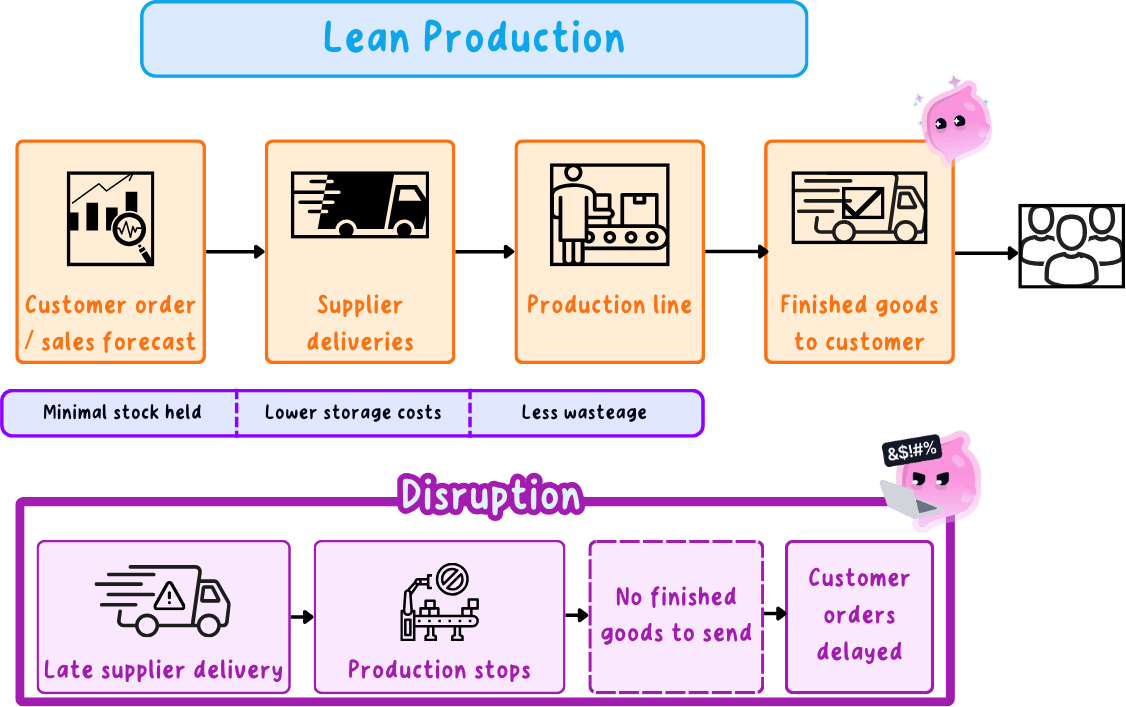
Just in time (JIT): a lean technique in which stock arrives from suppliers just as it is needed, so the business holds almost none.
- JIT raises efficiency by removing the wasted space and the cash tied up in a warehouse full of stock waiting to be used.
- It also exposes waste elsewhere, because with no spare stock to hide behind, a faulty batch or a slow stage stops the line and has to be put right rather than worked around.
Just in time, just in case and the trade-off between them are taught in full in the article on just in time and just in case.
- For explain how lean production could make the business more efficient, pick one waste that is visible in the case and follow it through to a lower unit cost.
- Name the waste you are removing, whether it is wasted time, materials, space, movement or effort, instead of writing generally about being more efficient.
- Finish the chain every time: less waste, lower total cost, lower unit cost, then either a lower price or a wider profit margin.
- What does it mean to say a business is efficient?
- Name four kinds of waste lean production sets out to remove.
- Why does removing waste lower the cost of each unit?
- Why is lean production not the same as cutting jobs?
- How does just in time raise efficiency?
