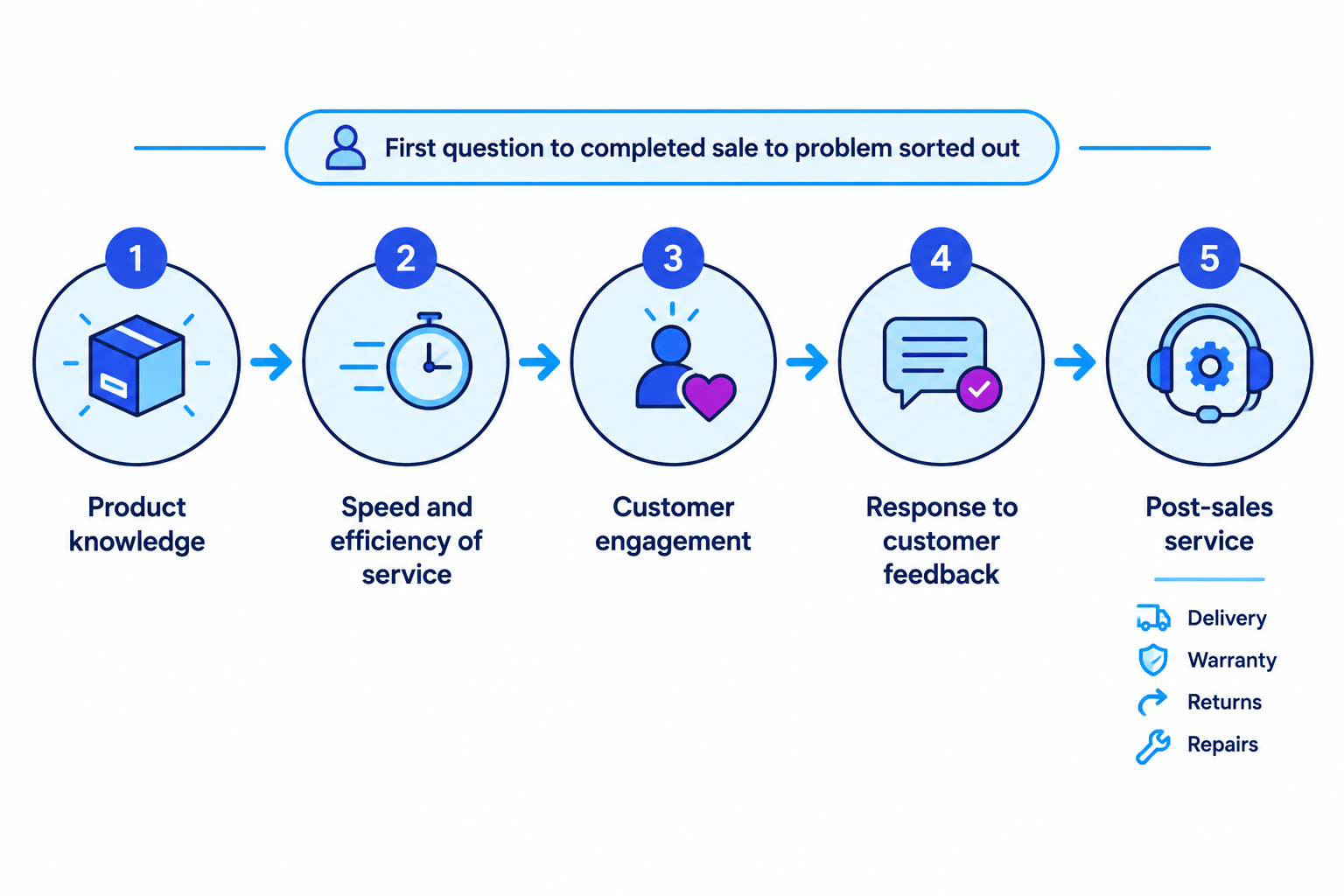
The sales process: every point where a customer meets the business
Definition
Sales process: the sequence of steps a business goes through to turn an interested person into a completed sale and a customer who comes back.
Post-sales service: the support a business gives after payment, including delivery, installation, warranties, returns and repairs.
- The process starts when a customer first asks a question and ends only when any problem after the purchase has been sorted out, so it does not stop when the money is taken.
- Edexcel names five elements, which run in order through a single sale, and any one of them done badly can lose the customer on its own.
The five elements in order, and what goes wrong when each is done badly
- Product knowledge: staff understand what they sell, so they can answer questions and match the right product to the customer in front of them.
- Without it the customer is given wrong information, so they either leave without buying or return the item later, which costs the business the sale and the handling of the return.
- Speed and efficiency of service: the customer is served quickly and without fuss, whether at a till, on a phone line or through a website checkout.
- A queue at lunchtime or a page that takes ten seconds to load hands the sale to a rival, because the customer abandons the purchase rather than waits for it.
- Customer engagement: staff listen to what the customer actually needs and help them choose rather than push a product, which builds trust and often a larger sale.
- Pushing whatever the shop needs to clear makes the customer feel processed, so they buy the cheapest option to get away and are slow to come back.
- Response to customer feedback: the business acts on what customers say, whether a complaint or a suggestion, and is seen to have acted.
- Feedback that is collected and then ignored does more damage than never asking, since the customer has given up their time and been shown that nothing changed.
- Post-sales service: delivery, installation, warranties, returns, spare parts and help lines after the money has changed hands, which is where a good sale becomes a repeat customer.
- A returns policy that argues with the customer turns one faulty item into a lost customer and a public review that warns everybody else off.
Example
- Greggs sells cheap hot food at high volume, so speed at the counter carries most of its sales process and a long lunchtime queue is the main way a sale is lost.
- Dyson sells vacuum cleaners at a premium on design and engineering, so product knowledge and a warranty matter far more than serving in under a minute.
- The five elements are the same in both, but the weight each one carries follows the price and the complexity of what is being sold.
Why the sales process decides whether the rest of the business pays off
- The sales process is the point where every other decision the business has taken finally meets the customer.
- A product designed well, priced carefully and promoted expensively can still be lost at the till, because the customer walks out over a twenty-minute queue or an assistant who cannot answer a straight question.
- Marketing therefore only converts into revenue if this last step holds, so advertising that brings a hundred extra customers into a shop that can serve sixty has paid to send forty of them to a rival.
- Operations depends on it too, since a well-made item returned because staff sold the wrong model still costs the business its materials, its labour and two lots of delivery.
Note
- Handled well, the process delivers repeat custom, word of mouth and a reputation strong enough to support a higher price.
- Those benefits belong to the next guide on good customer service, so keep your focus here on the steps themselves.
How technology has changed the sales process
- Self-checkout and online ordering: these strip time out of the middle of the process, so Tesco can take an order through click and collect without a member of staff serving that customer at all.
- Public reviews: post-sales service used to be private, but a refund handled badly on Amazon or eBay is now read by thousands of future customers rather than by one.
- Customer data: staff can see what a customer bought and when, so a help line can check a warranty or reorder a part without asking the customer to explain their own history.
- Technology shifts the risk as well as the speed, because a checkout page that crashes loses the sale silently with no member of staff there to rescue it.
Exam technique
- Name the element, then carry it through: strong product knowledge, so the right model is matched to the customer, so fewer returns and more repeat custom.
- The link most often dropped is the last one, because answers name an element and describe it without saying what it does to sales, costs or reputation.
- Use the business in the source booklet, since good service at a garage means clear explanations of repairs, while at a supermarket till it means speed.
- When the command word is analyse, build one element into a full chain rather than listing all five thinly.
Self review
- Name the five elements of the sales process in order.
- Define post-sales service and give two examples of it.
- What goes wrong for the business when staff lack product knowledge?
- Give one way technology has changed post-sales service.
- Why can a well-made, well-promoted product still fail at the point of sale?