The cost of maintaining quality: better inputs, trained staff and time spent checking
- Keeping quality consistent costs money before it saves any, and the spending shows up in four places.
- Better materials: a boot built to last needs thicker leather and stronger stitching than a fashion boot, and the supplier charges more for both.
- Training staff: workers have to be taught the standard before they can hit it, and training hours are paid hours in which nothing is produced.
- Inspection or assurance systems: the quality control and quality assurance methods of the previous guide have to be paid for, in testing equipment and in the wages of anyone whose job is to check rather than to make.
- Time spent checking: an item held back for a check is an item not yet sold, so output per hour falls even when nothing turns out to be wrong with it.
- All four raise the cost per unit, so a business that lifts its standards must either accept a thinner margin or charge a price customers will pay for the difference.
The cost of not maintaining quality: the bill that arrives later
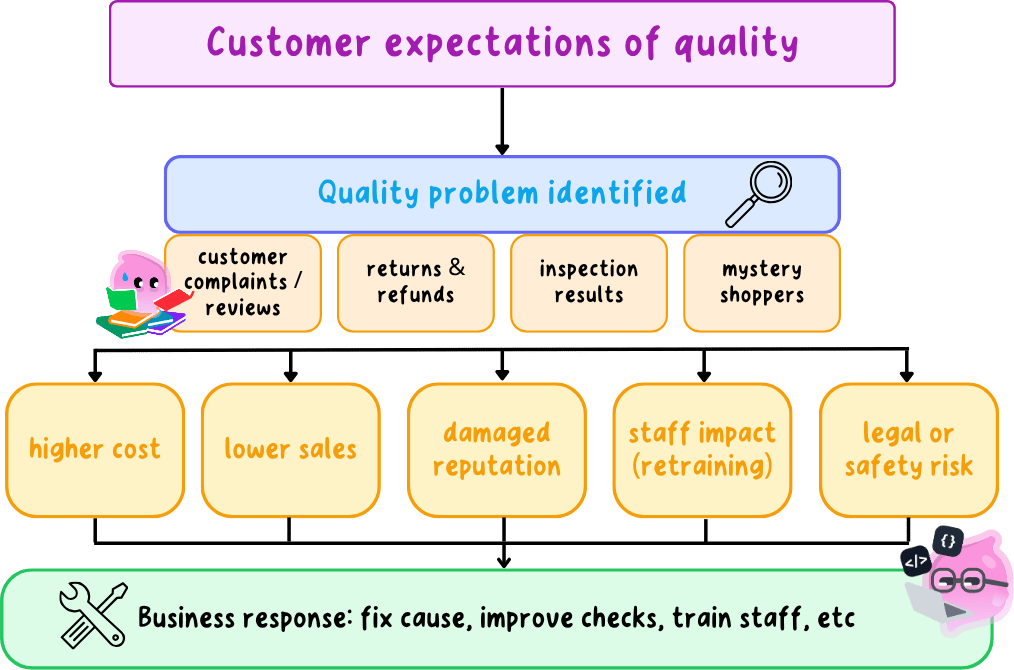
- Poor quality costs more than good quality, and the bill arrives in five places of which only the first two ever reach the accounts.
- Scrap and rework: a faulty item is thrown away or made again, so the business pays twice for one sale, once for the ruined materials and again for the labour that redoes the work.
- Refunds, replacements and repairs: consumer law gives a buyer the right to a remedy when goods are faulty or not as described, so the seller carries that cost whether it budgeted for it or not.
- Handling complaints: every complaint uses staff time on calls, emails and returns paperwork, which is time not spent making or selling anything.
- Lost repeat custom: a customer who receives a faulty order usually buys elsewhere next time, so the business loses not one sale but every sale that customer would have made for years.
- Reputational damage: one bad review sits online where every future shopper reads it, so sales are lost to people who never bought, never complained and never appear in any figure the business can count.
How quality turns into competitive advantage
Definition
Competitive advantage: a feature that makes customers choose one business over its rivals, such as a lower price, a better design or more dependable quality.
- Competitive advantage built on quality is a chain, and an answer earns its marks by saying every link out loud.
- Quality that is the same every time builds a reputation, because a customer knows what they will get before they hand over any money.
- That reputation makes customers pick this business over a cheaper rival, so demand holds up when a competitor cuts its price.
- Loyal demand lets the firm charge more without losing those buyers, so the revenue earned on each sale rises.
- A higher price on a similar cost base widens the margin, which pays for the materials, training and checks that hold the quality steady, so the advantage renews itself.
- Quality also makes the rest of the business easier to run, because fewer faults mean fewer returns for operations to process and promotion can advertise a claim the product actually delivers.
Example
- Dyson went through over 5,000 prototypes before selling a bagless vacuum cleaner, and competes on design and engineering rather than on price.
- Customers who expect the machine to keep working accept a price well above a supermarket own-brand vacuum, so the margin on each sale is wide.
- That margin funds the engineering that keeps the next model ahead, which is how the quality and the premium hold each other up.
- A run of failures would break the chain at the first link, because the reputation is the only reason anyone pays the premium.
Quality has to be right for the market, not the highest possible
- The right level of quality is the level the customer is paying for, because spending past that adds cost the price cannot recover.
- Budget retailers: Aldi and Lidl compete on price with a narrower product range, so their target is food that is consistently fresh, safe and worth the money rather than the best version of every line.
- Premium brands: Dr Martens sells boots on durability at a high price, so a pair that fell apart in one winter would remove the whole reason for paying it.
- Both models depend on quality and simply define it differently, dependable at low cost for the discounters and made to outlast the alternatives for the premium brands.
Exam technique
- Write the cost of poor quality as a chain: the item is remade, so the materials are paid for twice, so the cost per unit rises, so the profit on that order disappears.
- The cost most often missed is the customer who never returns, because that loss never appears on an invoice and has to be argued rather than counted.
- Judge the level of quality against the business in the source booklet, since a discount retailer and a premium brand are aiming at different standards.
- When the question says justify or evaluate, set what the quality spending costs now against the failure costs and lost custom it prevents later, then decide for that firm.
Self review
- Give three costs a business faces in maintaining quality.
- Explain why losing a repeat customer costs more than paying a single refund.
- Set out the chain from consistent quality to a wider profit margin.
- Why does good quality mean something different to Aldi than to Dr Martens?
- Name one way quality helps operations and one way it helps promotion.
