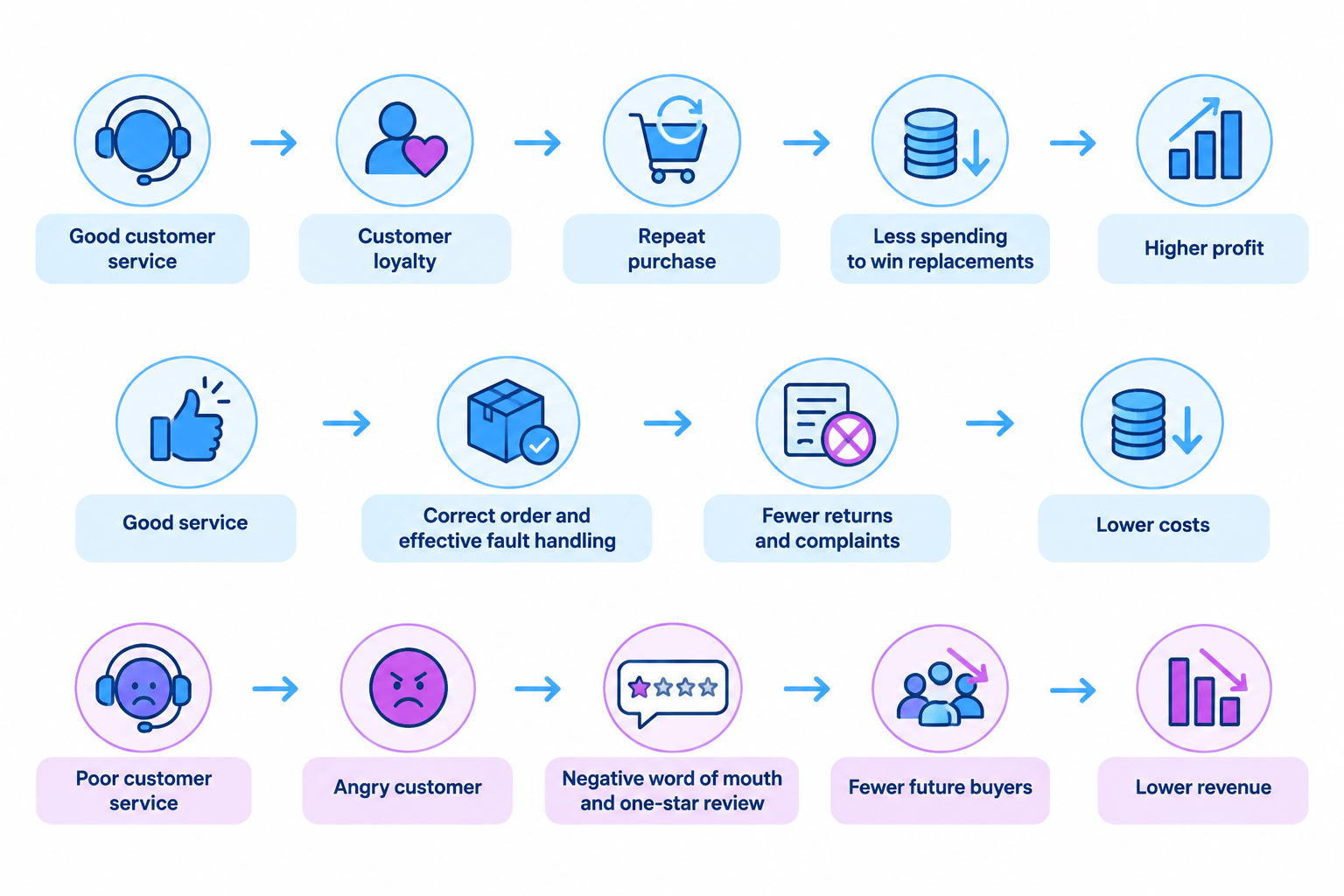
Loyalty and word of mouth: the two chains that bring customers back
Definition
Customer service: all the help a business gives a customer before, during and after the sale, from advice on the shop floor to handling a fault weeks later.
Customer loyalty: the habit of buying from the same business again instead of comparing rivals every time.
- A customer who is served well has no reason to shop around, so the next time they need the same thing they come back to you rather than to the shop next door.
- That is worth money because winning a new customer costs advertising, discounts and time, while a returning one walks in for nothing.
- So the profit the business keeps from one loyal customer rises the longer the relationship lasts, even though the price on the shelf never changes.
- Word of mouth: a satisfied customer recommends the business to friends and leaves a good review, which brings in buyers the business never paid to reach.
- The reverse is true and travels faster: an angry customer tells far more people than a pleased one, and a one-star review stays visible long after the complaint was settled, putting off buyers who never gave the business a chance.
Price and returns: service protects what each sale is worth
- Customers will pay more to a business they trust to put a problem right, because part of what they are buying is the confidence that a fault will be dealt with rather than argued over.
- Dr Martens sells boots on durability at a premium price, and that promise only holds if a customer whose pair fails early is dealt with quickly, because otherwise the reason for paying the higher price disappears.
- Fewer returns and complaints: getting the order right first time is cheaper than fixing it afterwards, since a return costs the delivery out, the delivery back, the staff time to process it and often a product that cannot be sold again at full price.
- Every hour spent settling a complaint is an hour a member of staff is not selling, so weak service pushes costs up and revenue down at the same time.
Example
- An online shoe shop picks the wrong size for a £120 order.
- It pays the return postage, checks and restocks the boots, then posts the right pair, so one sale now carries three lots of delivery cost and around twenty minutes of staff time.
- Picking the order correctly the first time would have cost nothing extra at all.
- The customer also decides on the strength of that mistake whether to order again.
Service is delivered by people, so it depends on the staff
- Every part of good service reaches the customer through a member of staff, so how well a business recruits, trains and keeps its people sets the ceiling on the service it can offer.
- A trained assistant who can say which model suits the customer keeps the sale in the shop, while an untrained one sends the shopper away to check online and usually loses them to whoever comes up first in the search.
- Staff who stay long enough to learn the stock and recognise regulars serve people faster and make fewer mistakes, so high staff turnover damages service even when the training budget has not been cut.
Note
How a business trains and motivates those staff is covered in 2.5.3 and 2.5.4.
What service costs, and why some businesses choose to offer less
- Good service is bought rather than wished for, and it shows up in three places on the cost side.
- Training and staffing levels: staff are paid while they learn, and serving people properly needs more of them on the floor at the busy hours.
- Time per customer: an assistant who spends ten minutes advising one shopper serves fewer people in that hour, so the wage cost carried by each sale rises.
- Returns policies beyond the legal minimum: refunding a customer who simply changed their mind means taking back goods the business could have refused, which is a real cost accepted to keep them.
- Aldi competes on price with a narrower product range, and a business built on the lowest price will deliberately keep service basic, putting fewer staff on the shop floor and moving customers through the till quickly so the saving can go into the price.
- That is a legitimate choice rather than a failure, because how much service is worth depends on what the business sells and how often the customer buys it.
- For cheap hot food from Greggs on the way to work, the service the customer wants is a short queue, and a long conversation at the counter would make the experience worse rather than better.
- A Dyson vacuum cleaner, sold at a premium price on design and engineering, is bought once in years, so the buyer needs someone who knows the machine and will sort out a fault, and poor service there loses a sale worth hundreds of pounds instead of a few.
| Business | How often bought | What the customer wants most | Service level that fits |
|---|---|---|---|
| Greggs | Daily or weekly | Speed and a low price | Fast and basic |
| Aldi | Weekly shop | Low price, narrow range | Few staff, quick tills |
| Dyson | Rarely | Advice, and a repair if it fails | Detailed, with after-sales |
| Dr Martens | Rarely | Durability and easy returns | Helpful, generous returns |
Exam technique
- Name the benefit, then carry it through: good service leads to repeat purchase, which cuts the advertising needed to replace lost customers, which raises profit.
- The link most often dropped is the last one, where the answer stops at "customers are happy" and never reaches sales, costs or profit.
- Match the answer to the business in the source booklet, since a discount retailer and a specialist shop need different levels of service to succeed.
- When the question says justify or evaluate, set what the service costs against what it protects for that firm before you land on an answer.
Self review
- Define customer service.
- Why is selling to a returning customer cheaper than selling to a new one?
- Give two costs a business takes on when it provides good customer service.
- Explain why a bad review can do more damage than a good one does good.
- Why does service matter more to a business selling vacuum cleaners than to one selling sausage rolls?