The entrepreneur: the person who makes a business happen
Definition
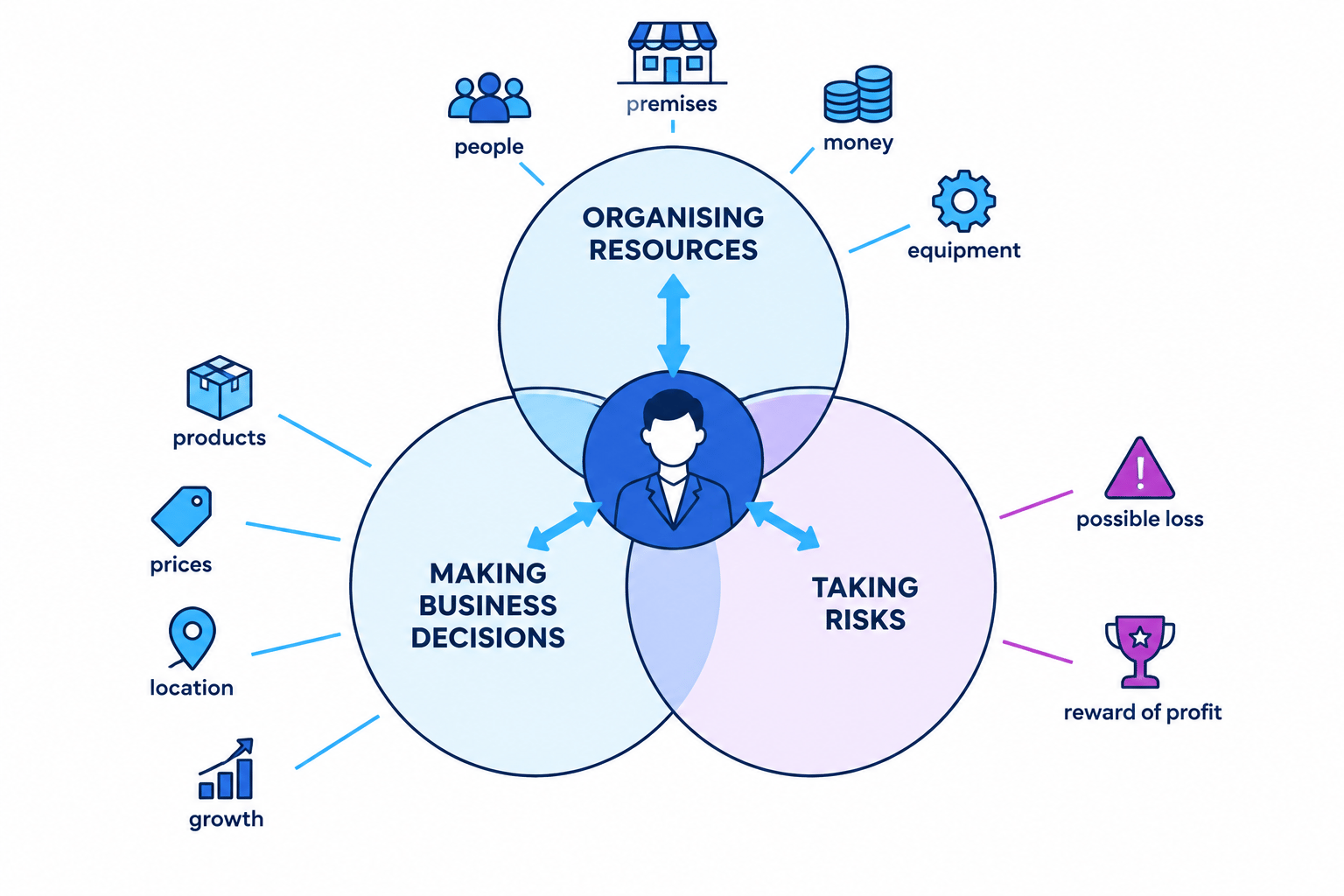
Entrepreneur: the person who sets up and runs a business, organising its resources, making its decisions and carrying the risk of it failing.
- Edexcel gives the entrepreneur three roles, and exam questions come from all three: organising resources, making business decisions and taking risks.
- The three run together rather than in sequence, since a decision about which supplier to use is also a decision about how much risk to carry.
Organising resources: getting the right inputs in the right amounts
- Organising resources means gathering everything the business needs and combining it so the business can trade.
- Premises and materials: somewhere to trade from, plus the stock or raw materials the product is made of.
- People: the staff and the skills they bring, from a single part-time assistant upwards.
- Money and equipment: the cash to pay the bills before customers pay, and the machinery, vehicles and tills the work needs.
- Getting the amounts right matters as much as getting the resources at all, since too much stock ties up cash the business needs for its rent and may end up thrown away.
- Too few staff means customers queue and leave, so the sale is lost even though the product was there.
Note
Where the money to buy those resources comes from is examined as sources of finance in 1.3.4.
Making business decisions: the choices nobody else will make
- In a small business there is no manager above the owner, so every decision that matters lands with them.
- What to sell and what to charge: which products to stock, which to drop when they stop paying, and a price high enough to cover costs but low enough that customers still come.
- Where to trade and who to employ: a high-street unit with passing customers and high rent or an online shop with lower costs and less visibility, and how many staff the takings can support.
- Whether to grow: taking on a second site or a larger order means spending before the extra revenue arrives.
- Start-up decisions are made quickly and with incomplete information, because waiting for certainty hands the opening to someone else.
- Each choice also closes another one off, since money spent on a delivery van is money not spent on advertising.
Common Mistake
- Do not describe an entrepreneur as simply "someone who owns a business".
- A shareholder owns part of a business without organising anything or making any decisions.
- Use Edexcel's three roles, since the mark scheme is built around organising resources, making decisions and taking risks.
Taking risks: the role that cannot be handed to anyone else
- An entrepreneur can pay someone else to do the accounts or run the shop, but the loss still falls on them if it fails.
- The risk is what earns the reward, because the profit left after everyone else has been paid belongs to the owner.
- Staff are paid their wages and suppliers are paid for their stock whether the week was busy or quiet, so the owner is paid last and only if anything is left.
Example
- Levi Roots was selling his Reggae Reggae Sauce before he appeared on Dragons' Den in 2007.
- He organised resources by winning £50,000 of investment and finding a manufacturer able to bottle the sauce in volume.
- He made decisions by giving up control of a share of the business in exchange for the money and contacts to reach supermarket shelves.
- He took the risk, since scaling from a market stall to a Sainsbury's listing meant committing to production runs before knowing whether shoppers would buy.
Judging which role decides whether an entrepreneur succeeds
- Which role matters most depends on the business. In a stock-heavy business, organising resources may be critical because too much cash can be tied up in inventory.
- In a fast-moving market, decision making may matter more; in an untested market, willingness to take risk may be decisive.
- Overall, taking risk gets the business started, but sound organisation and decisions are what make that risk sustainable.
Exam technique
- When a question asks about the role of an entrepreneur, pick one of the three roles and develop it rather than listing all three thinly.
- Show the role in action in the named business: not "she organises resources", but "she hired two part-time staff for Saturdays so the queue clears at the busiest hour".
- The mark most often dropped is the consequence, because answers name what the entrepreneur does and never say what it does for the business.
- On a justify or evaluate question, judge which role matters most for that particular firm and say why, rather than concluding that all three are important.
Self review
- Name the three roles of an entrepreneur.
- Give three kinds of resource an entrepreneur has to organise, with an example of each.
- Why does holding too much stock cause a problem for a small business?
- Why is the owner paid last out of the money the business takes?
- In an untested market, which of the three roles matters most, and why?