Adding value: the gap between what your inputs cost and what customers pay
Added value: the difference between the price a customer pays and the cost of the bought-in materials used to make the product.
- A business adds value when it does something to its inputs that makes a customer willing to pay more than those inputs cost.
- It is worked out as added value=selling price−cost of bought-in materials\text{added value} = \text{selling price} - \text{cost of bought-in materials}added value=selling price−cost of bought-in materials.
Take a café selling a flat white for £3.40, where the beans, milk, cup and lid cost £0.45.
added value=£3.40−£0.45=£2.95\text{added value} = \pounds 3.40 - \pounds 0.45 = \pounds 2.95added value=£3.40−£0.45=£2.95
That £2.95 is not profit, because it still has to cover the rent, the wages, the electricity and the machine repairs.
- Do not confuse adding value with adding cost.
- Spending an extra £1 on packaging only adds value if customers will pay more than £1 extra because of it.
- Do not confuse added value with profit either, since added value comes before wages, rent and bills are taken off.
Five ways a business adds value
Branding: the name, logo and reputation that make customers recognise a product and pay more for it than for an identical unbranded one.
Unique selling point (USP): the one feature a product has that no rival offers, which gives customers a reason to choose it.
- Edexcel names five routes to added value, and a business can use more than one at once.
- Convenience: customers pay more to save time or effort, which is why the same bottle of drink costs 65p in a supermarket and £1.80 at a motorway service station.
- Branding: a plain cotton t-shirt sells for £5, and the same shirt with a Nike tick on it sells for £25, because the name carries a reputation the plain one does not.
- Quality: better materials and workmanship let a business charge more, which is why a pair of Dr Martens boots at £160 outsells cheaper boots among customers who expect to wear them for years.
- Design: how a product looks and how well it works can justify a much higher price, as Dyson does by selling vacuum cleaners at several times the price of a basic model.
- Unique selling point: offering something no rival does, such as a bakery that is the only one in town making gluten-free bread, means customers who need it have nowhere else to go.
- The five overlap in practice, since a strong brand is usually built on quality and design that customers noticed first.
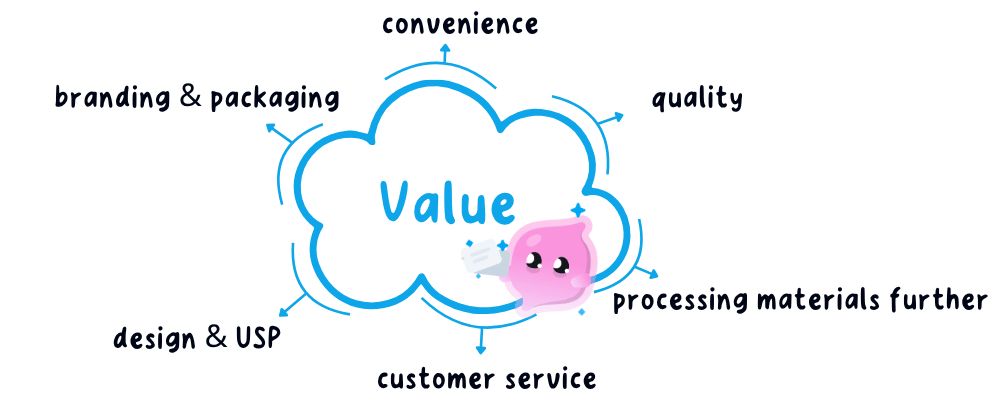
For GCSE Edexcel, focus on the five routes named in this article: convenience, branding, quality, design and a unique selling point. The diagram also shows other common ways a business may add value.
- Innocent sells a smoothie for around £2.75 when the fruit inside it costs a fraction of that.
- The convenience is that the fruit is already blended and chilled, ready to drink on the way to work.
- The branding is the friendly label and the promise of nothing but fruit, which shoppers trust enough to pay more for.
- A supermarket own-brand smoothie sitting next to it uses similar fruit and sells for about half the price.
- The price gap between the two is the added value the brand has created.
What a business gains from adding value
- Adding value changes what a business can charge, and that has three consequences worth knowing.
- A wider gap between price and material cost leaves more money to cover fixed costs, so the business breaks even on fewer sales.
- It lets a small firm compete without being the cheapest, which matters because a price war against a supermarket is one it cannot win.
- Customers who buy for the brand or the quality come back, so repeat sales cost less to win than new ones.
Added value sits behind much of Theme 2, so keep the detail of the design mix and pricing strategies for 2.2 and stay on the five routes here.
Where adding value fails to pay off
- Adding value is not free, and four things stop it working.
- It costs money up front: advertising, better packaging and staff training all have to be paid for before any extra revenue arrives.
- Better quality raises input costs: if the materials cost 80p more and customers will only pay 50p more, added value per unit has fallen.
- Customers have to notice and care: in a market where shoppers compare price alone, a better design earns nothing.
- Rivals copy it: a unique selling point stops being unique once a competitor offers the same thing, so the price premium fades.
- When household budgets tighten, customers trade down from branded goods to supermarket own-brands, which shows added value depends on the customer being willing as well as the business being clever.
- Calculate questions here give you a selling price and a materials cost, so subtract one from the other and label the answer in pounds.
- A correct figure earns the marks even without working, but write the subtraction anyway so a slip still shows the method.
- Then say what the number means, since "£2.95 per cup must cover rent and wages before any profit" is where the extra marks sit.
- On an "explain how this business adds value", name one of the five routes in Edexcel's own words and tie it to something in the source booklet.
- State the formula for added value.
- A sandwich sells for £4.20 and its ingredients cost £1.10, so how much value is added?
- Name the five ways Edexcel says a business can add value.
- Why is added value not the same as profit?
- Give one reason a unique selling point may stop adding value over time.
