What gross profit and net profit each measure
Definition
Gross profit: what is left out of sales revenue once the direct cost of the goods sold has been taken off.
Net profit: what is left out of gross profit once the other operating expenses and the interest have been taken off.
Gross profit
gross profit=sales revenue−cost of sales \text{gross profit} = \text{sales revenue} - \text{cost of sales} gross profit=sales revenue−cost of sales- This answers whether the product itself makes money, because the only cost taken off is the cost of the goods that were sold.
Net profit
net profit=gross profit−other operating expenses and interest \text{net profit} = \text{gross profit} - \text{other operating expenses and interest} net profit=gross profit−other operating expenses and interest- This answers whether the whole business makes money, because every running cost has now been paid out of what the trading earned.
- There are two profit figures because those are two different questions, and a business can be strong on one and weak on the other.
- A firm with a healthy gross profit and a thin net profit is selling its product well but paying too much to keep the doors open.
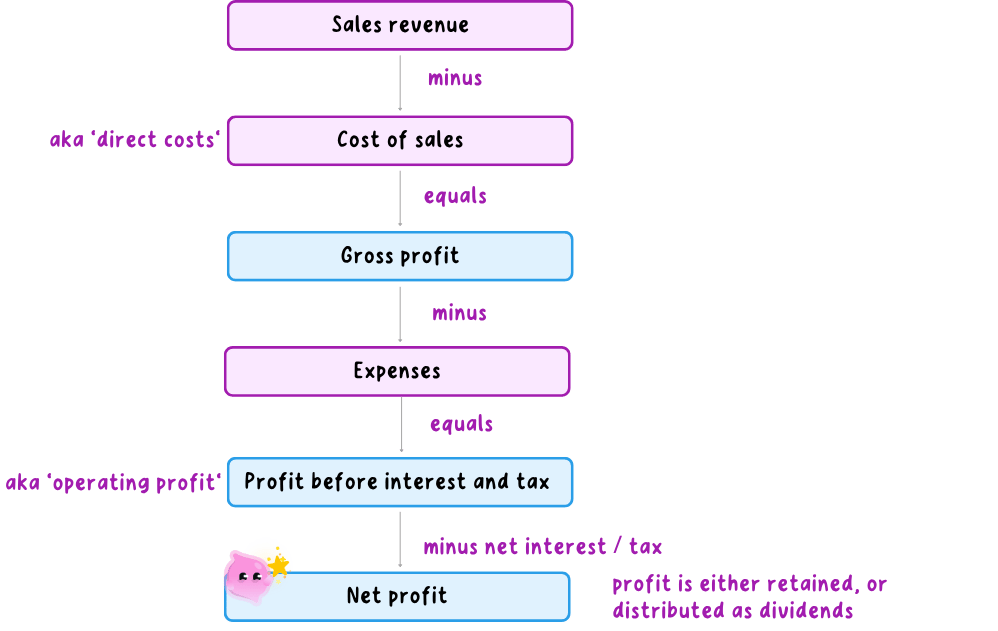
Note
This diagram shows a fuller income-statement flow than you need here. For GCSE Edexcel, focus on gross profit and net profit. “Profit before interest and tax” is also commonly called operating profit.
The figures set out in full: two trading years
- The lines below are one business over two years, each column read downwards from sales revenue at the top to net profit at the bottom.
| £ | 2025 | 2026 |
|---|---|---|
| Revenue | 250,000 | 264,000 |
| Cost of sales | 150,000 | 171,600 |
| Gross profit | 100,000 | 92,400 |
| Other operating expenses | 64,000 | 66,000 |
| Interest | 6,000 | 6,600 |
| Net profit | 30,000 | 19,800 |
Working down the figures: what each line means
Definition
Interest: the charge a business pays on money it has borrowed, which is taken off below gross profit alongside the other operating expenses.
Example
- Cost of sales: the direct cost of the goods actually sold, such as the materials in a product or the stock a shop has bought in.
- It is not the cost of running the business, so rent, wages and insurance never belong on this line.
- Gross profit
- This is the 2025 gross profit.
- That £100,000 is everything the trading itself produced before a single running cost has been paid.
- Other operating expenses: rent, wages, energy, insurance and marketing, the costs of keeping the business open whatever it sells.
- Interest: it sits below gross profit because it is the price of borrowed money rather than a cost of the goods, so it never touches the gross profit line.
- A business carrying a large loan can therefore report a strong gross profit and a weak net profit for that reason alone.
- Net profit
- This is the 2025 net profit.
- Only this bottom figure is money the owner can act on, since it is what remains to put back into the business or take as income.
Reading the change from 2025 to 2026: revenue up, profit down
Example
- Revenue: revenue rose by £14,000 between the two years, which on its own looks like the better year.
- Gross profit: gross profit fell by £7,600 all the same, down from £100,000 to £92,400.
- Cost of sales rose by £21,600 over the same period, far faster than the £14,000 rise in revenue.
- Cost of sales as a share of revenue
- The first figure is 2025 and the second is 2026.
- Every £1 of sales cost 60p to buy in and now costs 65p, so either suppliers have raised their prices or the business has discounted to shift stock.
- Net profit: net profit fell by £10,200, a wider drop than the £7,600 lost at the gross profit line.
- Other operating expenses rose from £64,000 to £66,000 and interest rose from £6,000 to £6,600, so the shortfall grew as it travelled down the page.
- A rising interest charge points at extra borrowing taken on during the year, and that is a cost the owner carries into the next one.
- The owner should investigate the 5p rise in the cost of every £1 sold before anything else, because reversing it lifts every line beneath it.
Common Mistake
Do not read a rise in revenue as a rise in profit, because this business sold £14,000 more and still ended the year £10,200 worse off.
Exam technique
- Recall both formulas and keep gross profit separate from net profit.
- For calculations, classify the costs correctly, show the formula and figures, then give the answer with a £ sign.
- For explanation or analysis, say what the profit figure or change means for the business rather than leaving the number on its own.
Self review
- State the formula for gross profit and the formula for net profit.
- A business has revenue of £80,000, cost of sales of £45,000, other operating expenses of £20,000 and interest of £3,000, so what are its gross profit and its net profit?
- Which costs belong in cost of sales, and which belong in other operating expenses?
- Why did gross profit fall in 2026 in a year when revenue rose?
- A firm has a healthy gross profit but a weak net profit, so where should the owner look first and why?
