What quality means: doing reliably what the customer was promised
Definition
Quality: how reliably a good or service does the job the customer who bought it was promised it would do.
- The standard is set by the target customer's expectations, and the same test covers a service, so a delivery that arrives inside the slot the customer was given is quality output just as a boot that lasts five winters is.
- Quality is not the same as being expensive, because a budget product is high quality when it does exactly what it promised: a Greggs sausage roll bought for a low price is a quality product if it is hot, fresh and the same in every shop.
Note
- Failing that standard brings refunds, rework and customers who do not come back.
- What maintaining quality does to a firm's costs and its competitive advantage is the next guide, 2.3.3b.
Quality control: checking the finished product and taking the faults out
Definition
Quality control: inspecting the finished product at the end of the process and removing the faulty ones, using inspectors rather than the workers who made it.
Quality assurance: building quality into the process itself so that faults are prevented, with every worker checking their own work as they go.
- Faults are caught before they reach the customer, so complaints and refunds fall and the shopper never sees the item that failed.
- It is cheap and simple to run, because only the inspectors need training in the standard and one checking point at the end is easier to organise than checks at every stage.
- The faulty item has already been paid for and its cause is left in place, so the materials, machine time and wages that went into a scrapped unit are lost and the setting or careless step behind it repeats the fault tomorrow.
- Quality becomes somebody else's job, so the people on the line have no responsibility for it and may pass on work they already know is poor.
Quality assurance: building quality in as the work is done
- Each worker checks their own output against an agreed standard before passing it to the next stage, so the checking runs all the way through the process instead of happening once at the end.
- A problem is found at the stage it occurs, so fewer faulty units are ever finished and less material and labour is thrown away as scrap or spent on rework.
- Staff carry the standard themselves, which tends to raise motivation because the work leaving their bench is judged as theirs rather than as an inspector's problem.
- It costs more to set up, because procedures have to be agreed and written down and every worker has to be trained, not just a handful of inspectors.
- It takes time to embed, so the training bill is paid months before the saving on wasted output shows up in the accounts.
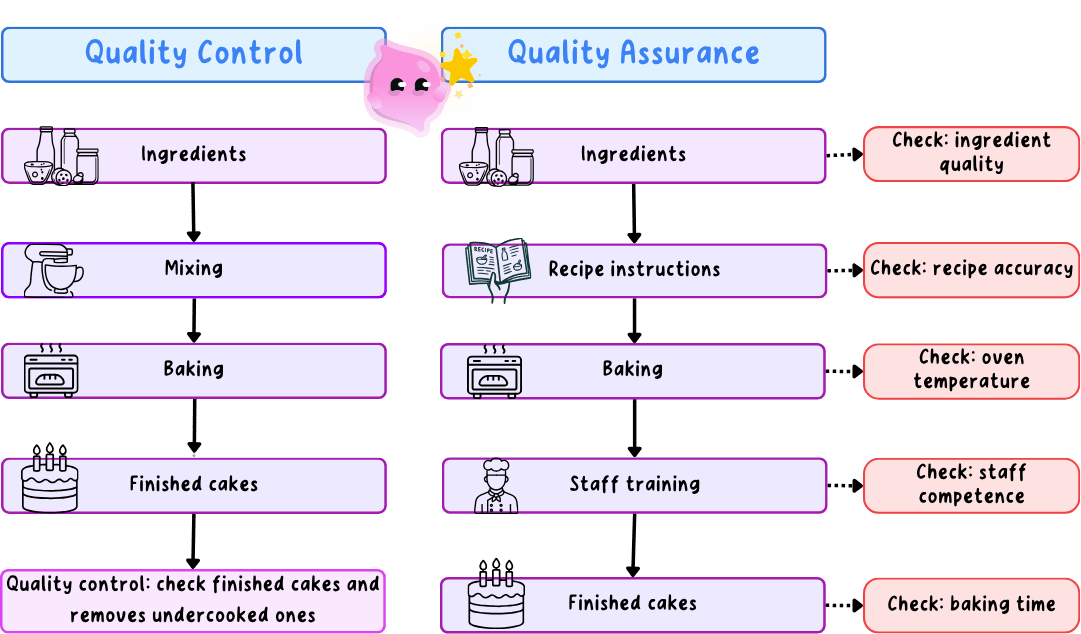
The two approaches split on four things, set side by side below.
| Quality control | Quality assurance | |
|---|---|---|
| When checking happens | Once, at the end | At every stage |
| Who is responsible | Separate inspectors | Every worker |
| Faulty output | Scrapped or reworked | Mostly never made |
| Cost | Low to start, waste continues | High to start, waste falls |
Judging which approach to use: it turns on what a fault would cost
- Quality assurance is more valuable when a fault would be expensive, damage a premium reputation or be repeated many times by flow production; quality control can be enough for cheap, simple output where a rejected unit costs little.
- The business must also be able to afford the up-front procedures and training: assurance costs more now but can cut waste later, while control is cheaper to start but allows the causes of faults to continue.
- Overall, choose by comparing the cost of preventing faults with the likely cost of one fault reaching the customer in that particular business.
Exam technique
- Identify whether the business uses end-of-process inspection or checks at every stage, then trace the effect through faults, waste and customer outcomes.
- For a judgement, compare the training and set-up cost with what a fault reaching the customer would cost this firm.
- Do not claim quality assurance removes faults completely; it is designed to prevent and reduce them rather than guarantee zero faults.
Self review
- What does quality mean in business?
- Why can a low-priced product still be a high quality one?
- Who does the checking under quality control, and at what point?
- Give one advantage and one drawback of quality assurance.
- Name two things that decide which approach suits a business.
