Logistics decisions and the costs that move with them
Definition
Logistics: moving, storing and delivering goods along the supply chain, from materials arriving at the factory to the parcel reaching the customer.
Lead time: the gap between placing an order with a supplier and the goods actually arriving.
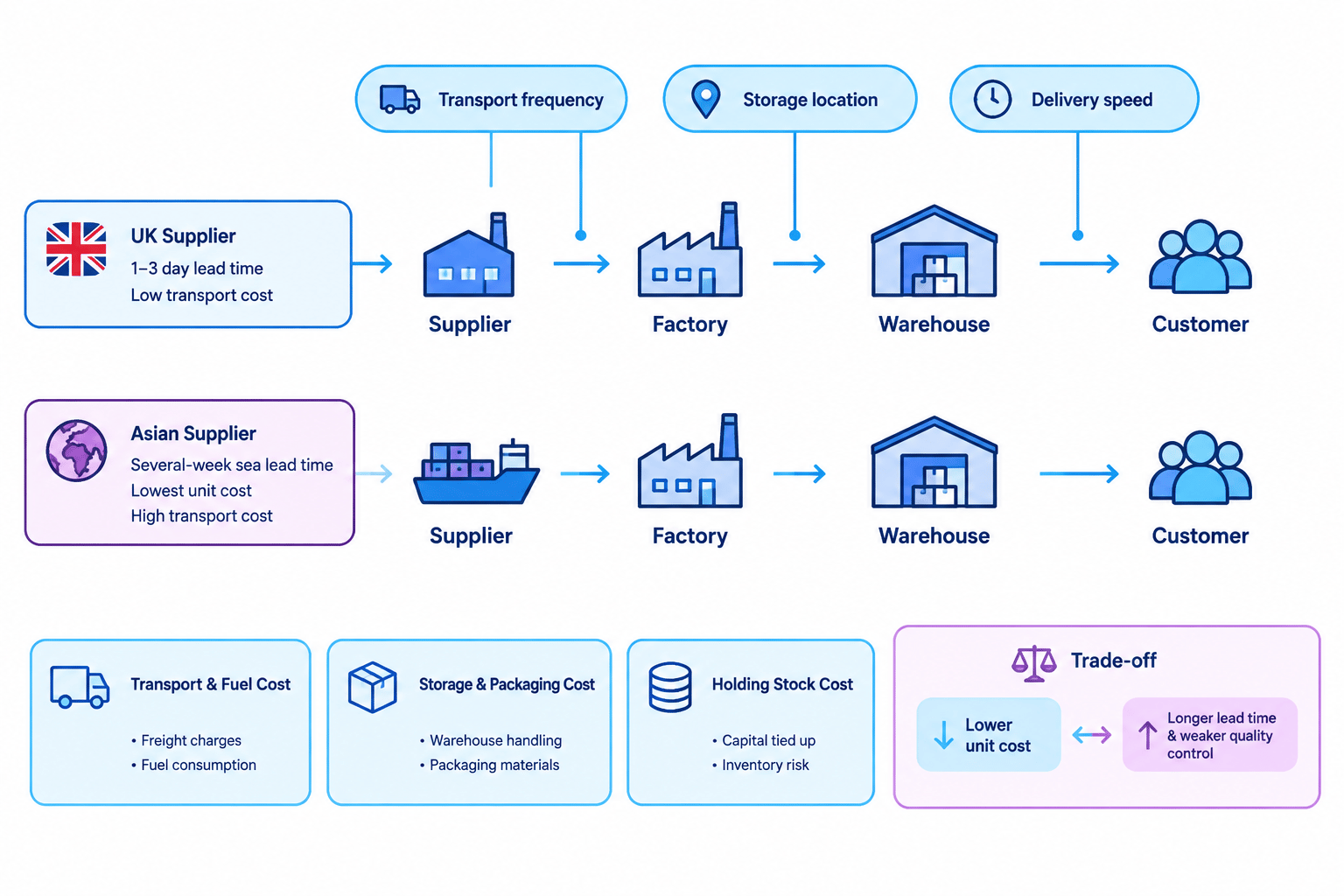
- Every logistics decision sets who carries the goods, how often they arrive and where they sit in between, and three groups of cost move with those choices.
- Transport and fuel: the further the goods travel and the more often the lorries run, the more diesel, driver hours and vehicle wear the business pays for.
- Storage and packaging: warehouse rent, heating, refrigeration and the stronger boxes a long journey needs are all paid before a single item is sold.
- Holding stock: money tied up in stock sitting on a shelf cannot be spent on anything else, and that stock can still be damaged, stolen or go past its date.
- One full lorry a week spreads the driver, fuel and vehicle cost over far more items than five small vans do, so frequent small deliveries cost more per unit even though they leave less stock sitting in the warehouse.
- Speed is the other lever and it always costs more, since air freight arrives in days where sea freight takes weeks, and a next-day courier charges more per parcel than a three-day service.
- That forces a choice between charging the customer £4.95 for next-day delivery and risking a dropped basket, or absorbing the cost as free delivery, which cuts the profit on every order and only pays if it wins enough extra ones.
The impact on reputation and on the customer: a delivery date is a promise
- Goods that arrive late or damaged reach the customer as a broken promise by the business whose name is on the box, not by the haulier it quietly hired to save money.
- Online reviews make that failure public within hours, so a one-star review about a missing parcel is read by shoppers who were never affected and who now buy elsewhere.
- Where the materials come from lands on reputation too, because customers and pressure groups ask about pay, working conditions and pollution in the factories a brand buys from, and a business that never checks its own supply chain hears about a problem at the same time as everyone else.
- Amazon offers next-day delivery on much of its range, so shoppers now treat fast, tracked delivery as normal and an online seller offering only a five-day courier looks slow even when its product is better.
- Delivery speed and reliability are therefore part of what the customer is buying, so a good product delivered late still loses the next sale and a firm that always delivers in three days keeps more customers than one that promises next day and misses one order in ten.
Sourcing at home or sourcing abroad
Buying abroad usually cuts the unit price because wages, land and materials cost less in many exporting countries, and the table sets out what that saving costs everywhere else.
| UK supplier | European supplier | Supplier in Asia | |
|---|---|---|---|
| Unit cost | Highest | Middle | Lowest |
| Lead time | One to three days | About a week | Several weeks by sea |
| Transport cost | Low | Medium | High |
| Checking quality in person | Easy | Possible | Very hard |
| Exchange rate risk | None | Yes | Yes |
- Read the table down the columns rather than across the rows, because the lowest unit cost sits in the same column as the longest wait and the weakest control over how the goods are made.
- Exchange rates add a risk a UK supplier does not, since a fall in the pound after the order is placed means the same shipment costs more pounds than it did when the price was agreed.
- That is why fresh, bulky and fast-changing products are usually bought close to home, while stable, high-volume products with a long shelf life are the ones worth shipping halfway round the world.
Judging it: should a business always take the cheapest supply option?
- The cheapest supplier can lower costs and support a lower price, but that advantage disappears if longer lead times, unreliable delivery or poor quality create refunds, lost sales or reputational damage.
- The best choice depends on how much customers value speed and reliability, how visible the supply chain is, and how costly one failed delivery would be.
- Overall, a price-led business with stable products may accept a cheaper distant supplier, while a business competing on service or reputation is more likely to benefit from paying more for reliability and control.
Exam technique
- Identify whether the question is about costs, reputation or customer satisfaction, then trace the supply decision to that impact.
- Use the delivery times, prices and business model in the source booklet rather than a memorised example.
- For a judgement, weigh the saving against the likely cost of a failed or slow delivery and commit to the better supplier choice.
Self review
- Name three groups of cost that change when a business alters its logistics.
- Define lead time.
- Why do frequent small deliveries cost more per unit than fewer large ones?
- Give two things a business gives up when it sources from a supplier abroad instead of a UK one.
- Why does a late delivery damage the seller's reputation rather than the haulier's?