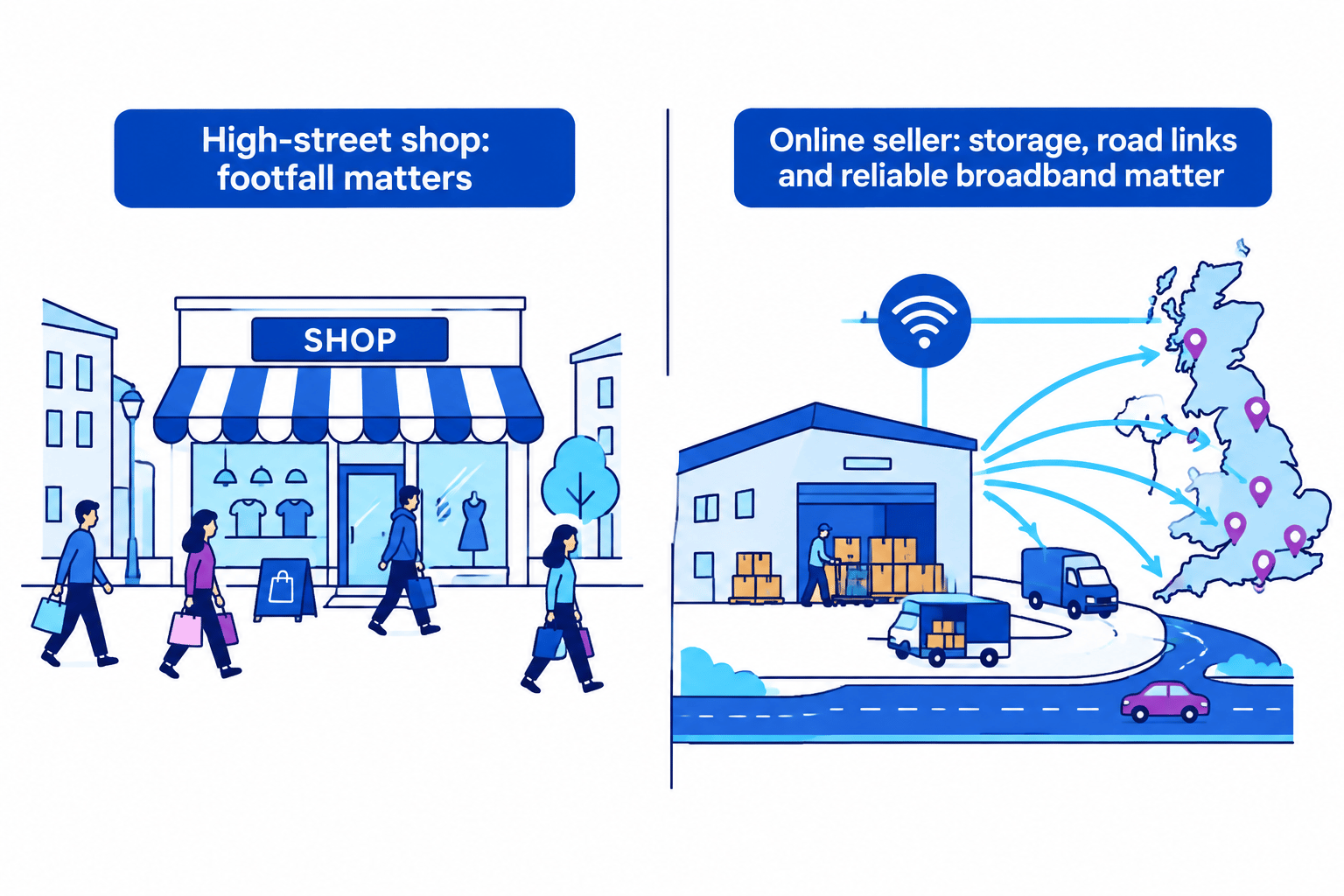
E-commerce and location: the customer no longer travels to you
Definition
E-commerce: buying and selling goods and services online instead of through a physical shop.
- E-commerce weakens the pull of being near the market, because the customer now reaches the business through a website instead of walking through a door.
- A firm can sell to the whole country from an industrial estate unit at £600 a month instead of a high-street shop at £3,000, and the same budget then buys several times the floor space.
- Selling online also widens the market, because a business in a small town can reach buyers across the UK, and abroad, without opening a second site.
- Potential sales rise while premises costs stay flat, since no extra rent, business rates or shop staff are needed to serve those extra customers.
Example
- Gymshark was founded in 2012 by Ben Francis in Birmingham, screen-printing gym clothing in a garage.
- It sold online through fitness influencers rather than from a shop, so it reached customers nationally without renting a single high-street unit.
- A market stall would have limited it to the people who walked past that stall, and the website carried no such limit.
What an online business needs from a site instead of footfall
- Location still decides an online seller's costs, but the site is judged on three things rather than on passing trade.
- Storage space: stock has to sit somewhere, and a warehouse gives far more square metres per pound of rent than a shop does.
- Road links: couriers collect every day, so a unit near a motorway junction gets parcels into the delivery network sooner and shortens the delivery time the business can promise.
- Reliable broadband: orders, payments and stock records all run through the website, so a slow or unreliable connection stops the business trading altogether.
- Being close to a delivery network now matters more than being close to shoppers, which is why warehouses sit beside motorways while shops sit in town centres.
Example
- ASOS sells clothing online rather than through high-street shops, so it never pays for a prime retail site.
- Amazon judges a site by how quickly parcels can leave it, so a warehouse with good road access beats a unit on a busy shopping street.
- The rent saved goes into stock, packing staff and cheaper delivery, which is the part the online customer actually notices.
The internet also widens competition and adds new costs
- The internet widens your market and every rival's market at the same moment, so your local customers are now within reach of sellers based anywhere.
- A local shop no longer has a captive local market, because a customer standing in the aisle can check the same product on eBay or Etsy before deciding to buy.
- Trading online carries its own costs, since the website, the packaging, the delivery and the returns all come out of the margin the shop used to keep.
- Returns bite hardest in clothing, where one customer may order three sizes and send two back, so the business pays postage twice and earns revenue on a single item.
Note
- The internet changes which location factors matter, not whether location matters at all.
- Rent, road links and delivery costs still shape the decision, they simply outrank footfall once the selling happens online.
- How technology affects place and the rest of the marketing mix belongs to the marketing mix guides, not to this one.
Where footfall still decides, and why many firms now do both
Definition
Click and collect: ordering online and collecting the goods from a shop or collection point instead of paying for delivery.
- E-commerce only removes the need for footfall where the product can be boxed and posted.
- A hairdresser, a dentist, a gym and a restaurant each deliver the service in person, so the customer still has to travel and passing trade still decides the site.
- Many businesses now run both channels, with a shop for browsing and trying on and a website for ordering, which is why Tesco offers click and collect.
- The store then earns its rent twice, as a place to shop and as a collection point that saves the cost of sending a courier to every door.
Exam technique
- Start a location answer by deciding whether the business posts a product or delivers a service in person, because that settles whether the internet helps it at all.
- Build the chain in full: selling online removes the need for footfall, so the firm takes a cheaper unit, so fixed costs fall, so it can undercut a high-street rival.
- Name the cost on the other side, since delivery, packaging and returns eat into the rent saving and a one-sided answer stalls in the middle level.
- When the question says justify or evaluate, tie the judgement to the firm in the source booklet, because a barber and an online clothing seller land on opposite answers.
Self review
- Define e-commerce.
- Give two things an online seller needs from its premises that a high-street shop does not.
- Explain one reason the internet raises competition for a small local shop.
- Name two costs a business takes on when it starts selling online.
- Why does the internet not change the location decision for a hairdresser?