The marketing mix: four decisions taken as one set
Definition
Marketing mix: the combination of product, price, promotion and place a business uses to sell a product to its chosen customers.
- The marketing mix is the set of four decisions a business makes about how it sells: what the product is, what it costs the customer, how customers hear about it and where they can buy it.
- Every business has a mix even if nobody sat down and planned one, because a market stall that sells one item at one price in one location has still made all four decisions.
- The four are chosen together rather than one at a time, since a customer sees a single offer and judges the whole of it before deciding whether to buy.
Analogy
- Treat the mix as a recipe with four ingredients rather than four separate dishes.
- One ingredient badly wrong spoils the meal however good the other three are, which is why a business that fixes only its promotion often sees no rise in sales.
- Different customers want different recipes, so the same four ingredients are blended in different proportions for different target markets.
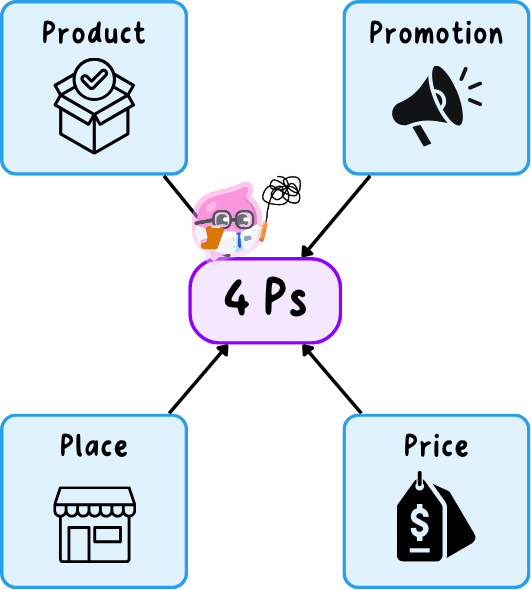
What each element decides and why it matters
- Each element answers a different question, and all four have to be answered before a product reaches a buyer.
- Product: the decision about what is actually sold, covering what it does, its quality, its features and how it looks.
- It matters most, because a product that does not meet the customer need cannot be rescued by the other three: cutting the price or advertising harder only tells more people about something they still do not want.
- The product also sets the limits for the rest of the mix, since a hard-wearing, well-designed item supports a higher price than a basic one.
- Price: the decision about what the customer is charged.
- It decides whether customers buy at all, because a shopper choosing between two similar coats normally takes the cheaper one unless something else justifies the gap.
- It also decides how much is left on each sale once costs are paid, so a price set too low can pull in customers and still leave the business losing money on every unit.
- Promotion: the decision about how customers are told the product exists and are persuaded to buy it.
- A product nobody knows about does not sell however good it is, so promotion is what turns a strong product into actual revenue.
- Promotion also signals what kind of product this is, so the message has to match the quality being offered and the price being charged.
- Place: the decision about where and how the customer can buy it, such as a shop, the firm's own website or a marketplace like Amazon or Etsy.
- A customer who cannot buy it conveniently buys something else instead, so awkward availability hands the sale to a rival that is easier to reach.
- Place has to suit the customer being targeted, since a shopper on a lunch break wants somewhere they already walk past while a gift buyer may want to see the item before paying.
Example
- Greggs sells cheap hot food, a product built for a fast, low-cost lunch.
- Prices are low and the shops sit on high streets and retail parks where people already pass by, so the price and the place both suit a lunchtime customer in a hurry.
- The vegan sausage roll it launched fits the same mix: a cheap hot item, in the same shops, aimed at the same customer with one more need met.
- All four elements point at one group of buyers, which is what makes the mix work rather than any single clever decision.
Why all four have to point the same way
- Every element sends a signal about who the product is for, so the mix only works when the four signals agree.
- Dyson sells bagless vacuum cleaners on design and engineering at a premium price, so its promotion talks about the technology inside the machine rather than about a bargain.
- Selling the same machine cheaply from a market stall would undercut that message, because customers would read the low price and the makeshift place as evidence of low quality and stop believing the premium claim.
- The reasoning runs in a chain: a strong product justifies a high price, a high price needs promotion that signals quality, and that promotion needs a place that matches, which means one element out of line weakens the other three and the business loses sales it had already paid to win.
- How a business then balances the mix against its competitors and changing customer needs is covered in the next guide.
Exam technique
- Name all four elements exactly as product, price, promotion and place, because a mix answer that misses one drops the knowledge mark straight away.
- For each element, say what it decides and then what that does to sales, costs or the firm's image, since the mark sits in the effect and not in the label.
- On a question asking which element matters most, argue it through the others: promotion cannot fix a product customers do not want, so product usually comes first.
- Keep pricing strategies, promotion methods and distribution channels out of a Theme 1 answer, because those belong to the Theme 2 questions on making marketing decisions.
Self review
- What is the marketing mix?
- Name the four elements of the marketing mix.
- Why can strong promotion not rescue a product that customers do not want?
- Which element decides how much is left on each sale after costs are paid?
- Give one reason a premium product should not be sold cheaply from a market stall.
