Proximity to market, labour, materials and competitors: four pulls on one site
Definition
Proximity: how close a business is to something it depends on, such as its customers, its workers or its suppliers.
Footfall: the number of people passing a site, which for a shop or a café is the main source of possible customers.
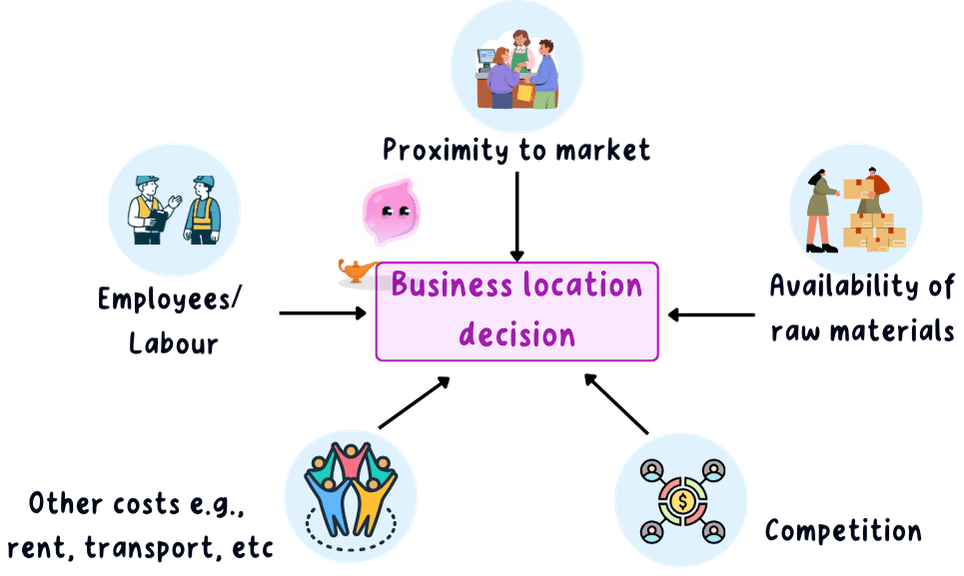
- A business can only occupy one site at a time, so four pulls compete for the decision and they rarely point to the same street.
- Proximity to the market: being near customers matters most where the customers travel to the business, such as a café, a hairdresser or a corner shop.
- Passing trade is then the main source of sales, so the same shop takes more money on a busy street than on a quiet side road without spending a penny more on advertising.
- Proximity to labour: the site has to be somewhere the right staff already live and can travel to by car or on public transport.
- This decides the choice where specific skills are needed or where wages are a large share of costs, because a firm that cannot fill its shifts locally has to raise pay to pull workers in from further away.
- Proximity to materials: being near suppliers cuts the cost and the time of bringing inputs in.
- It matters most where materials are heavy, bulky or perishable, such as a bakery in Leeds taking a daily flour delivery, since transport costs climb with every mile and fresh stock loses value in transit.
- Proximity to competitors: a business sometimes locates away from its rivals so that it does not split the same customers with them.
- Sometimes it locates deliberately near them, because a street known for restaurants or a road known for car dealerships pulls in more customers for everyone on it, and the bigger crowd outweighs having to share it.
Example
- Greggs puts shops on high streets and in retail parks, where people are already walking past on the way to work or to the shops.
- Cheap hot food sold in high volume only works if enough people pass the door every hour.
- A quieter site would cut the rent bill, but it would cut the passing trade the whole model runs on.
Nature of the business activity: what the firm does decides which pull wins
- The nature of the business activity settles which of the four factors dominates, so there is no single best location for every firm.
- A manufacturer: weighs materials and space, so an industrial unit near a motorway junction beats a town-centre shop it could not get a lorry into.
- A retailer: weighs footfall above everything, because a shop nobody walks past takes no money however low the rent is.
- An online business: weighs delivery links and the cost of storage, and does not weigh footfall at all, since no customer ever visits the unit.
Note
How the internet and e-commerce widen the choice of where a business can trade from is covered in the next guide, 1.4.2b.
Cost of the site: the constraint running through every factor
- Cost cuts across all four pulls, because the best located sites are the ones landlords can charge the most rent for.
- A start-up short of cash often takes a cheaper site off the main street and spends the difference on promotion instead.
- That swaps passing trade for a smaller rent bill, which the business has to cover whether it sells anything or not, so the choice only pays off if the promotion brings in customers who would otherwise have walked past a rival.
Judging which factor matters most: it depends on the type of business
- No factor wins in every case, so decide which matters most by asking who travels to whom.
- Where the customer travels to the business, as at a café or a hairdresser, proximity to the market decides it, because footfall is the only source of sales and no saving on rent replaces the customers a quiet site never delivers.
- Where the business travels or ships to the customer, proximity to the market barely counts, and cheap space near good road links counts for more.
- It also depends on the rent the firm can afford, on whether its customers come to it or it goes to them, and on how much of its selling is done online.
- Overall, proximity to the market is the deciding factor for a small retailer or service business, while for a manufacturer or an online seller the cost of space and access to materials outweigh it.
Exam technique
- Name the factor, say why it matters to that firm, then say what it does to the firm's sales or its costs.
- A memorised list of four factors with no ranking stays in the bottom level when the question says justify or evaluate.
- Use the detail in the source booklet, such as what the firm sells and where its customers are, to choose the factor you argue for.
- Land the judgement in comparative form: footfall matters more than rent here, because the café depends on passing trade.
Self review
- Which type of business gains most from being close to its market, and why?
- Give one reason a business might choose to locate close to its competitors.
- Which two location factors matter most to a manufacturer?
- Why does footfall not matter to an online seller?
- Name two things that decide which location factor is the most important for a firm.
