What a stakeholder is: any group with a stake in what the business does
Definition
Stakeholder: any individual or group with an interest in a business and how it performs, and who is affected by the decisions it takes.
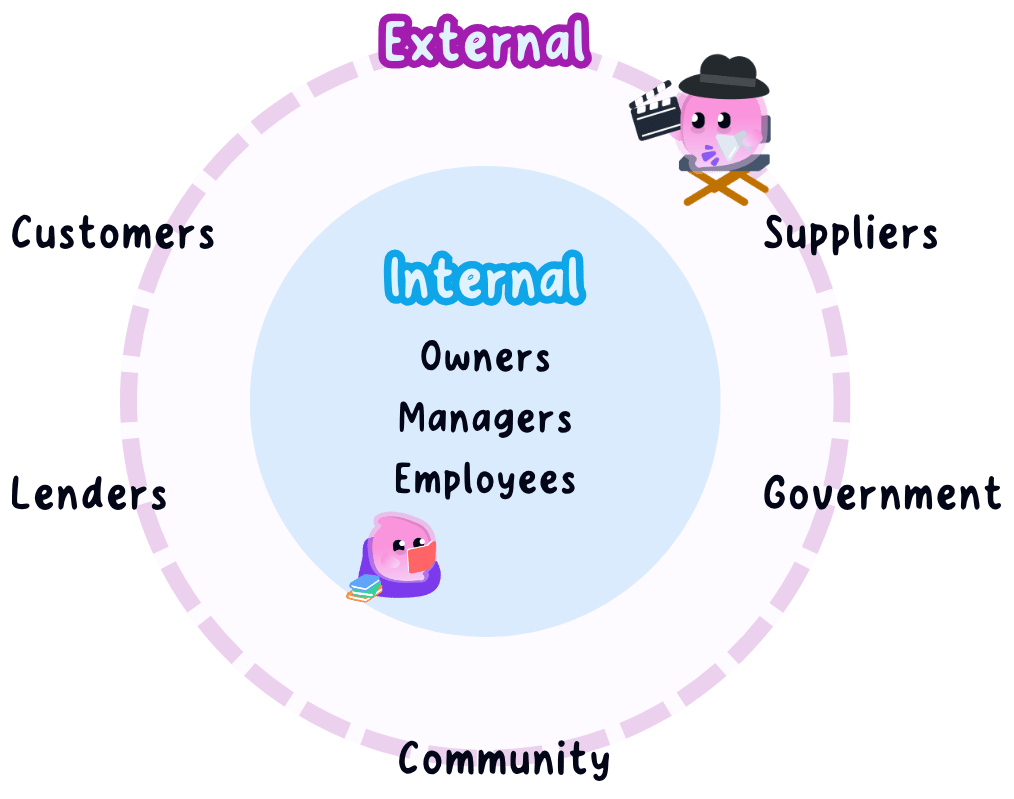
Internal and external stakeholders: internal stakeholders own the business or work inside it, while external stakeholders deal with it from outside.
- Having an interest means a decision by the business changes something that group cares about, such as its wages, its prices, its profit or the traffic on its street.
- Edexcel names eight stakeholder groups, and they divide into two sets by where each group sits.
- Internal: shareholders, employees and managers, who put money, labour or decisions into the business itself.
- External: customers, suppliers, the local community, pressure groups and the government, who meet the business as buyers, sellers, neighbours, campaigners or regulators.
- Every business has stakeholders whether it plans for them or not, from a market stall with one wholesaler and thirty regulars to Tesco with millions of shareholders and shoppers.
The internal stakeholders: what owners, staff and managers want
- An internal stakeholder's objective follows from what they put into the business and what they stand to lose.
- Shareholders (owners): a return on the money they invested, taken as a share of the profit and as a rising share value, plus a say through their vote in how the business is run, because they carry the loss if it fails.
- Employees: secure jobs, fair pay, safe working conditions and training that leads to promotion, because one employer supplies their whole household income.
- Managers: the business to hit its sales and cost targets, since their salary, bonus and job depend on those figures, along with the budget and the staff needed to reach them.
- Owners and managers are the same people in a sole trader, but in a large company the owners hire managers to run it, so the two objectives are held by two different sets of people.
Example
- Wilko traded from 1930 and ran around 400 shops before entering administration in August 2023.
- Its employees wanted secure jobs and steady pay, and around 12,500 of them lost that when every shop closed by October 2023.
- Its owners wanted a return on the capital tied up in the chain, and were left with a business worth nothing.
- The managers' objective, hitting the sales targets that kept the shops trading, was the one that would have protected both groups.
The external stakeholders: what customers, suppliers, neighbours, campaigners and the state want
- An external stakeholder's objective follows from the one relationship it has with the business.
- Customers: good quality at a fair price, a choice of products, and service they can rely on such as accurate delivery dates and an easy refund, because it is their own money being spent.
- Suppliers: regular repeat orders and payment in full on the agreed date, because their own cash flow has to cover their wages and rent whether the customer pays or not.
- The local community: jobs for local people and money spent in local shops, with as little noise, heavy traffic and pollution as possible, because residents live beside the site every day.
- Pressure groups: a change in how the business behaves on one specific issue, such as plastic packaging, animal welfare or the pay and conditions of the workers who make its products.
- The government: businesses that pay their corporation tax and VAT to HMRC, obey employment and consumer law, employ people and add to the growth of the economy.
- Greggs shows how far apart these can sit: its customers want a hot roll for a low price, its suppliers want that order repeated every week, and the council wants the shop to control litter on the high street.
Note
- How each of these groups affects the business, and how the business affects them, is the next guide.
- Where two groups want opposite things, the guide after that deals with the conflict.
One person can sit in more than one group
- Stakeholder groups are roles, not separate people, so the same person can hold two or three of them at once.
- A woman who works at the Tesco store, owns Tesco shares through a pension and lives on the road behind it is a stakeholder three times over.
- Her objectives do not all agree: as an employee she wants a pay rise, as a shareholder she wants profit protected so dividends keep coming, and as a resident she wants the night deliveries stopped.
- So identify the role someone is acting in before you state their objective, because the answer changes depending on which hat they are wearing.
Exam technique
- A question that names a group wants that group's objective, so write about payment dates for suppliers, not about profit.
- Add the reason after the objective, because "suppliers want paying on time so they can cover their own wage bill" earns more than "suppliers want money".
- Every shareholder is a stakeholder, but not every stakeholder is a shareholder, so never swap the two words.
- Use the stakeholders named in the source booklet, such as the residents near that firm's depot, since application marks are gated on that context.
Self review
- Define a stakeholder in one sentence.
- Which three of the eight groups are internal stakeholders?
- State two objectives of employees and say why they hold them.
- What does a supplier want from a business, and why does the timing of payment matter to it?
- Give one example of a person who belongs to more than one stakeholder group.
