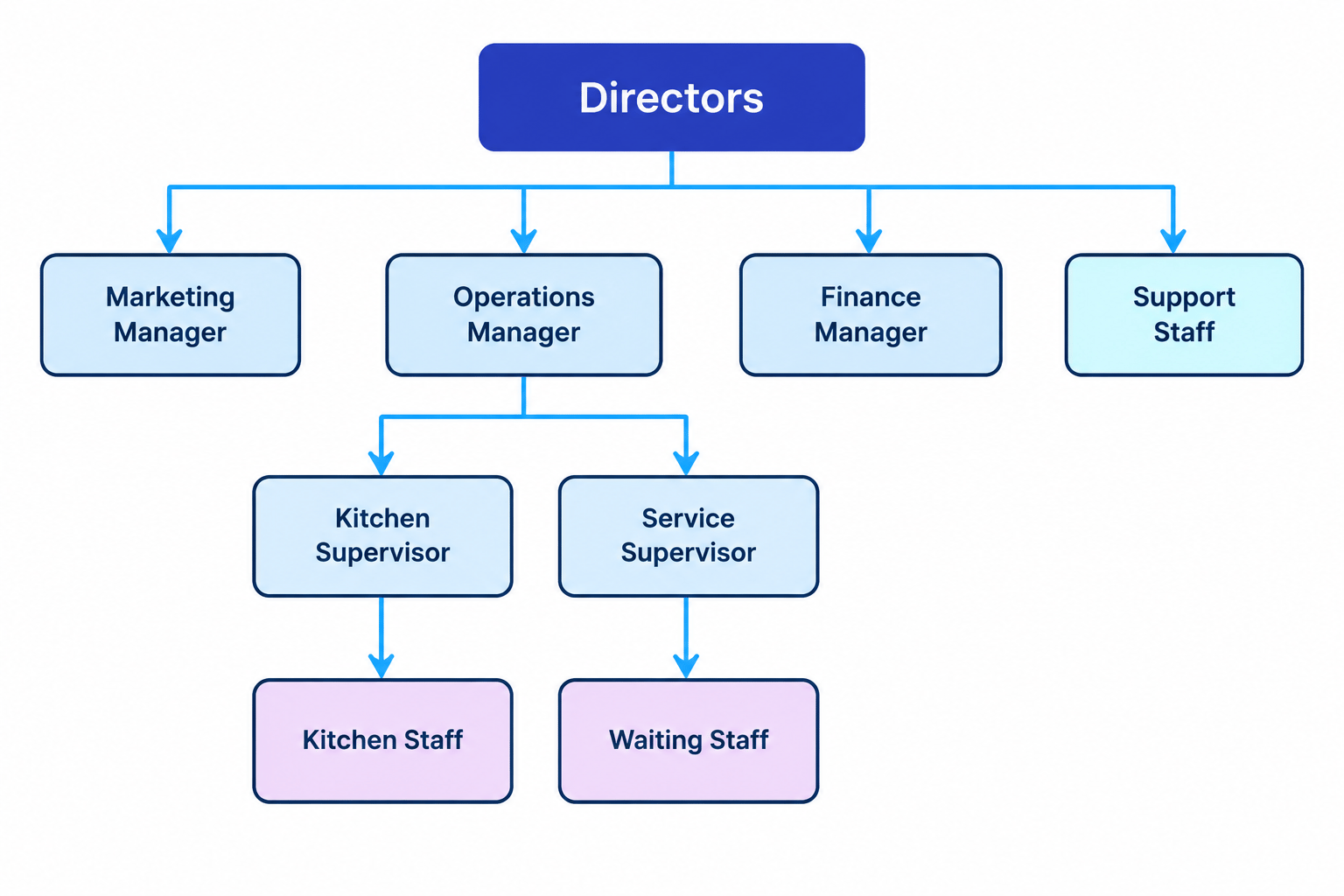
Why a business needs a structure
- Clear responsibilities: everyone knows which tasks belong to them, so jobs are not missed and two employees do not do the same work twice, which would waste wages.
- Clear reporting lines: each employee has one line manager, so they know who to ask when a decision is needed and who will check their work.
- Known communication routes: instructions travel down the structure and feedback travels back up it, so information reaches the people who need it instead of being announced at random.
- Coordination: a manager above several teams can pull them towards the same objective, for example making sure marketing launches an advert in the week operations can actually supply the product.
- Progression: staff can see the roles above their own, so they know what a promotion would look like and what they would have to do to earn it.
In a Nando's restaurant the kitchen staff answer to the head chef and the waiting staff to the front-of-house manager, so a complaint about slow service goes to one named person instead of being passed around the room.
Job roles through the business
- Directors: appointed by the owners or shareholders, they set the aims and objectives and take the long-term decisions, such as whether to open a factory abroad.
- Managers: each runs a function or a site, organising staff, budgets and equipment to hit the targets set above them, and reporting results back up.
- Supervisors and team leaders: they oversee the daily work of a small group, handing out jobs at the start of a shift and sorting out immediate problems without involving a manager.
- Operatives: the front-line staff who make the product or serve the customer, responsible for their own output and for following the agreed procedures.
- Support staff: they manage nobody but keep the business running, for example administrators, IT technicians and maintenance staff.
At JCB a director decides whether to build a new plant, a production manager decides how many diggers that plant builds this month, and an operative on the line fits the parts.
Responsibility, authority and accountability
Responsibility: being in charge of a task, a resource or the work of other people.
Authority: the power that comes with a role to make decisions and give instructions to others.
Accountability: being answerable for how a task turns out, even when somebody else carried it out.
- Responsibility widens as you move up the structure: an operative answers for their own work, a supervisor for a team, a manager for a department and a director for the whole business.
- Authority belongs to the role rather than the person, so a new store manager at Currys takes on exactly the same decisions as the one who left.
- Because every role has a named holder, poor work can be traced to the person responsible for it and put right, instead of nobody being answerable.
A job role is the position somebody holds, while their responsibilities are the specific things they must make sure get done, so a question about responsibilities wants tasks and decisions rather than job titles.
How the structure changes as a business grows
- A sole trader working alone has no structure to draw, because the owner takes every decision and does every job from serving customers to keeping the accounts.
- As staff are taken on, the work is split into functions such as marketing, finance, operations and human resources, and each function is given its own manager.
- Once a manager has more staff than one person can supervise, a layer of supervisors is added, so the business gains another level of hierarchy.
- Growth also forces the business to write things down, such as job descriptions and set procedures, because the owner can no longer tell each person what to do face to face.
Gymshark began with one person packing orders at home, and by the time it was selling worldwide it needed separate marketing, logistics and finance teams, each with a manager reporting upwards.
- Give three reasons a business sets up an organisational structure.
- What is the difference between the work of a director and the work of a supervisor?
- Define authority and accountability.
- Name two things support staff might do in a business.
- Why does a growing business add a layer of supervisors?