Organisational structure: the way a business arranges its staff into levels and roles so that everyone knows what they do and who they report to.
Hierarchy: the levels of authority inside a business, where each level has authority over the level below it.
- Organisation chart: a business sets its structure out on a chart where every box is a job role and every line shows who reports to whom, so you read down the chart to find who a manager is responsible for and up the chart to find who someone answers to.
- Levels of hierarchy: each horizontal row of the chart is one level. Greggs has directors at the top, then regional managers, then a manager in each shop, then the assistants who serve customers, which is four levels.
Chain of command
Chain of command: the line of authority running from the top of a business to the bottom, along which instructions are passed down.
- You trace the chain vertically down the chart, so the more levels of hierarchy a business has, the longer its chain of command.
- A long chain means an instruction is handed on by more people, so it arrives slowly and can be changed or misunderstood on the way; a short chain gets a decision to front-line staff quickly.
At Tesco an instruction from head office may pass to a regional manager, then a store manager, then a department manager, before it reaches the assistant stacking the shelves.
Span of control
Span of control: the number of employees who report directly to one manager.
- You count the span across the chart, not down it: it is the number of boxes joined directly beneath one manager, and it ignores anyone further down.
- Wide span: many subordinates report to one manager, so nobody is supervised closely and the manager has to pass work down.
- Narrow span: few subordinates report to one manager, so work can be checked in detail and control is tight, but the business needs more managers to cover the same workforce and so pays more in salaries.
- Span of control counts the people reporting to one manager, while chain of command counts the levels an instruction passes through.
- Never write span of command or chain of control.
Delegation
Delegation: when a manager passes a task, and the authority needed to carry it out, down to a subordinate, while the manager stays accountable for the result.
- The manager gives up the day-to-day work but not the accountability. If a delegated task is done badly, the manager is still answerable for it, which is the part most often got wrong.
- A wide span of control forces a manager to delegate, because one person cannot check the work of fifteen subordinates in detail.
- Being trusted with a task can motivate a subordinate and build skills that prepare them for promotion, but the task will be done badly if the person has not been trained for it.
Delayering
Delayering: removing one or more levels of management from the hierarchy.
- Delayering takes out a whole layer, usually middle managers, rather than a few jobs scattered around the business.
- Removing a layer shortens the chain of command and widens the span of control of the managers who are left.
- It saves money, because management salaries are high, and speeds decisions up, but the remaining managers supervise more people and staff can be demotivated by redundancies and by having fewer levels to be promoted into.
Delayering is not the same as downsizing: delayering removes a level of the hierarchy, while downsizing cuts the total number of employees.
Tall and flat structures
- Tall structure: many levels of hierarchy, narrow spans of control and a long chain of command, which gives tight control and a clear promotion ladder but slow communication.
- Flat structure: few levels of hierarchy, wide spans of control and a short chain of command, which gives faster, more direct communication and more delegation, but managers are stretched across many subordinates.
- Tall and flat describe the shape of the hierarchy, not the size of the business: the same 40 staff can be arranged in six levels or in three.
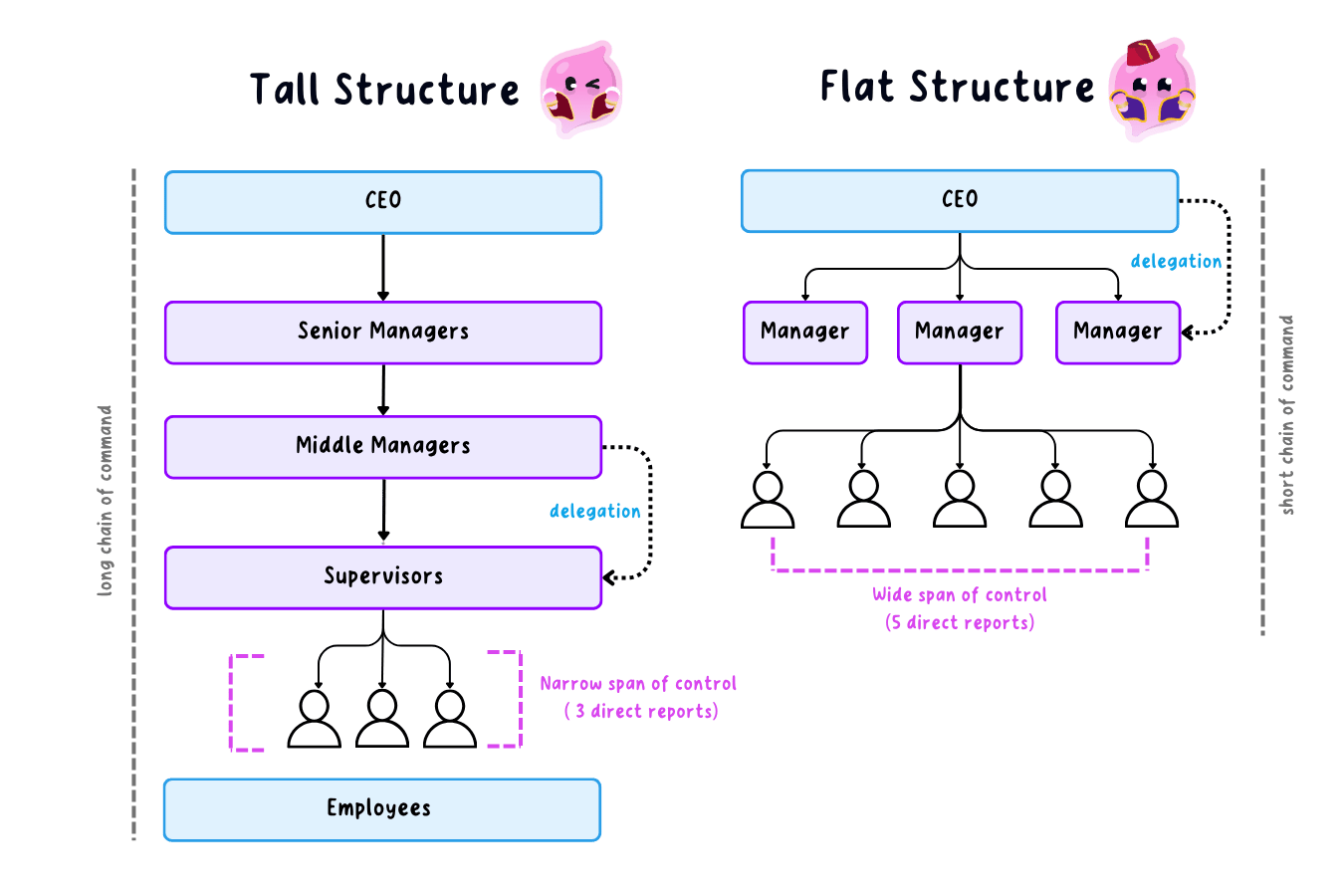
Which structure actually suits a particular business, and how the structure affects communication inside it, is covered in the article on the appropriateness of organisational structures.
- What does one horizontal row on an organisation chart represent?
- Define chain of command and span of control, and say how they differ.
- After a task is delegated, who is accountable for the result?
- What happens to the chain of command and the span of control when a business delayers?
- Give the three features of a flat structure.
