Choosing an appropriate structure
- Size of the business: a cafe with four staff needs no layers at all, while the NHS employs over a million people and could not have them all reporting to a handful of managers, so it needs many levels.
- Speed the market demands: a business competing on how fast it reacts, such as Deliveroo changing delivery fees during a busy evening, suits a flatter structure so decisions do not have to climb a chain.
- Cost of a mistake: where an error is expensive or dangerous, such as a lending decision at Barclays or a safety check at Nissan Sunderland, narrow spans and an extra level of checking are worth paying for.
- Skill of the staff: experienced employees cope with the wide spans and heavy delegation of a flat structure, while new or untrained staff need the close supervision a taller structure gives.
- Cost of managers: every extra level adds salaries, so a business competing on low prices, such as Aldi with its small store teams, keeps the number of layers down.
Example
- Monzo grew quickly with a flat structure, so a small team could change the app and see the result within days.
- Barclays keeps more levels, because lending and compliance decisions are checked by several managers before they take effect.
Centralisation and decentralisation
Definition
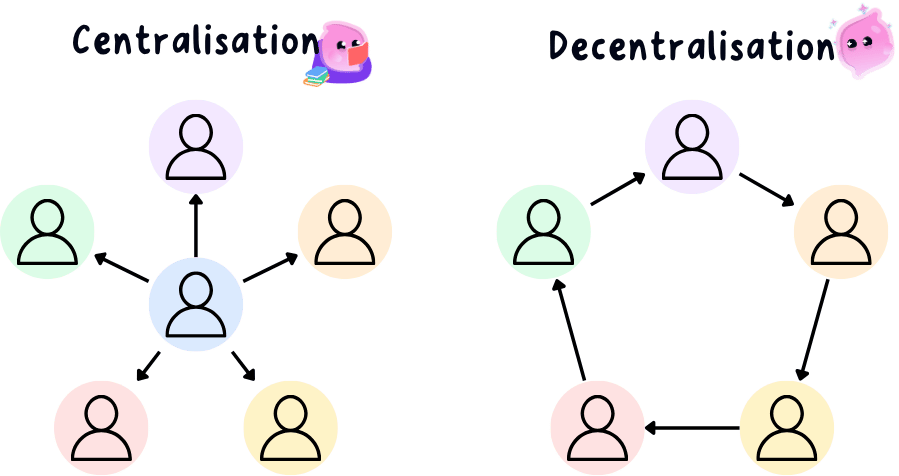
Centralisation: when the power to take decisions is kept at the top of the business, usually at head office.
Decentralisation: when the power to take decisions is passed down to branches, regions or departments.
- In a centralised business the branches carry out decisions taken above them on prices, product ranges and promotions, rather than choosing for themselves.
- Centralisation keeps every branch consistent, puts major decisions in the hands of the most experienced managers, and lets the business buy for all its sites at once so the cost per unit falls.
- Its drawback is that decisions take longer to reach the front line and local knowledge is wasted, so a store can be left selling a range its own customers do not want.
- Decentralisation lets a local manager react to local customers the same day, motivates that manager because the authority is real, and frees senior managers to work on longer-term plans.
- Its drawback is that branches drift apart, because two managers can answer the same question differently, and a less experienced manager can make a costly decision.
- Most businesses do both: Tesco buys stock and sets prices centrally, while a store manager decides the rota and how to lay out a seasonal display.
Common Mistake
Centralisation is about where decisions are taken, while tall and flat describe how many levels the structure has, so a business can be flat and still keep almost every decision at head office.
How a tall or flat structure affects the way a business is managed
- In a tall structure managers manage by supervising. Narrow spans leave time to check work in detail, so standards stay consistent and problems are caught before they reach the customer.
- That control costs speed and money, because approval has to climb the chain and come back down, and each extra layer adds management salaries to the wage bill.
- In a flat structure managers manage by delegating, because a wide span leaves no time to check every job, so staff take more day-to-day decisions themselves.
- That makes the business cheaper to run and quicker to act, and being trusted can motivate staff, but work is checked less often, so errors reach customers and stretched managers have little time for any one person.
- Neither shape is automatically the modern or the better one. A business doing safety-critical work, such as Nissan Sunderland, needs the extra checking a tall structure gives, while a business competing on how fast it reacts cannot afford the delay.
Example
A Greggs shop manager decides staffing and how much to bake through the day, because one area manager covering dozens of shops cannot supervise each one hour by hour.
Structure and communication
- A long chain of command means an instruction is retold at every level, so it arrives late and the wording drifts, and staff can end up acting on a version that is not what the director asked for.
- Upward communication suffers most in a tall structure, because a complaint or an idea from a shop-floor worker has to get past several managers to reach the top and is often filtered out on the way.
- A flat structure allows direct, usually face-to-face communication, because a member of staff is only a level or two from the person who can make the decision.
- The method of communication changes with the span of control: a manager responsible for thirty people cannot hold thirty conversations, so uses team briefings, notices and email, while a manager with four can talk to each one individually.
- Decentralisation shortens communication as well, because a local manager settles a question on the spot instead of emailing head office and waiting for a reply.
Analogy
Sending an instruction down six levels works like passing a whispered message along a row of people: by the end the wording has changed, even though nobody meant to change it.
Self review
- Give two things that decide whether a tall or a flat structure suits a business.
- Define centralisation and give one benefit and one drawback of it.
- Why do managers in a flat structure have to delegate more?
- Explain two ways a long chain of command harms communication.
- How does a wide span of control change the way a manager passes information on?
