Place and the channel of distribution
Definition
Channel of distribution: the route a product takes from the producer to the customer, either direct or through businesses in between.
- Place is the part of the marketing mix that decides how and where the customer gets hold of the product, and a business can only sell to customers its chosen route reaches.
- Every business that handles the product on the way, called an intermediary, does a job for the producer and takes a share of the final price for doing it, so the choice of channel is a choice between reach and the share of the price the producer keeps.
The channels a business can use
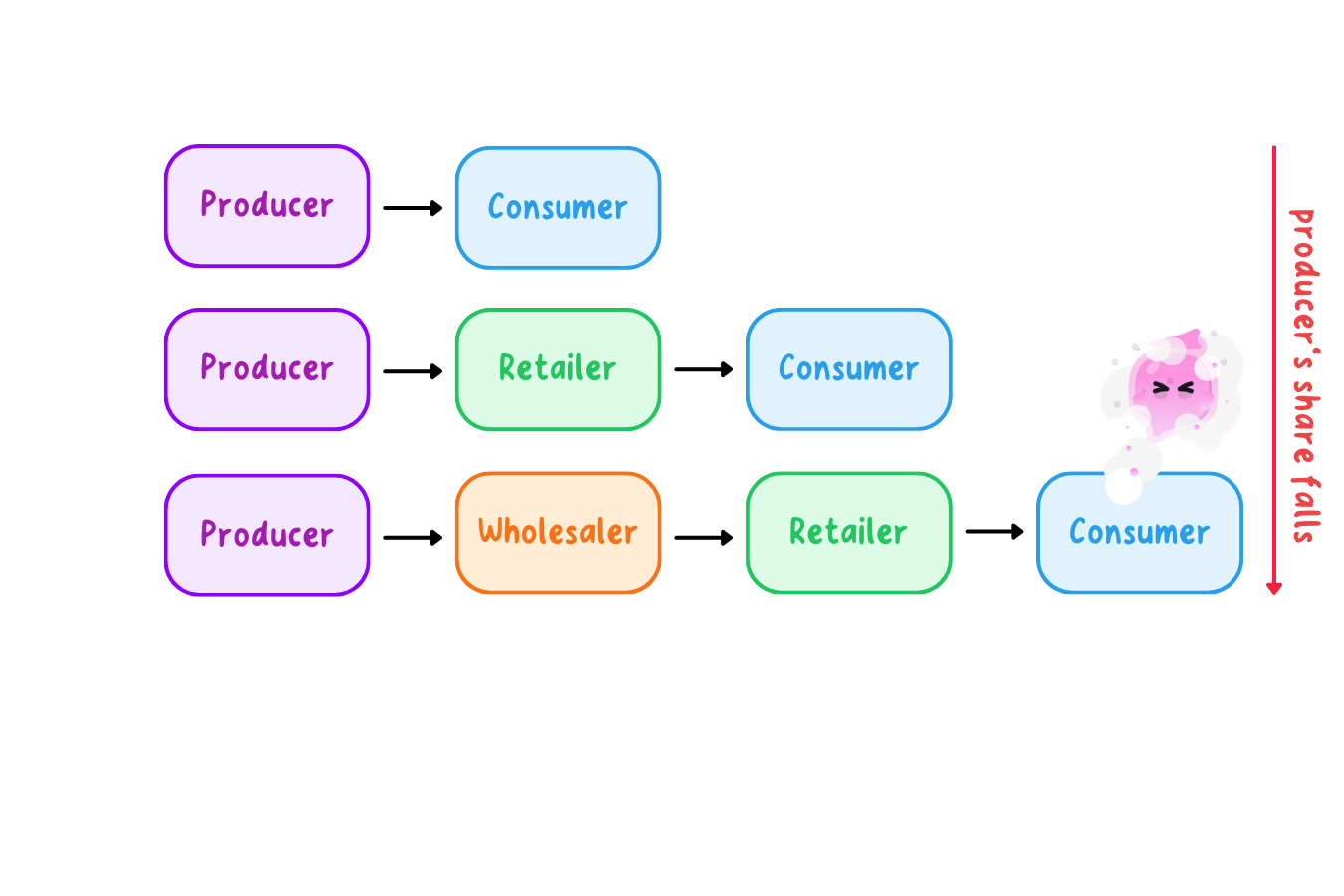
- Producer to customer: the producer sells straight to the customer, from its own shop, its own website, a factory outlet or over the telephone. A farm shop selling its own vegetables is the simplest version.
- Producer to retailer to customer: the producer sells in bulk to a shop, which sells single items to the public. Warburtons delivers bread straight to Tesco, which sells the loaves.
- Producer to wholesaler to retailer to customer: the producer sells lorry-loads to a wholesaler such as Booker, thousands of corner shops buy a few boxes each from the wholesaler, and customers buy single packets from the shops.
Example
- One crisp manufacturer can use two channels at the same time, selling multipacks direct to the big supermarket chains and single bags through a wholesaler to corner shops.
- The supermarket buys enough to be worth a delivery of its own, while no manufacturer would send a lorry to a shop that wants two boxes.
What retailers and wholesalers add
Definition
Retailer: a business that sells goods in small quantities to the final customer, in a shop or online.
Wholesaler: a business that buys in bulk from producers and breaks that bulk into smaller quantities to sell on to retailers.
- A retailer brings customers. It provides high-street locations, opening hours, displays, staff who answer questions and the footfall of shoppers who came for something else, none of which the producer would have to build itself.
- A retailer also takes the stock off the producer's hands and pays for a large order, which brings cash in sooner and moves the risk of unsold stock down the chain.
- A wholesaler breaks bulk. A village shop can buy two boxes instead of a pallet, so small retailers can afford to stock the product at all, and the producer reaches thousands of tiny shops it could never deliver to.
- A wholesaler also stores the goods, delivers them and handles the paperwork, so the producer deals with a handful of large customers instead of thousands of small orders.
Common Mistake
- A wholesaler sells to other businesses and a retailer sells to the public, and mixing the two up is the most common error on this topic.
- Do not write that intermediaries add cost for nothing, because both of them do work the producer would otherwise have to do.
Why a longer channel raises the price
- Each business in the chain sells for more than it paid, adding a margin to cover its own costs and its profit.
Example
- A drinks producer sells a bottle to a wholesaler for £0.30, the wholesaler adds £0.15 and the corner shop adds £0.50.
- The producer receives £0.30 of the £0.95 the customer pays, and the other £0.65 buys storage, delivery and shop space.
- If that producer sold the same bottle from its own website at £0.70 it would keep far more of the price, but it would then have to find and serve every customer itself, so the shorter channel is only worth it if the extra promotion and delivery cost less than the margins it has saved.
Selling direct and by telesales
Definition
Telesales: selling to customers over the telephone, either by taking their calls or by ringing them, with no shop involved.
- Selling direct shortens the chain to nothing, so the producer keeps the whole price, controls how the product is presented and owns the relationship with the customer, which also means it collects the data on who is buying.
- The work does not disappear, it moves. The producer now pays for storage, packing, delivery, returns and all the promotion needed to make customers aware, and it reaches fewer people than a national retailer would.
- Telesales is one way of selling direct. It needs no premises on a high street, one team can cover the whole country, a trained seller can answer objections and suggest a more expensive option, and every call can be recorded and checked.
- Its drawbacks are that customers cannot see or handle the product, wages make each sale expensive, and unwanted sales calls annoy people and can damage the business's image. It works best for services and repeat orders, such as insurance renewals and business supplies, rather than for goods customers want to try.
Note
Selling through a website or an app is the other main direct route, and the next guide covers e-commerce and m-commerce in full.
Choosing the channel for a given business
- The product decides a great deal. Fresh or fragile goods need short channels, cheap everyday goods sold in thousands of small shops need a wholesaler, and expensive goods that must be demonstrated, such as a JCB digger, are sold through specialist dealers.
- The market and the money decide the rest. A business selling nationally needs retailers, telesales or a website to reach that far, while a small producer with a strong local following can sell direct and keep the whole price. A premium brand also checks that the shops stocking it match the image it charges for.
- A long channel also hands power away. A small producer that sells almost everything through one supermarket has to accept the price it is offered and can be dropped at the end of the contract, which is why many producers keep their own website running alongside the retailers.
Exam technique
- Analyse whether this business should sell through retailers or direct to customers wants the gain and the sacrifice of each route, applied to the product in the case.
- Write the chain out in the right order, producer to wholesaler to retailer to customer, and say what each link does for this business.
- The mistake to avoid is claiming a business saves money by cutting out intermediaries without saying who now does their storing, delivering and selling.
Self review
- What is a channel of distribution?
- State the three main channels in order, from shortest to longest.
- What does breaking bulk mean, and which small businesses does it help?
- Why does a longer channel usually mean a higher price for the customer?
- Give one benefit and one drawback of selling by telesales.
