Just in time
Definition
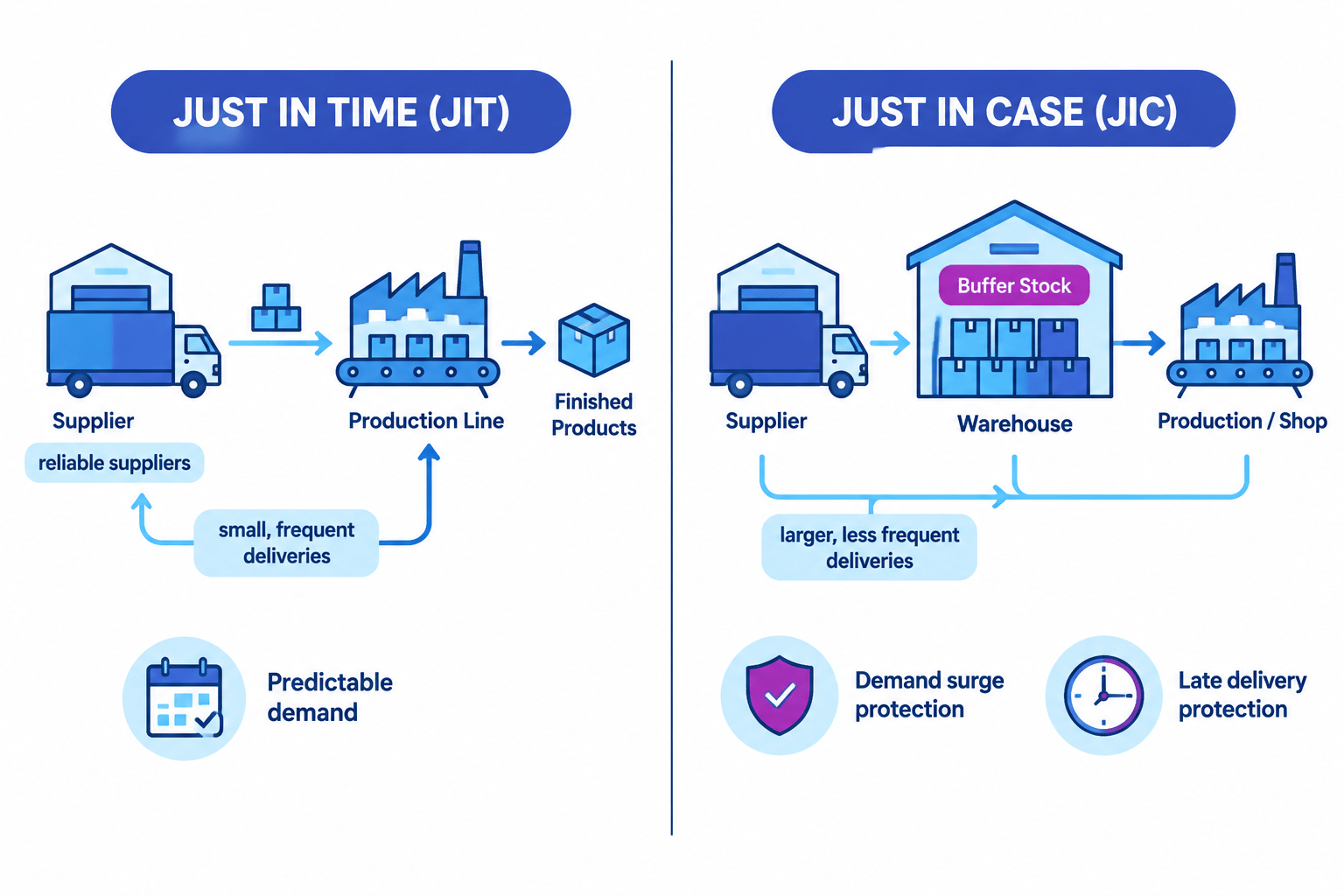
Just in time (JIT): a way of managing stock in which materials and goods arrive from suppliers just as they are needed, so almost no stock is held.
- Small, frequent deliveries: orders are timed to match what is being made or sold that day, rather than sized to fill a warehouse.
- Almost no stock is held. Materials go straight into production and finished goods go straight out, so there is no pile of stock sitting between the stages.
- Suppliers must be reliable. With no spare stock to fall back on, a supplier who is late by a few hours stops the business working.
- Demand must be known accurately. The business has to tell suppliers what it needs and when, which takes good record-keeping and close communication.
Example
- Nissan's Sunderland plant has seats and dashboards delivered to the line only hours before they are fitted to a particular car.
- Some suppliers sit on industrial estates a few miles away so they can deliver several times a day.
Just in case
Definition
Just in case (JIC): a way of managing stock in which a buffer of extra stock is deliberately held, in case demand suddenly rises or a delivery is late.
- A buffer is always kept. The business sets a minimum level of stock it aims never to fall below, and reorders before it gets there.
- Orders are larger and less frequent. Buying in bigger quantities means fewer deliveries to organise and pay for.
- It protects against a surge in demand. If a product is suddenly popular, the stock is already there to sell, so no sale is turned away.
- It protects against a late delivery. Production and selling carry on from the buffer while the business chases the supplier, so a supply problem never reaches the customer.
- This suits a business with unpredictable demand or suppliers it cannot fully depend on, such as a builders' merchant or a supermarket in the run-up to Christmas.
The benefits of just in time
- Cash is freed up. Money that would sit on a warehouse shelf as unsold stock stays in the bank, where it can pay wages, suppliers or for new equipment.
- Storage space is freed up. The business needs a smaller warehouse, so it pays less rent, heating, insurance and security, or uses the space for production instead.
- Less stock is lost. Nothing is sitting long enough to go past its use-by date, get damaged in the warehouse or go out of fashion before it sells.
- Faults are found quickly. Deliveries go straight into use, so a batch of poor materials shows up at once rather than after weeks in storage.
The drawbacks of just in time
- There is no safety net. One late lorry, strike or road closure can stop production or empty the shelves the same day, because nothing is held in reserve.
- Sudden demand cannot be met. If a product unexpectedly takes off, the business has nothing extra to sell and the customer buys from a rival instead.
- Frequent deliveries cost money. Many small drops mean more transport charges, more paperwork and more staff time spent receiving and checking goods.
- Bulk discounts are lost. Ordering little and often means the business does not qualify for the lower price per unit a large order would earn.
Note
The costs and benefits of holding stock are set out in detail in the article on the costs and benefits of stock management.
Judging just in time for a given business
- Start with the suppliers, because JIT only works when they deliver the right goods on time every time, and when they are close enough to deliver often.
- Then look at demand, because steady, predictable sales can be matched by small deliveries, while spiky or seasonal demand needs a buffer.
- Then look at the product, because JIT is worth most where stock is bulky, expensive or perishable, and worth least where it is small, cheap and keeps for years.
- Finally look at the cash position, because a business short of cash gains most from not having thousands of pounds sitting in a warehouse.
- A small independent shop with one weekly delivery and unpredictable trade would be badly served by JIT, while a car plant with local suppliers is a strong fit.
Exam technique
- The command word here is usually evaluate the use of just in time at this business, so you must come down on one side rather than describe both approaches.
- Use the terms precisely, since JIT holds almost no stock while JIC deliberately holds buffer stock.
- The mistake to avoid is claiming JIT always saves money, because extra delivery charges and lost bulk discounts can swallow the saving.
Self review
- What is just in time?
- What is just in case, and what is the buffer for?
- Give two things just in time frees up for the business.
- Why does just in time need reliable suppliers?
- Name two costs a business takes on when it switches to just in time.