What efficiency means in production
- Efficiency means getting a given amount of output from as few resources as possible, so very little of what the business pays for is wasted.
- A more efficient factory turns the same workers, machines, materials and floor space into more finished goods.
- That matters because the money already spent on wages, rent and machinery is then carried by more units, so the cost of each unit falls.
- AQA names two ways of raising efficiency in production: lean production, and just in time as one of the techniques inside it.
Lean production
Definition
Lean production: an approach to operations that cuts waste of every kind, so the same output is produced using fewer resources.
- Lean production starts by looking at every step in the process and asking whether that step adds anything the customer would pay for.
- Steps that add nothing are redesigned or removed, and the workers who do the job are usually the ones who spot them.
- It is a continuous habit rather than a one-off project, so small improvements are made week after week.
Common Mistake
- Lean production does not mean cutting jobs, and it does not mean cutting the quality or the features customers are paying for.
- It means removing the waste inside the process, so the same staff produce more with less scrap, less waiting and less walking about.
The waste lean production removes
- Wasted time: workers and machines standing idle while they wait for parts, instructions or a slower stage to catch up.
- Wasted materials: offcuts, spillage, and faulty units that have to be scrapped or reworked, all of which were bought and paid for.
- Wasted space: floor space and warehousing filled with stock and half-finished work, which the business is paying rent, heating and insurance on.
- Wasted movement: parts and people travelling further than they need to, because machines and benches are laid out in the wrong order.
- Wasted effort: checks, forms and handling repeated at more than one stage, and making more units than there are orders for.
Example
- A Greggs shop that moves the ovens, trays and till into the order the work actually flows cuts the steps each member of staff walks in a shift.
- The same staff serve more customers per hour, so the wage cost carried by each sandwich falls.
How less waste lowers the unit cost
- Waste is money the business has already spent and will get nothing back for, so removing it lowers total costs while output stays the same.
- The cost of each unit is the total cost spread across the units made, so a lower total cost across the same output gives a lower unit cost.
Example
average unit cost=total costoutput
\text{average unit cost} = \frac{\text{total cost}}{\text{output}}
average unit cost=outputtotal cost
- A Warburtons bakery makes 10,000 loaves a week at a total cost of £12,000.
- Cutting scrapped dough and idle oven time takes the weekly cost to £10,800 for the same 10,000 loaves.
- Each loaf now costs 12p less to make, which the bakery can take as extra profit on every loaf or use to undercut a rival's price.
- A lower unit cost also gives room to survive a fall in the selling price, because there is more distance between the cost of a unit and its price.
Just in time
Definition
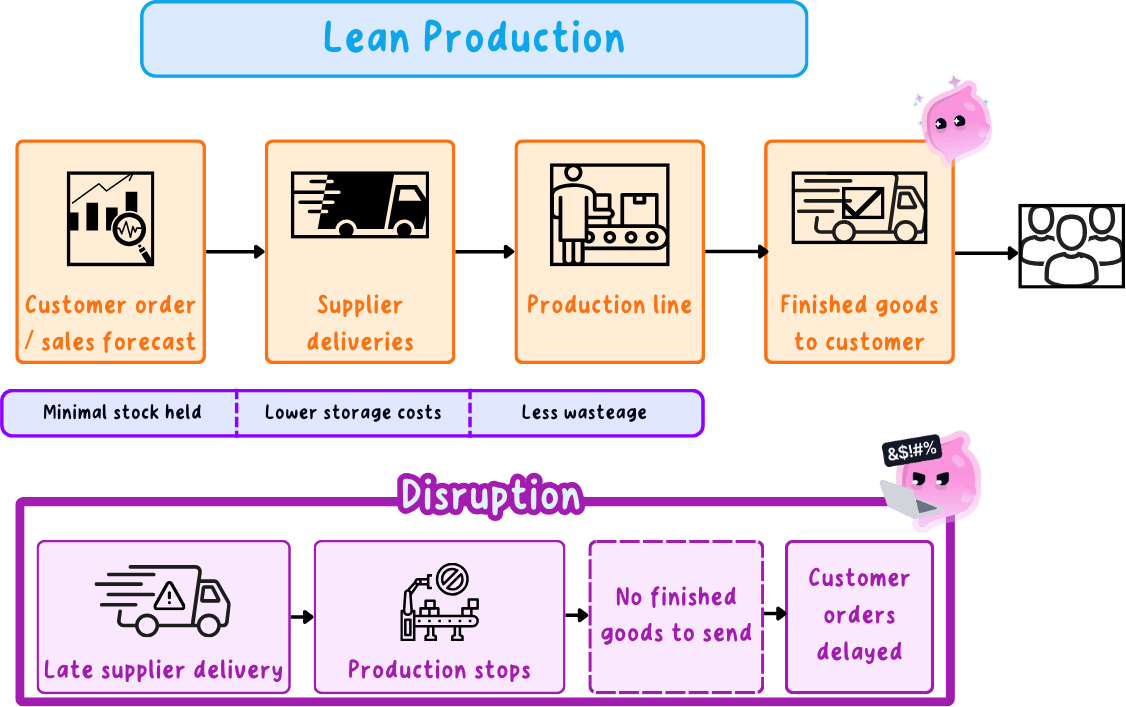
Just in time (JIT): a lean technique in which stock arrives from suppliers just as it is needed, so the business holds almost none.
- JIT raises efficiency by removing the wasted space and the cash tied up in a warehouse full of stock waiting to be used.
- It also exposes waste elsewhere, because with no spare stock to hide behind, a faulty batch or a slow stage stops the line and has to be put right rather than worked around.
Note
Just in time, just in case and the trade-off between them are taught in full in the article on just in time and just in case.
Exam technique
- For explain how lean production could make the business more efficient, pick one waste that is visible in the case and follow it through to a lower unit cost.
- Name the waste you are removing, whether it is wasted time, materials, space, movement or effort, instead of writing generally about being more efficient.
- Finish the chain every time: less waste, lower total cost, lower unit cost, then either a lower price or a wider profit margin.
Self review
- What does it mean to say a business is efficient?
- Name four kinds of waste lean production sets out to remove.
- Why does removing waste lower the cost of each unit?
- Why is lean production not the same as cutting jobs?
- How does just in time raise efficiency?
