The impact of business activity on stakeholders
- The first direction runs outwards from the business: what it decides to do lands on the groups around it, and each group feels a different part of the same decision.
- Cutting costs to protect profit: owners and shareholders keep more of the profit and customers may see lower prices, while employees face a pay freeze or redundancy and suppliers are pushed to accept less per unit.
- Raising prices: owners gain more revenue on every sale, while customers pay more for the same product and some of them switch to a rival.
Example
- When Honda closed its Swindon car plant, around 3,000 employees lost their jobs, the parts firms that supplied the line lost their largest contract, and shops and cafés in the town lost the wages those workers used to spend there.
- The owner of the business was the one stakeholder that gained, because it stopped paying to run a plant it could not fill.
The influence stakeholders have on the business
- The second direction runs back into the business, because stakeholders are not passive and each group holds something the business needs.
- Owners and shareholders hold the capital, so they vote at the annual general meeting, press the directors for a bigger dividend, and can sell their shares or vote a director out.
- Employees hold the labour, so they negotiate over pay and hours, work to rule or strike through a trade union, or simply leave and take their training with them.
- Customers hold the revenue, so they switch to a rival, post one-star reviews, complain on social media or join a boycott.
- Suppliers hold the stock and materials, so they set the price and the credit terms, shorten the time allowed to pay, or refuse to supply at all.
- The local community holds the permission to be there, so residents object to planning applications, petition the council, take a campaign to the local paper and lobby their MP.
- How much influence a group actually has depends on two things: how badly the business needs what that group holds, and how easily the group can act together.
- One shopper walking out of Tesco changes nothing, while a hundred thousand shoppers signing a petition changes a policy, and a single supplier with the only factory making a part can dictate terms on its own.
Example
- Sustained customer pressure over plastic waste pushed Tesco and other UK supermarkets to strip the plastic wrapping from loose fruit and vegetables, which meant new packaging specifications for their suppliers.
- No law forced the change; the risk of shoppers taking their trolleys elsewhere was enough.
How stakeholders change a business's objectives
- Stakeholder pressure works through costs and revenue, so employees winning a pay rise raise the wage bill and push a profit target out of reach, while customers switching to a rival cut revenue and turn an aim of growth into an aim of survival.
- Pressure can also add a whole new objective, so a firm that has lost a planning appeal to local objectors will set itself an aim on emissions, delivery hours or landscaping to get the next application through.
- One dominant stakeholder can reshape the objectives entirely, since a small bakery that supplies Greggs will plan its output, its opening hours and its quality standards around that single contract.
Stakeholder conflict
Definition
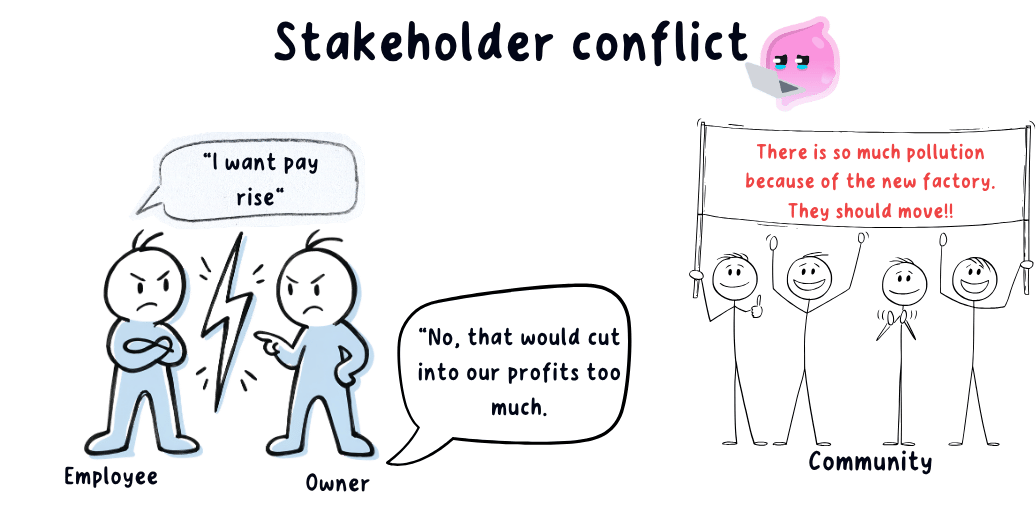
Stakeholder conflict: a situation where meeting one stakeholder group's objective makes it harder to meet another group's objective.
- Conflict happens because the business has one pot of money and one set of decisions, and the groups want that pot spent in different places.
- Owners against employees: wages are a cost, so every £1 added to the wage bill is £1 less profit available as dividend, which is why a pay claim and a dividend target cannot both be met in full.
- Customers against suppliers: customers want the lowest price, and the way a supermarket delivers it is by paying its growers and dairy farmers less per unit.
- Owners against the local community: owners want a bigger site, longer opening hours and earlier deliveries, and all three arrive on the residents' street as traffic and noise.
- Shareholders against the business's own future: profit paid out as dividends this year is profit not reinvested in new equipment, so a high payout can weaken the firm the employees rely on.
Example
- A Tesco Extra opens on the edge of a market town: shoppers get lower prices and a far wider range, around 200 local people get jobs, and the farms that supply it get a large steady order.
- The same store adds several hundred car journeys a day to the ring road and pulls trade away from the butcher and greengrocer on the high street, some of whom close.
- Customers and employees want the store, part of the community does not, and the council granting permission has to choose between them.
Weighing up which stakeholder comes first
- Compare how many people are affected and how severely, because 200 new jobs set against slower traffic on a ring road is a different balance from 200 redundancies set against a small saving.
- Compare how long each effect lasts, since a redundancy can follow a worker for years while extra delivery noise can be fixed by changing the delivery times.
- Ask whether the business can function at all without that group, because a firm can usually survive unhappy neighbours but not customers who have all left or suppliers who have all stopped delivering.
- Businesses handle the clash in three ways: they prioritise the group they most depend on, they compromise by softening the loss for the others, and they communicate early so objections do not become a strike or a campaign.
- A compromise looks like phasing redundancies and paying for retraining, or banning deliveries before seven in the morning and planting a screen of trees along the boundary.
Common Mistake
- Do not claim a conflict has been resolved when it has only been softened, because a business can compensate the losing group without giving it what it wanted.
- Do not write that a decision affects "all stakeholders" in the same way, since the whole point of conflict is that one group gains while another loses.
Exam technique
- Analyse the impact on one stakeholder group wants a chain rather than a list, so run action, then what changes for that group, then what that means for them.
- Discuss whether the business should is where conflict belongs: name the group that gains, name the group that loses, then say which matters more to this particular firm and why.
Self review
- What are the two directions in which a business and its stakeholders affect each other?
- Give two ways employees can influence the business they work for.
- How can a local community stop a business expanding on its site?
- Define stakeholder conflict, then explain why a supermarket cannot satisfy both its customers and its suppliers on price.
- Name three things a business can compare when deciding which stakeholder to put first.
