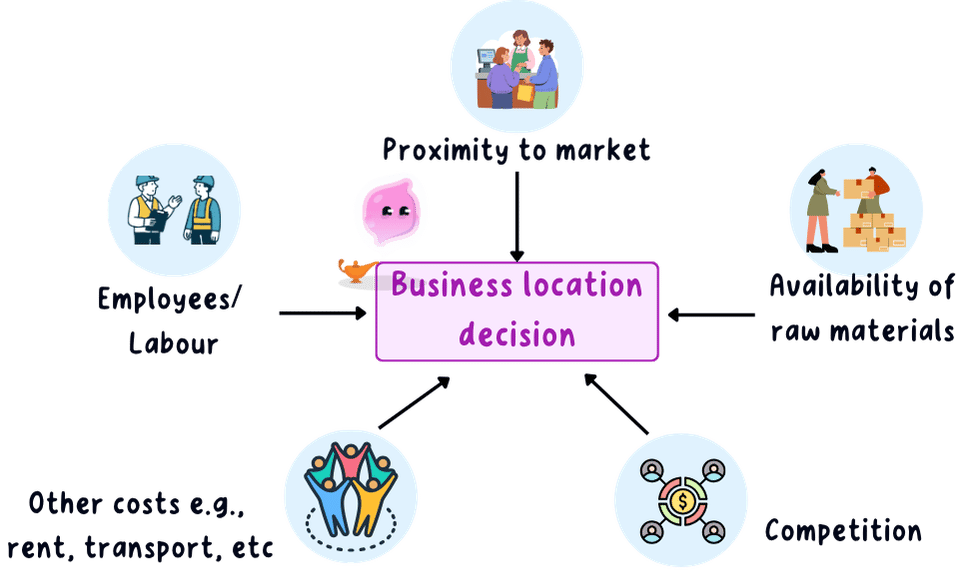
What the location decision involves
Definition
Business location: the area of the country and the specific premises a business chooses to operate from.
- A business makes this decision when it starts up and again every time it opens another site, and it is expensive to reverse once a lease is signed and equipment is installed.
- Every location factor works through one of two things: what the site costs to run, or how much the business can sell from it, and no site scores well on all five at once.
Proximity to the market
- This means locating close to the customers the business wants to serve, and for a shop or a café it comes down to footfall, meaning the number of people who walk past the door.
- For a business that delivers rather than waits to be visited, being near the market cuts fuel and driver hours on every order, and it protects perishable goods that lose quality on a long journey.
Example
- Greggs puts shops inside mainline railway stations because tens of thousands of commuters pass through between seven and nine each morning, exactly when people buy coffee and a bake.
- The same unit on a quiet side street a hundred metres away would sell a fraction of that, which is why the business pays far more for the station site.
Availability of raw materials
- This means locating near the suppliers of the inputs the business uses, and it pulls hardest when those inputs are heavy, bulky or perishable.
- Transport is charged by weight and distance, so when the finished product weighs less than the materials that went into it, the cheaper journey is the one made by the finished goods.
- A business whose inputs are light, or which buys them in small quantities from a wholesaler, is barely pulled by this factor at all, so a jewellery maker can work from anywhere with a postal service.
Example
- British Sugar sites its factories in the middle of the beet-growing counties of East Anglia, because a lorry of beet becomes a much smaller weight of sugar and beet does not keep well.
- A farm shop takes this to its limit by selling on the farm itself, so the raw materials travel a few hundred metres and arrive fresher than anything in a supermarket.
Availability and cost of labour
- Availability is whether enough people with the right skills already live within travelling distance, so an engineering firm looks for an area with an engineering history and a nearby college running the right courses.
- If the skills are not there, the business has to recruit from further away or train people from scratch, and both add cost before a single unit is sold.
- Cost is what those people have to be paid, and wage rates vary across the UK because the cost of living varies, so the same job is cheaper to fill outside the south east.
- This is why UK banks and insurers put their call centres in places such as Sunderland, Glasgow and Swansea rather than central London: the work can be done anywhere with a phone line, so the business picks the location where the wage bill and the rent are lowest.
Competition
- Locating away from rivals gives a business an area to itself, so a hairdresser opening on an estate with no other salon has the whole neighbourhood to draw on.
- Locating next to rivals can work instead, because customers who want to compare before they buy will travel to the place where everything is side by side, which is why car dealerships share the same retail park.
- The risk of clustering is that near-identical businesses simply split the same customers, so a fourth takeaway on a parade of three takes trade from the others rather than creating new demand.
Key Idea
- Being near competitors helps when customers compare before buying, and hurts when they do not.
- Nobody drives across town to compare three sandwich shops, but plenty of people will do it to compare three used cars.
Costs of the site
- The costs to compare are the rent or the price of the land, the business rates charged by the council, and the cost of fitting the building out for what the business does.
- A unit on a busy high street might cost £45,000 a year in rent while a similar unit on an industrial estate costs £12,000, so the extra rent on the high-street site is £45,000−£12,000=£33,000\pounds45{,}000 - \pounds12{,}000 = \pounds33{,}000£45,000−£12,000=£33,000 a year.
- The high street is only worth taking if the extra footfall brings in more than £33,000 of extra profit a year, so the owner has to estimate the added sales before signing the lease.
- The cheapest site is not automatically the best one, because a unit with no passing trade and poor road access can cost the business more in lost sales than it saves in rent.
Common Mistake
- Do not treat low cost as an automatic advantage without asking what the cheap site does to sales.
- Do not confuse the location of the business with the size of its premises, since a firm can move to a cheaper area and still rent a bigger unit.
Exam technique
- Explain one factor that influences where this business locates wants the factor that fits the firm in front of you, so for a bakery living off passing trade you write about proximity to the market.
- Recommend where the business should locate means naming one site and defending it, usually by weighing the rent of the better site against the sales it would bring.
- The mistake to avoid is walking through all five factors at equal length, which uses up the answer and leaves nothing to say about which one decides it.
Self review
- Name the five factors that influence where a business is located.
- Why does a business using heavy raw materials locate near them rather than near its customers?
- Give one reason a business might choose to open right next to its competitors.
- Which three site costs should a business compare between two possible premises?
- Why does proximity to the market barely matter for a call centre?
