What an exchange rate is
Definition
Exchange rate: the price of one currency in terms of another, such as how many euros or dollars a pound will buy.
Stronger pound: each pound buys more foreign currency than it did before.
Weaker pound: each pound buys less foreign currency than it did before.
- Exchange rates move every day, so a UK business that trades abroad finds the price its overseas customers see, and the cost of the supplies it buys in, changing without it deciding anything.
- Two kinds of business feel the movement: the exporter that sells abroad, and the importer that buys from abroad.
- A movement that helps one of them hurts the other, so the effect only makes sense once you have said which of the two you are talking about.
Analogy
- Treat the pound as a ticket for buying abroad: a stronger pound makes the ticket go further overseas, and a weaker pound makes it go less far.
- Foreign customers buying British goods hold the opposite ticket, which is why every movement has a winner and a loser.
A weaker pound
- UK exports become cheaper abroad. An overseas customer needs less of their own currency to buy the same British product, so it looks better value against local rivals.
- Export sales tend to rise, so the exporter's revenue and profit rise, and it may need extra output to meet the orders.
- The alternative is to leave the overseas price alone and collect more pounds from each sale, which raises profit per unit instead of raising sales.
- Imports become dearer. A UK business buying stock or raw materials priced in another currency must hand over more pounds for exactly the same goods.
- Its costs rise, so profit falls unless it puts its own prices up, and raising prices risks losing customers to a rival that has not.
Key Idea
- Weak pound: exports rise, imports dearer.
- A strong pound is simply the same line read backwards: exports fall, imports cheaper.
A stronger pound
- UK exports become dearer abroad. An overseas customer needs more of their own currency for the same British product, so it looks expensive next to a local rival and export sales tend to fall.
- To keep those customers the exporter can cut the price it charges overseas, but then it receives fewer pounds per sale and its profit margin is squeezed.
- Imports become cheaper. A UK importer hands over fewer pounds for the same stock, so its costs fall and its profit rises if it keeps its selling prices where they are.
- It can also pass the saving on as a lower shelf price and try to win sales from competitors.
Example
- JCB exports diggers, so a weaker pound makes its machines cheaper for buyers in Germany and India and its export orders tend to grow.
- A Scotch whisky distiller gains in the same way, since a weaker pound makes a bottle more affordable in its overseas markets.
- Currys is on the other side of the same movement, because it buys much of its electrical stock from suppliers in Asia and a weaker pound raises what that stock costs it.
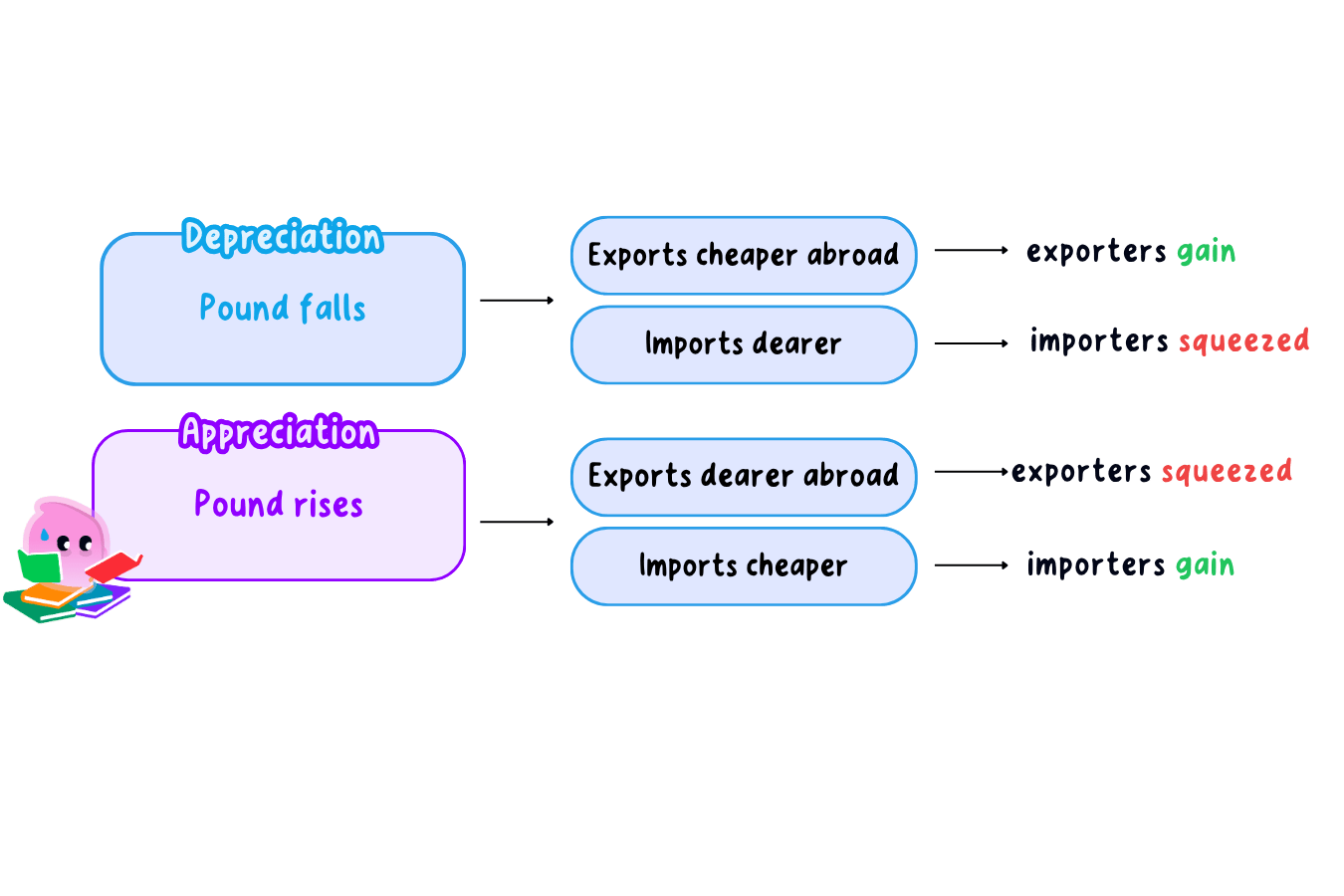
Always say who the change is good for
- Name the business before you name the effect, because the same movement that lifts a UK exporter's sales raises a UK importer's costs: a weaker pound is good news for JCB as an exporter and bad news for a retailer importing its stock.
- Plenty of UK businesses are both at once, importing materials and exporting the finished product, so a weaker pound lifts their export sales and their input costs together.
- Which side matters more depends on how much of the product's cost is imported and how much of its output is sold abroad, so use those details from the case.
Common Mistake
- The commonest error is writing that a weaker pound is bad because everything costs more, without saying that it is only bad for the importing side.
- A change in the pound is a change in the price of foreign currency, not a rise in the price of everything sold in the UK.
Exam technique
- The usual wording is explain the impact of a fall in the value of the pound on this business, so decide first whether the business mainly imports or mainly exports.
- Build the chain in order: the direction of the pound, the price the other side now sees, the effect on sales or costs, then the effect on profit.
- You are asked to interpret the direction of the effect, so describe cheaper or dearer rather than trying to work out prices in another currency.
Self review
- What does an exchange rate measure?
- What happens to the overseas price of a UK exporter's product when the pound weakens?
- Why does a weaker pound raise the costs of a UK retailer that buys its stock from Asia?
- Which type of UK business gains from a stronger pound, and why?
- Why must an answer about the pound always say who the change is good for?
