Globalisation and UK businesses
Definition
Globalisation: the growing links between the world's economies, so that businesses buy, sell and produce across national borders as if in one large market.
Import: a good or service a UK business buys from a supplier based in another country.
Export: a good or service a UK business sells to a customer based in another country.
- Cheap container shipping, the internet and the lowering of trade barriers have made buying and selling abroad normal even for small UK firms.
- Trade runs in both directions for a UK business, as imports coming in and exports going out.
- Many UK manufacturers do both at once, importing components and exporting the finished product, so globalisation reaches them from two sides.
Example
- JCB builds diggers in Staffordshire and sells them in well over a hundred countries, so most of its customers are not British.
- Scotch whisky is made only in Scotland, yet the bulk of every year's output is shipped overseas.
How UK businesses compete internationally
- Better design: a product that works in a way rivals cannot copy gives overseas customers a reason to choose it, as Dyson does with its bagless vacuum cleaners and cordless motors.
- Higher quality: better materials, reliability and finish let a firm charge more and still win the order, which is how JCB machinery and Jaguar Land Rover vehicles sell abroad.
- Lower prices: a business with genuinely lower costs, from large-scale production or efficient methods, can undercut overseas rivals and still make a profit.
- Few UK firms beat producers in low-wage countries on price alone, so the realistic version of this is offering better quality at a competitive price rather than the cheapest price on the market.
- Strong branding: a trusted name and British origin let a firm charge a premium, as Burberry does with its coats and Scotch whisky does with its protected name.
- E-commerce: selling through its own website and online marketplaces lets a UK business take orders from overseas customers without opening a single shop abroad.
- The website has to work for that customer, which means overseas delivery, a returns route and prices and product information they understand.
Example
- Gymshark grew into an international brand by selling online and through social media, rather than by opening stores country by country.
- Burberry takes the opposite route, competing on brand and quality so that customers overseas accept a high price for a British-made coat.
Benefits of globalisation for a UK business
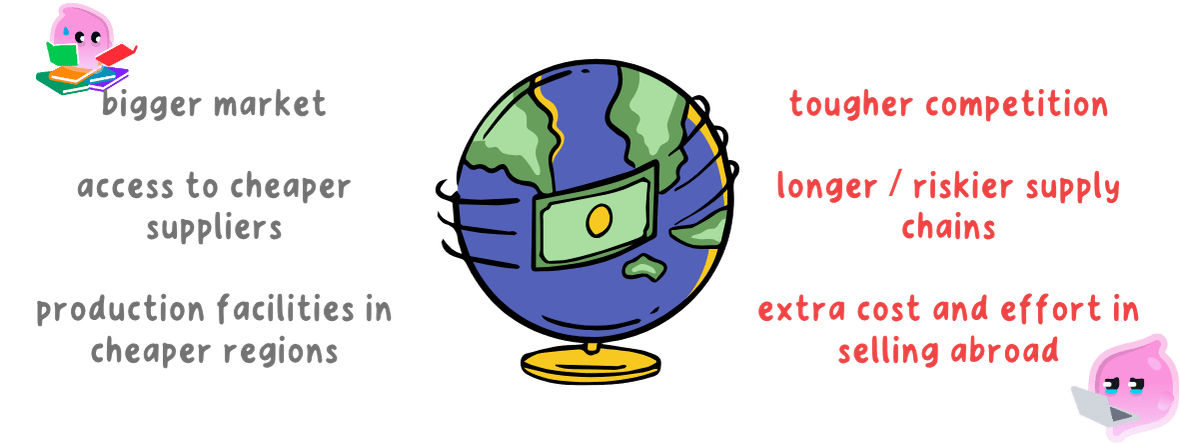
- A much bigger market: exporting puts millions of extra customers within reach, so sales can keep growing even when the UK market is full.
- Selling in several countries also spreads risk, because weak demand in one market can be offset by stronger demand in another.
- Cheaper supplies: buying materials and components from overseas suppliers cuts costs, so the business can widen its profit margin or pass the saving on as a lower price.
- A wider choice of suppliers also means access to materials and parts that are not made in the UK at all.
- Producing abroad: a UK business can set up or use factories overseas where wages are lower or where it is closer to its customers, cutting production and delivery costs.
Example
- Dyson designs in the UK but manufactures in Asia, which keeps its costs down and puts production near fast-growing Asian markets.
- Jaguar Land Rover sells heavily in China and the United States, so its sales no longer depend on how many cars British buyers want.
Drawbacks of globalisation for a UK business
- Tougher competition at home: overseas firms sell into the UK too, often at prices a UK producer cannot match, so a business can lose sales in its own market.
- The response is either to cut price and accept a thinner margin, or to improve design, quality or service so customers still choose it.
- Longer, riskier supply chains: goods travel thousands of miles, so delays at ports, rising shipping costs and faulty batches are slower to spot and harder to put right.
- A late shipment can stop production or empty the shelves, so some firms hold extra stock as protection, which ties up cash.
- Checking quality and working conditions at a distant supplier is difficult, and a problem there becomes the UK brand's problem.
- Extra cost and effort in selling abroad: the product and its packaging often have to be adapted to local tastes, languages and rules, and transport adds cost to every sale.
Note
How cheap a UK export looks abroad, and how much an imported supply costs in pounds, also depend on the exchange rate, which is covered in 2.4.2.
Exam technique
- A common wording is analyse the benefits and drawbacks of globalisation for this business, so pair each benefit you give with the drawback that actually threatens that business.
- Read what the business does first: an exporter cares most about bigger markets, while a firm selling only in the UK cares most about foreign rivals arriving here.
- When asked how a business could compete internationally, pick the method that suits its product and explain why an overseas customer would choose it over a local rival.
Self review
- What is globalisation?
- What is the difference between an import and an export?
- Name four ways a UK business can compete against overseas rivals.
- How does e-commerce help a small UK business reach customers abroad?
- Give one benefit and one drawback of globalisation for a UK manufacturer that imports its components.
