Why the government passes business laws
Definition
Legislation: laws passed by Parliament that a business must obey, with penalties for any business that does not.
- Protecting employees: employment law and health and safety law set minimum standards for pay, fair treatment and working conditions that no employer is allowed to fall below.
- Protecting consumers: consumer law gives buyers rights over how a product is described and over what happens when it turns out to be faulty, so a seller cannot simply keep the money.
- Protecting the public: rules on safe premises, noise and waste protect people who are neither staff nor customers, such as households living near a factory or pedestrians passing a building site.
- Obeying the law is compulsory, not a choice, so a business cannot decide that compliance is too expensive and opt out.
- The same rules bind Tesco and a single independent shop, so competition between them stays fair.
Note
- The wage laws and the Equality Act 2010 are covered in 2.5.2 Employment law.
- The Health and Safety at Work Act 1974 and consumer law on trade descriptions are covered in 2.5.3.
- You need only brief knowledge of what each law says, because questions are built around the effects on the business.
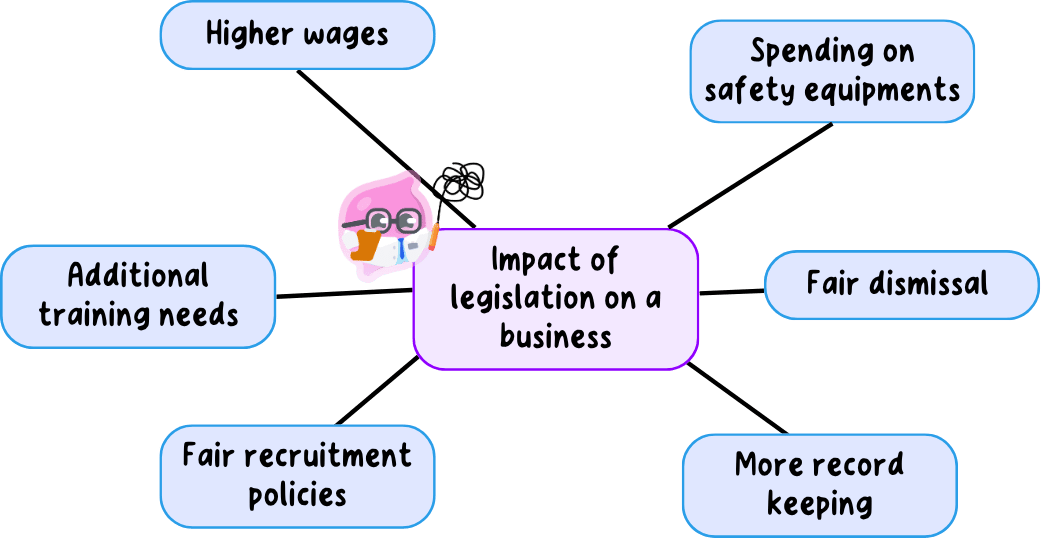
The effects of legislation on a business
- Higher wage costs: a legal minimum hourly rate raises the wage bill of any business employing large numbers of low-paid staff, and the rate rises again most years.
- Spending on equipment and premises: safety law means paying for machine guards, protective clothing, fire equipment and repairs that an owner might otherwise put off.
- Training needs: staff have to be taught safe lifting, safe use of machinery and customers' refund rights, and managers have to be taught how to interview and promote fairly.
- Training time is paid time, so the business carries the trainer's fee and loses output while staff are away from the job.
- Changes to recruitment: adverts, shortlisting and interviews all have to be free of discrimination, so many firms ask every candidate the same set questions and write down why the successful one was chosen.
- More record keeping: contracts of employment, hours worked, pay rates, risk assessments and accident reports all have to be recorded and kept, which is somebody's paid time.
The benefits of providing a safe working environment
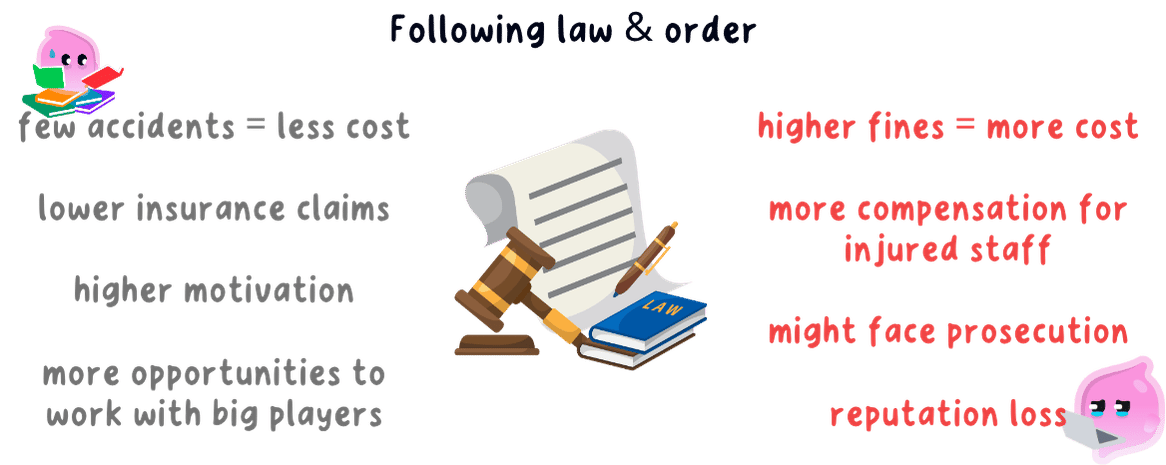
- Fewer accidents and less absence: a safe workplace means fewer injuries, so fewer days are lost and output keeps flowing instead of stopping while cover is arranged.
- Lower insurance and fewer claims: insurers charge lower premiums to a workplace with a clean accident record, and there are no compensation claims to settle.
- Better motivation and lower staff turnover: workers who can see that they are protected feel valued, so more of them stay and the business spends less on recruiting and training replacements.
- A record that wins work: large customers such as the NHS and JCB check a supplier's safety record before awarding a contract, so good practice brings in orders.
Analogy
- Paying for safety is like servicing a delivery van: the yearly bill feels avoidable right up to the morning the engine fails.
- The service is a small predictable cost, while the breakdown costs a day of missed deliveries, a recovery charge and the repair anyway.
- Compliance works the same way, because the money saved by cutting corners is small next to the cost of one serious accident.
The consequences of failing to follow legislation
- Fines: a court or a regulator can fine the business, and for a serious safety breach the fine for a large firm can run into millions of pounds.
- Compensation: an injured worker, or a customer sold goods that were not as described, can claim compensation, which the business pays on top of any fine.
- Prosecution: owners and managers can be taken to court personally, and the most serious cases end in a prison sentence.
- Being stopped or shut down: an inspector can order dangerous work to stop, close premises such as a restaurant kitchen, or withdraw a licence, so the business earns nothing until it puts things right.
- Lost reputation: news of an unsafe factory, a discrimination case or a misleading advert drives customers away and makes good staff harder to recruit.
Common Mistake
- Do not stop at "the business would be fined", because the question is what the fine, the closure or the lost customers do to its profit and its ability to keep trading.
- A fine is paid once, while a damaged reputation keeps costing the business customers and job applicants for years.
Exam technique
- This topic is usually examined as explain the impact of a change in the law on this business, so answer with effects on the business rather than with legal detail.
- Pick two or three named effects, such as a higher wage bill, paid training time or extra record keeping, and follow each one through to costs, output or reputation.
- The common mistake is to describe what a law says and stop there, which never answers a question about the business.
Self review
- Which three groups does business legislation set out to protect?
- Name three ways that obeying the law adds to a business's costs.
- Give two benefits to a business of providing a safe working environment.
- List four consequences a business can face for breaking the law.
