The two routes to expansion
Definition
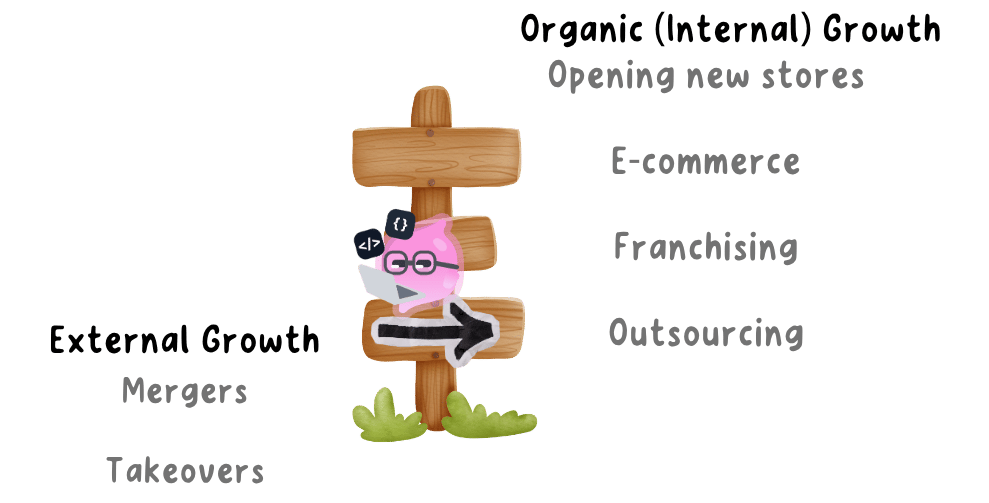
Organic growth: expansion that a business achieves using its own resources, such as opening new stores, selling online, franchising or outsourcing.
External growth: expansion achieved by combining with another business through a merger or a takeover.
- Organic growth, also called internal growth, is normally paid for out of retained profit or a loan, and it happens a step at a time.
- External growth is faster, because the other firm's shops, staff, customers and brand transfer at once, but it costs a large sum up front.
- The test is where the extra capacity comes from: building it yourself is organic growth, and buying it from someone else is external growth.
Opening new stores and e-commerce
- Opening new stores: the business rents or buys extra premises so that it can serve customers in new towns and cities.
- Benefit: it reaches customers who could never travel to the original shop, and the larger chain can buy stock in bigger volumes at a lower price per unit.
- Drawback: each store needs rent, fittings and staff before it takes a single pound, so it ties up a lot of cash, and a badly chosen site can lose money for years.
- Greggs has grown this way for years, adding shops on high streets, in retail parks and at petrol stations to reach more than 2,000 UK locations.
- E-commerce: the business sells through a website or an app, so it can take orders from the whole country, or from abroad, without opening a single extra shop.
- Benefit: it reaches a national or international market without paying rent or shop wages, and the site takes orders at any hour of the day.
- Drawback: it adds the cost of building the site, packing and delivery, customers can compare the price with a rival in seconds, and returns eat into the profit on each sale.
- Gymshark grew from a small operation into an international sportswear brand almost entirely by selling direct to customers online.
Example
- A single farm shop in Devon wants to sell more of its cheese.
- Opening a second shop in Exeter costs £40,000 in rent and fittings and reaches shoppers in one more city.
- Setting up an online shop costs far less and reaches customers across the UK, so long as the cheese can be packed and delivered chilled.
Franchising and outsourcing
- Franchising: the business sells other people the right to trade under its brand name and use its products and systems, in return for a one-off fee and a share of the sales.
- Benefit: the franchisee pays for the premises and hires the staff, so the brand can add outlets quickly without funding each one, and it earns a fee plus a share of every outlet's sales.
- Drawback: the brand loses day-to-day control, because it depends on franchisees keeping standards up, and one poor outlet damages the name everywhere.
- Most McDonald's and Domino's outlets in the UK are run by franchisees, which is how both chains covered the country so fast.
- Outsourcing: the business pays another firm to carry out work it used to do itself, such as manufacturing, deliveries, payroll or customer service.
- Benefit: output can grow without buying more machinery or hiring more staff, because the supplier already has the capacity and the expertise.
- Drawback: quality and delivery times are no longer fully in the firm's hands, and a supplier that raises its prices or misses a deadline at Christmas damages the firm's reputation, not its own.
- An online clothing brand that outsources deliveries to Evri can handle a busy Christmas without buying vans or employing drivers.
Common Mistake
- Franchising and outsourcing are still organic growth, because the business is expanding its own operation rather than buying another firm.
- Do not mix up the two sides of franchising: the franchisor grows the brand, and the franchisee is starting a business of its own.
Mergers and takeovers
Definition
Merger: when two businesses agree to join together to form one larger business.
Takeover: when one business buys enough of another business to gain control of it, whether or not the other business wants to be bought.
- Merger: an agreement between the two sets of owners, so the firms are usually of a similar size and the new business often trades under a combined name.
- Benefit: two sets of customers, premises and expertise combine at once, costs such as head office and advertising can be shared, and because the deal is agreed the staff are more willing to cooperate.
- Drawback: two different ways of working have to be blended, which brings clashes over how things are done, duplicated jobs and the redundancies that follow, and slower decisions while it is sorted out.
- Dixons and Carphone Warehouse merged in 2014 to form Dixons Carphone, putting electricals and mobile phones under one roof.
- Takeover: a purchase, so the buyer ends up owning the other business and can rename it, change its management or close parts of it.
- Benefit: it is the fastest route to growth, because market share, premises, staff and a known brand are bought in one go, and a competitor is removed from the market.
- Drawback: it is expensive, since the buyer usually has to pay more than the business is currently worth, and an unwanted takeover leaves resentful staff and customers who dislike the new owner.
- Kraft took over Cadbury in 2010 by buying more than half of its shares, which gave Kraft control of the Dairy Milk brand and Cadbury's factories.
Note
- The word merger is often used loosely in the news for deals that are really takeovers, so look at who ends up in control.
- If one firm bought the other, it is a takeover, and if the two agreed to become one, it is a merger.
- The benefits and drawbacks above belong to each individual method, whereas what growing does to the business as a whole, including economies and diseconomies of scale, is covered in the article on the benefits and drawbacks of expansion.
Exam technique
- State one method of organic growth is only answered by new stores, e-commerce, franchising or outsourcing, so a merger or takeover here answers the wrong question.
- When asked to explain one method of expansion this business could use, pick the method the case study can actually afford and say how it would work for that firm.
Self review
- What is the difference between organic and external growth?
- Name the four methods of organic growth.
- Give one benefit and one drawback of franchising for the brand that sells the franchise.
- Give one benefit and one drawback of outsourcing.
- Explain the difference between a merger and a takeover, and give one drawback of each.
