1.2.1 Structure of DNA
DNA stores the genetic information of a cell
DNA
The molecule that stores the genetic information of a cell, made of two strands of nucleotides wound into a double helix.
- DNA stands for deoxyribonucleic acid, and it is the chemical that stores the genetic information of a living organism.
- In an animal or plant cell, almost all of the DNA is held inside the nucleus, packaged into thread-like structures called chromosomes.
- The information is stored as a chemical code written along the length of the molecule.
- The cell reads that code to build proteins, and the proteins it builds decide what the cell is able to do.
- Every body cell of an organism contains the same DNA, so the same complete set of instructions is available in each one.
DNA is a store of coded instructions, and the cell uses those instructions to build proteins.
DNA is a polymer built from nucleotides
Polymer
A large molecule made of many small repeating units joined together in a long chain.
Nucleotide
The repeating unit of DNA, made of a sugar, a phosphate group and one of four bases.
Sugar-phosphate backbone
The chain of alternating sugars and phosphate groups that runs along the outside of each DNA strand.
- A polymer is a long molecule made by joining many small repeating units, called monomers, into a chain.
- The monomer of DNA is a nucleotide, so DNA is described as a polymer of nucleotides.
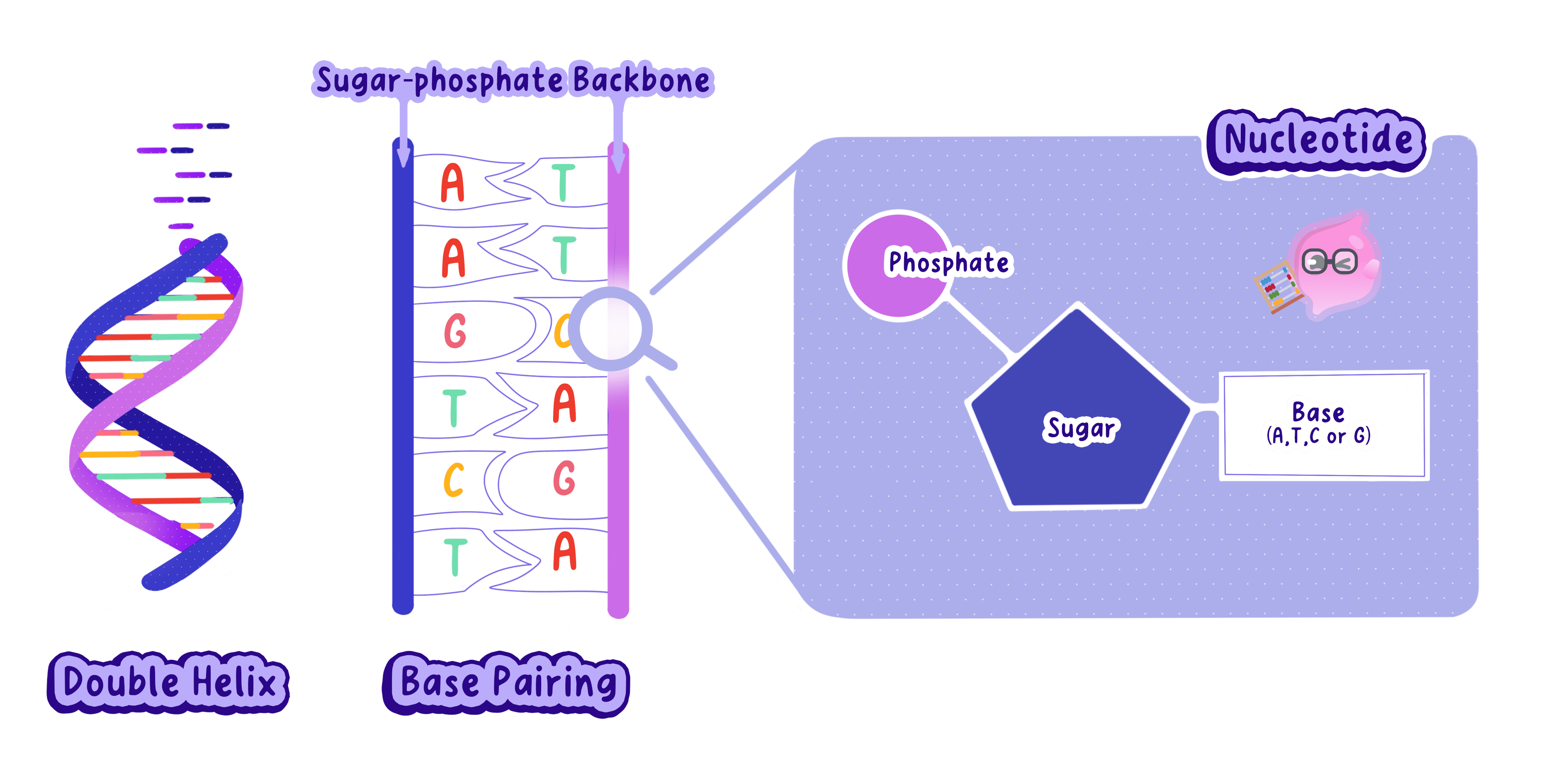
- Each nucleotide is made of three parts joined together: a sugar, a phosphate group and one base.
- The sugar and the phosphate group are identical in every nucleotide, which is what makes them the repeating part of the chain.
- The base is the only part that varies, and there are four bases to choose from: A\text{A}A, C\text{C}C, G\text{G}G and T\text{T}T.
- Nucleotides join into a chain when the sugar of one nucleotide bonds to the phosphate group of the next.
- This alternating run of sugars and phosphate groups is the sugar-phosphate backbone, and it forms the outside edge of the strand.
- One base is attached to each sugar along the backbone, and every base points sideways, off the edge of the chain.
- A single strand of DNA is therefore a backbone with a row of bases hanging from it, and the order of those bases is the coded information.
Counting the parts of a strand
- A single strand of DNA is 121212 nucleotides long.
- It therefore contains 121212 sugars, 121212 phosphate groups and 121212 bases.
- The 121212 sugars and 121212 phosphate groups alternate along the backbone in a fixed pattern.
- Only the order of the 121212 bases differs between this strand and any other strand of the same length.
A nucleotide is not the same thing as a base, because the base is only one of the three parts a nucleotide is made from.
Two strands twist together into a double helix
Double helix
The shape of a DNA molecule, in which two strands are twisted around each other into a spiral.
- A complete DNA molecule is made of two strands, not one.
- The two strands lie alongside each other with their backbones on the outside and their bases pointing inwards, towards the other strand.
- Each base on one strand lines up with a base on the other strand, and the two joined bases are called a base pair.
- The base pairs act as the rungs of a ladder, holding the two backbones a fixed distance apart along the whole length of the molecule.
- The bonds holding each base pair together are weak, so the two strands can be separated when the cell needs to read or copy the code, then joined again afterwards.
- The two strands are also twisted around each other into a spiral, and this two-stranded spiral shape is the double helix.
- The two strands run in opposite directions to each other, which is why a flat diagram of DNA shows one strand drawn the other way up.
- Winding the molecule into a helix keeps a very long chain compact enough to fit inside a nucleus and holds the bases protected in the middle.
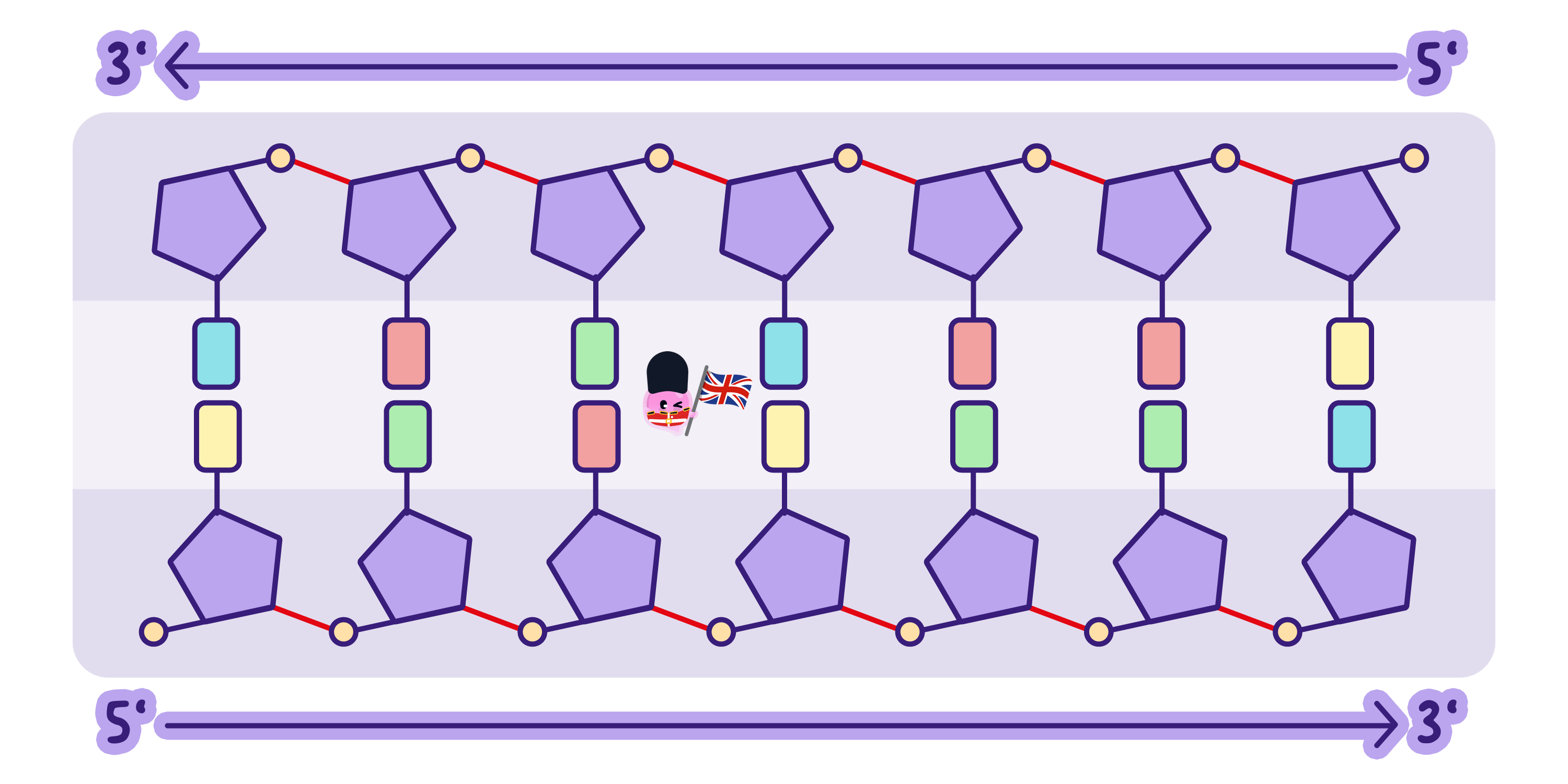
A double helix is a rope ladder that has been gripped at both ends and twisted, with the two backbones as the sides and the base pairs as the rungs.
Describing the structure of DNA
- Give the number of strands, the shape and what holds the strands together, because a three-mark description question is usually marking those three points.
- Use the phrase sugar-phosphate backbone rather than just saying sugar and phosphate, since the backbone is the labelled feature on a diagram.
- Say the strands are held together by base pairs in the middle, because writing only that they are twisted together does not score.
The two strands are joined by the base pairs in the middle of the molecule, not by the sugar-phosphate backbones on the outside.
- How many strands does a DNA molecule contain, and what shape do they form?
- What are the three parts of a nucleotide?
- Which part of a nucleotide varies, and how many versions of it are there?
- What runs along the outside of each DNA strand, and what points into the middle?
- Why is it useful that the bonds holding the two strands together are weak?
1.2.2 Nucleotides and complementary bases
There are four different nucleotides
Nucleotide
The repeating unit of DNA, made of a sugar, a phosphate group and one of four bases.
- All four nucleotides in DNA share the same sugar and the same phosphate group.
- The one part that differs between them is the base attached to the sugar.
- The four bases are adenine (A\text{A}A), thymine (T\text{T}T), cytosine (C\text{C}C) and guanine (G\text{G}G).
- Because there are four possible bases, there are exactly four different nucleotides, and DNA is built from those four alone.
- A strand of DNA is a chain of these four nucleotides in a particular order, and that order is what carries the coded information.
- A single gene can be thousands of nucleotides long, so the number of possible orders is enormous, which is how a four-letter alphabet codes for every protein an organism makes.
The sugar and the phosphate group never change from one nucleotide to the next, so a question asking what makes the four nucleotides different is asking about the base.
Bases join in fixed complementary pairs
Complementary base pairing
The fixed pairing of bases between the two DNA strands, in which adenine pairs with thymine and cytosine pairs with guanine.
Hydrogen bond
A weak bond that forms between a pair of bases and holds the two DNA strands together.
- The bases on the two strands are not paired at random, they follow a fixed rule called complementary base pairing.
- Adenine always pairs with thymine, written as the pair A\text{A}A and T\text{T}T.
- Cytosine always pairs with guanine, written as the pair C\text{C}C and G\text{G}G.
- Each base pair is held together by weak hydrogen bonds that form across the middle of the molecule.
- One hydrogen bond on its own is easily broken, but a DNA molecule contains millions of them, so together they hold the two strands firmly.
- Every pair contains one larger base and one smaller base, so each rung of the ladder is the same width and the helix keeps a constant shape along its length.
- A pairing such as A\text{A}A with G\text{G}G never happens, because the shapes of those two bases do not fit together across the gap.
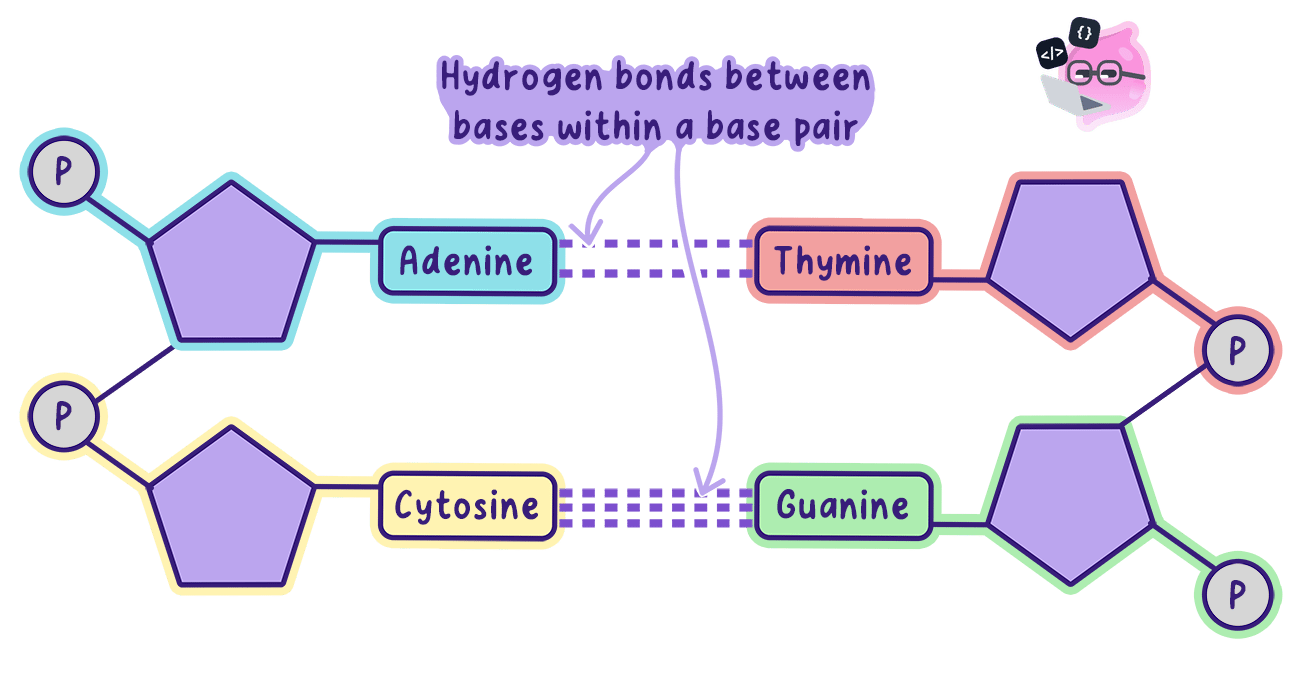
A\text{A}A and T\text{T}T are both straight-sided letters and C\text{C}C and G\text{G}G are both curved letters, which is a quick way of keeping the two pairs apart under pressure.
Never write that A\text{A}A pairs with G\text{G}G or that C\text{C}C pairs with T\text{T}T, because only the pairs A\text{A}A with T\text{T}T and C\text{C}C with G\text{G}G occur in DNA.
One strand sets the sequence of the other
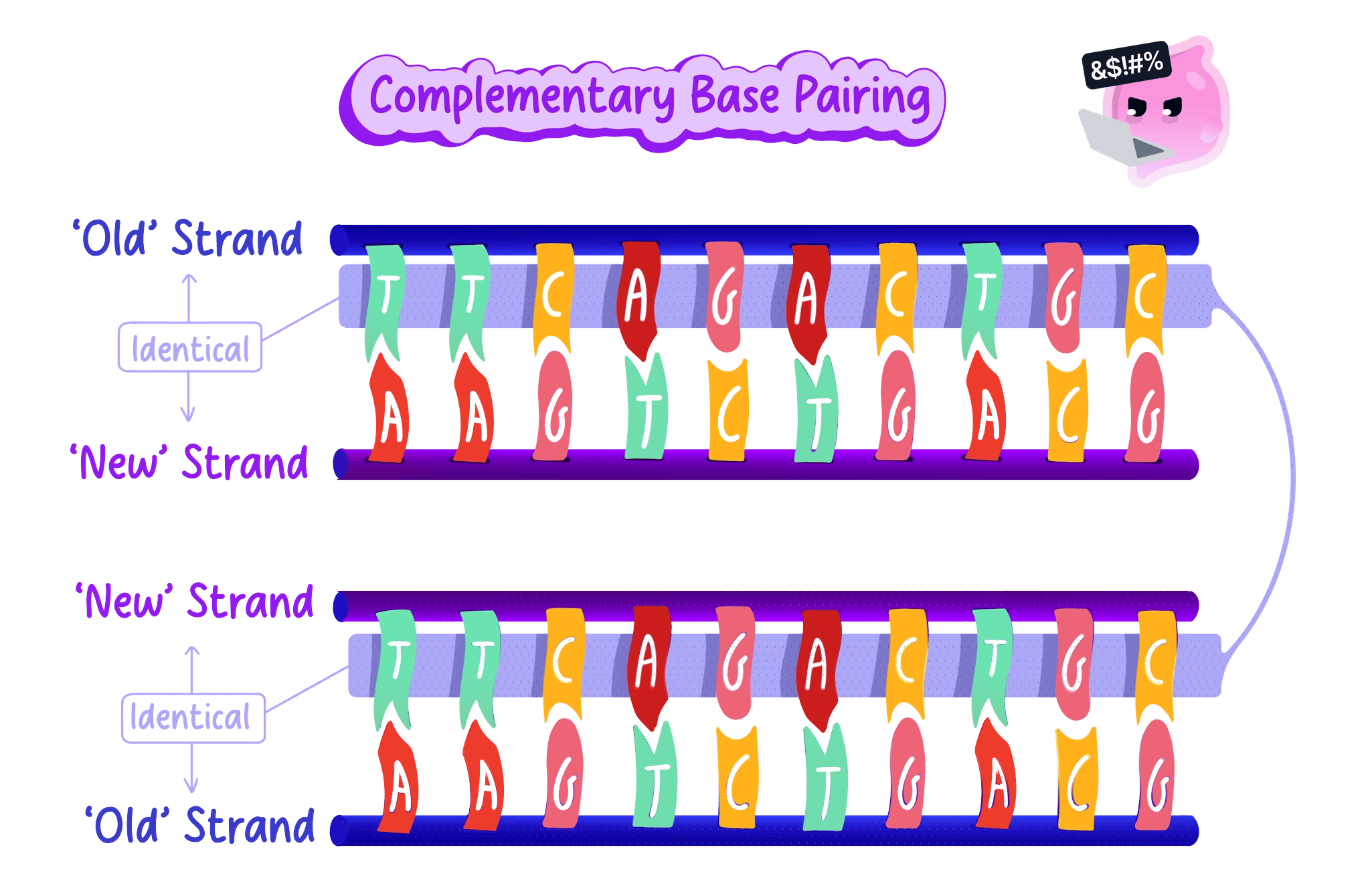
- Because the pairing rule is fixed, knowing the base order of one strand tells you the base order of the other.
- To work out the partner strand, replace every A\text{A}A with T\text{T}T, every T\text{T}T with A\text{A}A, every C\text{C}C with G\text{G}G and every G\text{G}G with C\text{C}C.
- The two strands are called complementary because each is the matching partner of the other, not an identical copy of it.
- This also means the amount of A\text{A}A in a DNA molecule always equals the amount of T\text{T}T, and the amount of C\text{C}C always equals the amount of G\text{G}G.
- When the hydrogen bonds break and the strands separate, each exposed strand can act as a template, because the pairing rule leaves only one possible partner for each base.
- Fixed pairing is therefore what lets the base sequence be rebuilt without error whenever the molecule is copied or read.
Building the complementary strand
- One strand of a DNA molecule reads T\text{T}T A\text{A}A C\text{C}C G\text{G}G G\text{G}G A\text{A}A.
- Take the bases one at a time and swap each for its partner: T\text{T}T gives A\text{A}A, A\text{A}A gives T\text{T}T, C\text{C}C gives G\text{G}G, G\text{G}G gives C\text{C}C, G\text{G}G gives C\text{C}C and A\text{A}A gives T\text{T}T.
- The complementary strand therefore reads A\text{A}A T\text{T}T G\text{G}G C\text{C}C C\text{C}C T\text{T}T.
- Both strands contain six bases, which is the check that no base has been missed out.
Working out the proportion of each base
- A sample of DNA is found to contain 30%30\%30% adenine.
- Adenine pairs only with thymine, so thymine must also make up 30%30\%30% of the bases.
- That accounts for 30+30=60%30 + 30 = 60\%30+30=60%, leaving 100−60=40%100 - 60 = 40\%100−60=40% for cytosine and guanine together.
- Cytosine and guanine pair with each other in equal numbers, so each makes up 40÷2=20%40 \div 2 = 20\%40÷2=20%.
Completing a base sequence
- Work along the sequence base by base rather than trying to read the whole strand at once, because a single slip loses the mark for the entire line.
- Count that your answer has exactly as many bases as the strand you were given.
- Write the letters as clear capitals, since a G\text{G}G that looks like a C\text{C}C cannot be credited.
- If the question asks you to explain the pairing, name the bases in full rather than using only the letters.
- Why are there exactly four different nucleotides in DNA?
- Name the base that pairs with adenine and the base that pairs with cytosine.
- What type of bond holds a base pair together, and why does a molecule need so many of them?
- Write the complementary strand for the sequence G\text{G}G C\text{C}C A\text{A}A T\text{T}T T\text{T}T G\text{G}G.
- A DNA sample contains 22%22\%22% guanine. What percentage is adenine?
1.2.3 Protein synthesis
Protein synthesis happens in two stages
Gene
A gene is a section of DNA that contains the instructions for making a particular protein.
Protein synthesis
The making of a protein from the coded instructions in a gene, by transcription and then translation.
- A gene is a section of DNA that carries the code for one protein, and that code is simply the order of the bases along the gene.
- Protein synthesis is the process that turns that coded order into an actual protein molecule.
- The DNA itself never leaves the nucleus, because the molecule is far too large to pass out through the pores in the nuclear membrane.
- Proteins are assembled at ribosomes out in the cytoplasm, so a copy of the gene has to be carried from the nucleus to the ribosome.
- That need for a copy is why the process is split into two stages: transcription in the nucleus, then translation in the cytoplasm.
- Only the genes a cell currently needs are used, which is why a muscle cell and a liver cell carry identical DNA but build very different sets of proteins.
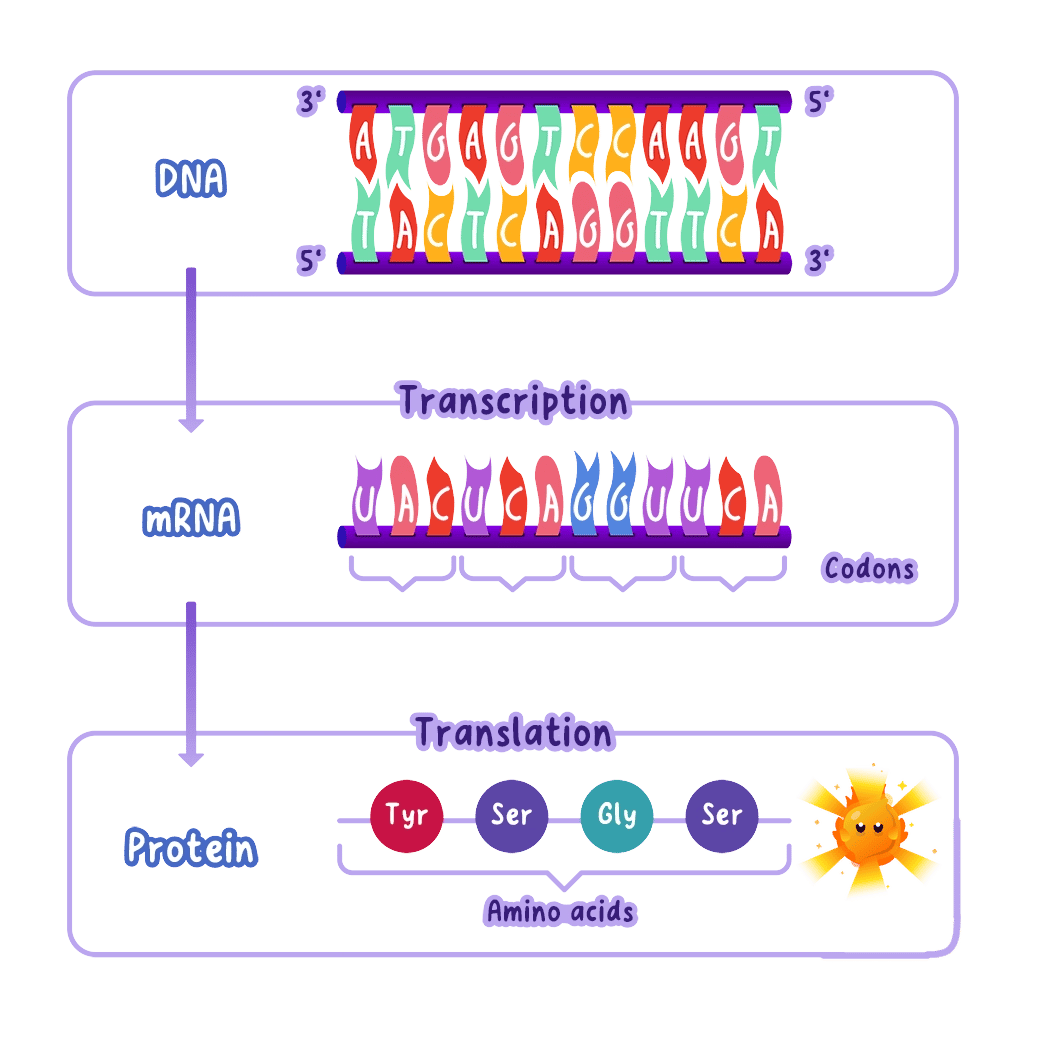
The gene stays in the nucleus and a working copy of it travels to the ribosome, which is the whole reason protein synthesis needs two separate stages.
Transcription copies the gene into mRNA
Transcription
The stage of protein synthesis in which the base sequence of a gene is copied into a molecule of mRNA inside the nucleus.
Messenger RNA
A single-stranded molecule that carries a copy of a gene's base sequence from the nucleus to a ribosome.
- Transcription begins when the DNA unzips along the length of the gene that is being used.
- The weak hydrogen bonds between the base pairs break, the two strands come apart, and the bases of the gene are left exposed.
- The enzyme RNA polymerase attaches at the start of the gene and moves along one of the exposed strands, which acts as the template.
- Free RNA nucleotides floating in the nucleus line up against the template strand by complementary base pairing, so the copy matches the gene base for base.
- RNA carries the base uracil (U\text{U}U) in place of thymine, so a T\text{T}T appears as a U\text{U}U in the copy while A\text{A}A, C\text{C}C and G\text{G}G stay the same.
- RNA polymerase joins the lined-up nucleotides into one continuous strand of messenger RNA (mRNA).
- When the end of the gene is reached the mRNA is released, and the two DNA strands pair up again so the gene is left undamaged.
- The mRNA is short and single-stranded, so unlike the DNA it is small enough to pass out through a nuclear pore into the cytoplasm.
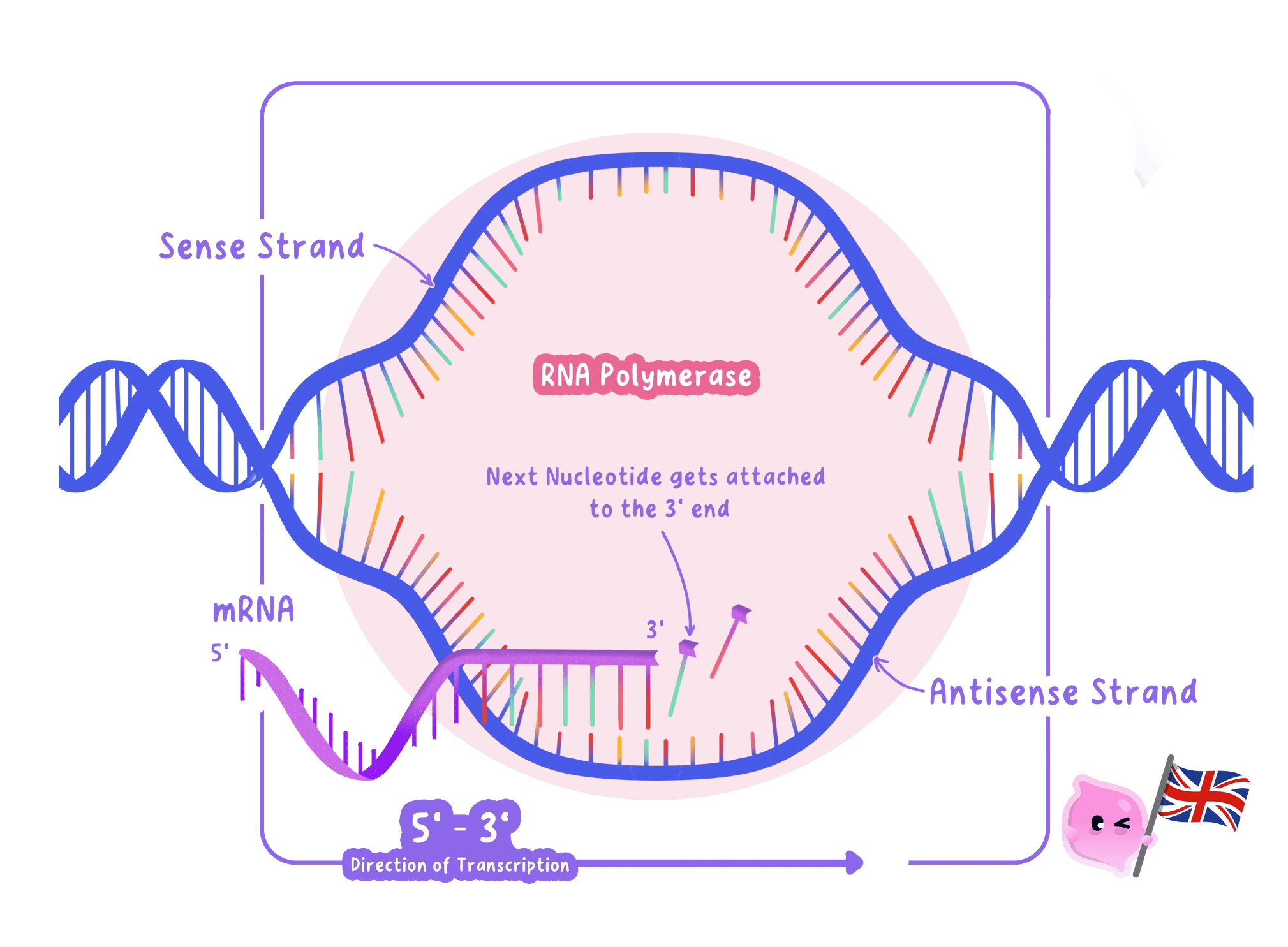
Only the gene in use is unzipped and copied, so do not write that the whole chromosome or the whole DNA molecule is transcribed.
Describing transcription
- Name the nucleus as the location before describing anything else, because location is often the first marking point.
- Say that the DNA unzips and that one strand is used as a template, since saying only that the gene is copied is too vague to credit.
- Name RNA polymerase if the question asks which enzyme is involved.
- End with the mRNA leaving the nucleus, which is the point that links this stage to the next one.
Translation builds the protein at a ribosome
Translation
The stage of protein synthesis in which the base sequence of mRNA is read at a ribosome so that amino acids are joined in the coded order.
Ribosome
The sub-cellular structure in the cytoplasm at which amino acids are joined together to make a protein.
Transfer RNA
A molecule that carries a particular amino acid to the ribosome during translation.
- Out in the cytoplasm the mRNA attaches to a ribosome, which grips the strand between its two halves.
- The ribosome reads the mRNA in groups of three bases at a time, working steadily from one end of the strand to the other.
- Transfer RNA (tRNA) molecules in the cytoplasm collect amino acids and carry them to the ribosome.
- Each tRNA carries one particular amino acid and can only slot into the ribosome opposite the group of three mRNA bases that matches it.
- The ribosome joins each delivered amino acid onto the end of the growing chain, then moves on to the next group of three bases.
- The empty tRNA leaves the ribosome, picks up another amino acid of the same type and is used again.
- Because the tRNA molecules can only bind where they match, the amino acids are joined in exactly the order set out by the mRNA.
- When the ribosome reaches a stop signal at the end of the mRNA, the finished chain of amino acids is released.
- The released chain then folds up into a particular three-dimensional shape, and the folded chain is the finished protein.
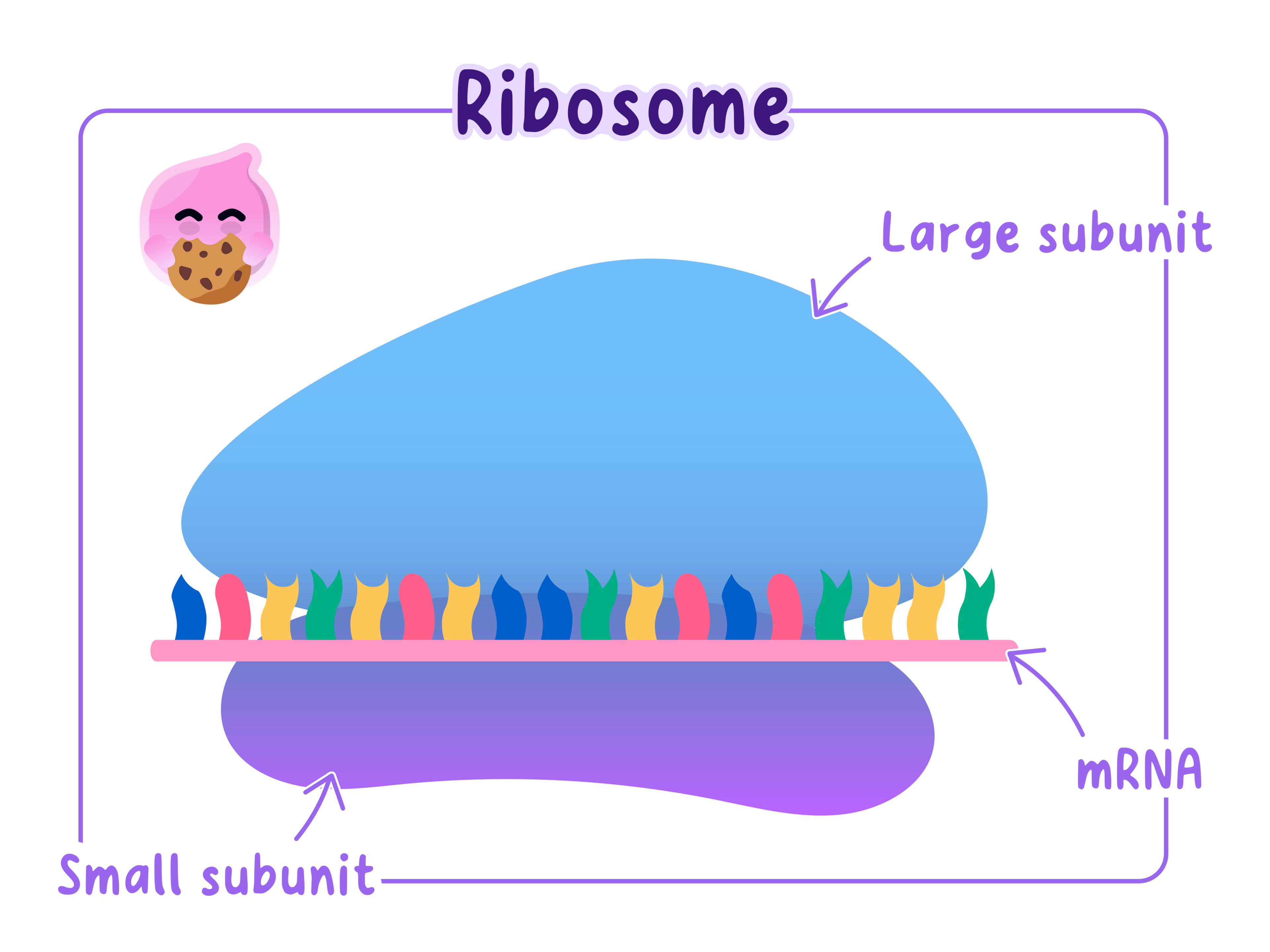
The mRNA is a written order, the ribosome is the worker reading it one line at a time, and the tRNA molecules are the deliveries that bring the right part to the bench at the right moment.
Following one gene through to its protein
- A gene in the nucleus has a coding sequence 900900900 bases long.
- Transcription copies it into an mRNA molecule that is also 900900900 bases long, and that mRNA leaves the nucleus.
- At the ribosome the mRNA is read three bases at a time, giving 900÷3=300900 \div 3 = 300900÷3=300 readings.
- Each reading brings in one amino acid, so the finished chain contains 300300300 amino acids.
The ribosome does not decide the order of the amino acids, it only reads the order already written in the mRNA.
- Why can the DNA not travel to the ribosome itself?
- Where does transcription take place, and which enzyme carries it out?
- What happens to the DNA strands before the mRNA is built, and what happens to them afterwards?
- What is the job of a transfer RNA molecule during translation?
- An mRNA molecule is 150150150 bases long. How many amino acids will the chain contain?
1.2.4 DNA structure and the proteins made
Three bases code for one amino acid
Triplet code
The rule that each sequence of three bases in DNA codes for one amino acid.
Amino acid
The small molecule that is the building block of a protein.
- The bases along a gene are read in groups of three, and each group of three is called a triplet.
- Every triplet stands for one amino acid, and this rule is known as the triplet code.
- The triplets are read in order from one end of the gene to the other, so the order of the triplets fixes the order in which the amino acids are joined.
- Reading in threes gives 4×4×4=644 \times 4 \times 4 = 644×4×4=64 possible triplets, which is comfortably more than the 202020 amino acids used to build proteins.
- Reading in pairs would give only 4×4=164 \times 4 = 164×4=16 combinations, which is too few, and that is why the code works in threes rather than twos.
- Because there are more triplets than amino acids, several different triplets can stand for the same amino acid.
- A few triplets code for no amino acid at all and act as a stop signal, marking the end of the chain.
- The number of amino acids in a protein is therefore the number of coding bases in the gene divided by three.
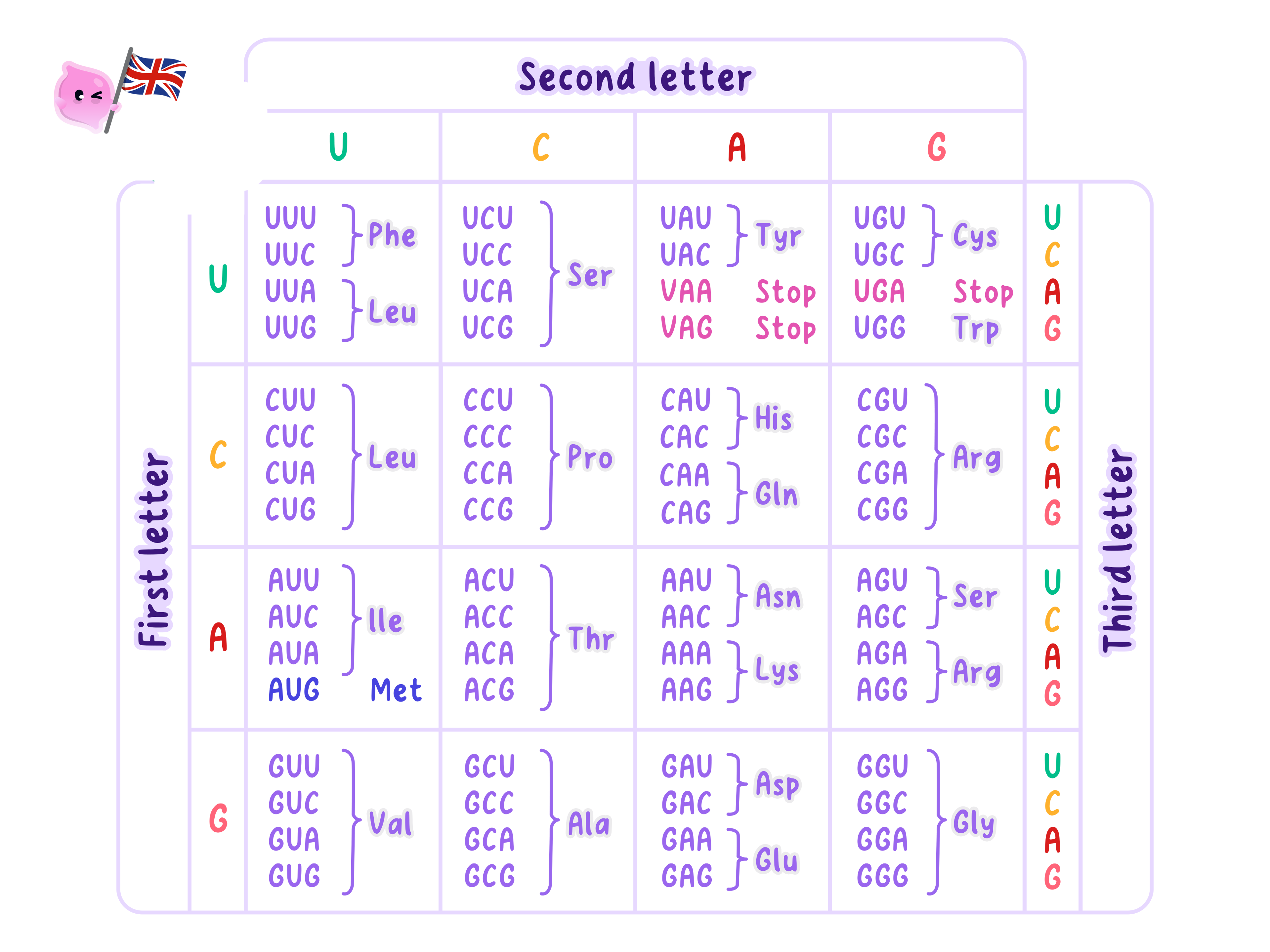
Splitting a base sequence into triplets
- Part of a gene reads C A T G G A T T C\text{C}\ \text{A}\ \text{T}\ \text{G}\ \text{G}\ \text{A}\ \text{T}\ \text{T}\ \text{C}C A T G G A T T C.
- Divide it from the left into groups of three: CAT\text{CAT}CAT, GGA\text{GGA}GGA, TTC\text{TTC}TTC.
- Nine bases give 9÷3=39 \div 3 = 39÷3=3 triplets, so three amino acids are joined.
- They are joined in the order CAT\text{CAT}CAT first, then GGA\text{GGA}GGA, then TTC\text{TTC}TTC, because the triplets are read in sequence.
Converting between bases and amino acids
- Divide by three to go from bases to amino acids, and multiply by three to go the other way.
- Show the division as working, because the calculation mark is often separate from the answer mark.
- Read the question carefully for whether it gives you bases or triplets, since the two are easy to confuse under time pressure.
Amino acid order sets shape, and shape sets function
Protein
A polymer made of a chain of amino acids folded into a particular three-dimensional shape.
- The amino acids are joined into a long chain in the exact order the gene specifies.
- There are 202020 different amino acids, and each has its own chemical properties, so different parts of the chain attract or repel each other.
- Those attractions pull the chain into a folded, three-dimensional shape.
- The same order of amino acids always produces the same pattern of attractions, so the chain always folds into the same shape.
- A protein can only do its job if it has the correct shape, so the shape of a protein determines its function.
- An enzyme works because the folding leaves a pocket whose shape matches the molecule it acts on.
- A structural protein such as collagen works because its chains fold into long, strong fibres that hold tissues together.
- A hormone such as insulin works because its shape fits the receptor on the cells it acts on.
- Antibodies and the carrier proteins in a cell membrane work in the same way, each with a shape suited to the one job it does.
The base order sets the amino acid order, the amino acid order sets the folded shape, and the shape sets the job the protein can do.
A change in the bases can change the protein
Mutation
A mutation is a change in the base sequence of DNA.
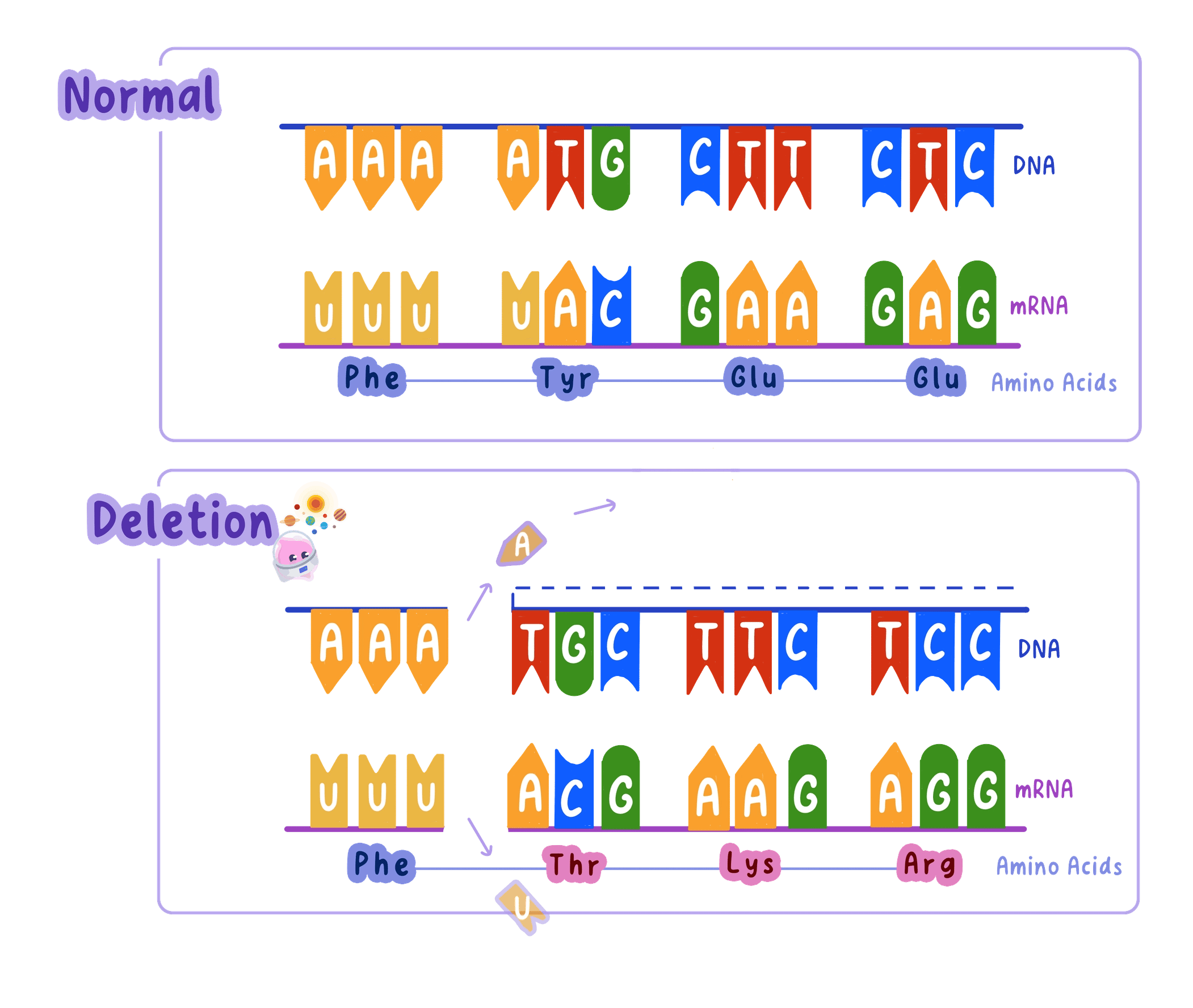
- A mutation is a change in the base sequence of DNA, and because the bases are the code, changing them can change the message.
- If one base is swapped for another, only the triplet containing it changes, so at most one amino acid in the chain is replaced.
- If a base is removed instead, every base after it shifts along, so all the triplets from that point on are grouped differently and most of the remaining amino acids change.
- A different amino acid brings different attractions into the chain, so the chain can fold into a different shape.
- Once the shape is wrong, the protein works less well or stops working altogether.
- In an enzyme, a change to the shape of the pocket can mean the molecule it normally acts on no longer fits, so that reaction is no longer speeded up.
- In a structural protein, a change to the shape can weaken the fibre it forms, so the tissue it supports is weaker.
- Many changes to the bases have no effect at all, either because the new triplet codes for the same amino acid or because the change falls in DNA that does not code for a protein.
- A change can also fall in a part of the DNA that switches a gene on or off, in which case the protein itself is normal but the amount of it produced changes.
Following a single base change
- A triplet in a gene reads CTT\text{CTT}CTT and codes for one particular amino acid.
- A mutation swaps the middle base, so the triplet becomes CAT\text{CAT}CAT.
- The triplets before and after it are untouched, so only that one position in the chain is affected.
- CAT\text{CAT}CAT stands for a different amino acid, so one amino acid in the chain is replaced and the chain may fold differently around that point.
Do not write that every mutation changes the protein, because most changes to the bases make no difference to how the finished protein works.
- How many bases code for one amino acid, and what is that group called?
- A coding sequence is 360360360 bases long. How many amino acids will the protein contain?
- Explain the chain of cause and effect from base order to the job a protein does.
- Why does removing one base usually change more of the protein than swapping one base?
- Give two reasons why a change in the DNA bases might have no effect on an organism.
1.2.5 Investigating enzymatic reactions
Measuring the rate of an enzyme-controlled reaction
Enzyme
A protein that acts as a biological catalyst, speeding up a reaction in a living organism without being used up.
Optimum
The temperature or pH at which an enzyme catalyses its reaction at the fastest rate.
- An enzyme investigation is followed either by measuring how quickly the substrate disappears or by measuring how quickly a product appears.
- For amylase, the substrate is starch, and starch is detected with iodine solution, which turns blue-black when starch is present and stays orange-brown when it is not.
- The moment the iodine first stays orange-brown is the end point, because all the starch has by then been broken down into sugars.
- For catalase, the substrate is hydrogen peroxide and one product is oxygen gas, so the reaction is followed by collecting the gas given off: 2H2O2→2H2O+O22\mathrm{H_2O_2} \rightarrow 2\mathrm{H_2O} + \mathrm{O_2}2H2O2→2H2O+O2.
- When the measurement is a time taken for the reaction to finish, the rate is the reciprocal of that time, rate=1t\text{rate} = \dfrac{1}{t}rate=t1.
- Multiplying by a constant such as 100010001000 gives easier numbers to plot, rate=1000t\text{rate} = \dfrac{1000}{t}rate=t1000, and does not change the shape of the graph.
- When the measurement is a volume of gas, the rate is the volume divided by the time, rate=Vt\text{rate} = \dfrac{V}{t}rate=tV, in cm3 s−1\mathrm{cm^3\,s^{-1}}cm3s−1.
- A shorter time therefore means a faster rate, so a graph of time against temperature and a graph of rate against temperature are opposite shapes.
- The value of the independent variable that gives the highest rate is the optimum.
Turning a reaction time into a rate
- At 30 ∘C30\,^\circ\mathrm{C}30∘C the starch disappears after 80 s80\ \mathrm{s}80 s, so the rate is 100080=12.5\dfrac{1000}{80} = 12.5801000=12.5.
- At 40 ∘C40\,^\circ\mathrm{C}40∘C it disappears after 40 s40\ \mathrm{s}40 s, so the rate is 100040=25\dfrac{1000}{40} = 25401000=25.
- Halving the time has doubled the rate, which is the relationship the reciprocal captures.
- The same constant of 100010001000 must be used for every temperature, or the values cannot be compared.
Effect of substrate concentration on catalase activity
- Aim: to find how the concentration of hydrogen peroxide affects the rate at which catalase from liver breaks it down.
- Apparatus: fresh liver or potato discs, cork borer, scalpel and white tile, hydrogen peroxide solution, distilled water, 10 cm310\ \mathrm{cm^3}10 cm3 and 25 cm325\ \mathrm{cm^3}25 cm3 measuring cylinders, boiling tube with a delivery tube and bung, trough of water, inverted measuring cylinder or gas syringe, stopclock, balance, forceps, goggles and gloves.
- Variables: the concentration of hydrogen peroxide is the independent variable, the volume of oxygen collected in a fixed time is the dependent variable, and temperature, pH, the mass and surface area of liver, the total volume of solution and the timing are all controlled.
- Method, preparing the solutions:
- Dilute the stock hydrogen peroxide with distilled water to make a set of at least five concentrations, for example 20%20\%20%, 40%40\%40%, 60%60\%60%, 80%80\%80% and 100%100\%100% of the stock.
- Keep the total volume the same in every tube, for example 20 cm320\ \mathrm{cm^3}20 cm3, so only the concentration differs.
- Cut liver discs of the same thickness with a cork borer so that every piece has the same surface area, and check their mass on a balance.
- Method, collecting the gas:
- Fill a measuring cylinder with water, invert it over the trough and feed the delivery tube up into it, or connect a gas syringe instead.
- Pour the first hydrogen peroxide solution into the boiling tube, drop in the liver with forceps, and push the bung in firmly as you start the stopclock.
- Record the volume of oxygen collected after a fixed time such as 60 s60\ \mathrm{s}60 s, reading the measuring cylinder at eye level.
- Rinse the apparatus, repeat each concentration three times with fresh liver, and calculate a mean volume.
- Results: the volume of oxygen collected in the fixed time increases as the concentration of hydrogen peroxide increases, and then levels off at the highest concentrations.
- Maths: calculate the rate as rate=Vt\text{rate} = \dfrac{V}{t}rate=tV in cm3 s−1\mathrm{cm^3\,s^{-1}}cm3s−1, plot rate on the vertical axis against concentration on the horizontal axis, and draw a smooth curve of best fit.
- Watch out: gas escapes if the bung is fitted late or loosely, liver left in air loses activity, and pieces of different thickness give different surface areas even at the same mass.
- Safety: hydrogen peroxide is an irritant, so wear goggles and gloves, cut on a tile away from your fingers, wash hands after handling liver and point the tube away from other people.
Setting up a fair test of temperature and pH
- The factor you deliberately change is the independent variable, and the thing you measure is the dependent variable.
- Everything else that could affect the rate is a control variable and must be kept the same, otherwise you cannot tell which factor caused the change.
- The control variables in an enzyme investigation are the concentration and volume of the enzyme, the concentration and volume of the substrate, and whichever of temperature and pH you are not changing.
- Temperature is controlled with a water bath, which holds the tubes steady at a set value far better than leaving them on the bench.
- pH is controlled with a buffer solution, which resists changes in pH as the reaction proceeds.
- The enzyme and the substrate are left in the water bath in separate tubes before they are mixed, so that the reaction starts at the temperature being tested.
- Each value of the independent variable is repeated at least three times and a mean is calculated, which reduces the effect of random error.
- A reading that sits well away from the others is an anomaly, and it is left out of the mean and, where possible, repeated rather than simply ignored.
Effect of temperature on amylase activity
- Aim: to find how temperature affects the rate at which amylase breaks down starch, and so to find the optimum temperature of the enzyme.
- Apparatus: amylase solution, starch solution, pH 777 buffer, iodine solution in a dropping bottle, white spotting tile, boiling tubes and rack, two syringes or graduated pipettes, water baths set to a range of temperatures, thermometer, stirring rod, dropping pipette, stopclock and goggles.
- Variables: temperature is the independent variable, the time for the starch to disappear is the dependent variable, and the volumes and concentrations of amylase and starch, the pH, the size of each drop and the sampling interval are controlled.
- Method, setting up:
- Place a single drop of iodine solution in each well of the spotting tile, enough for the whole run.
- Set the water baths to at least five temperatures across a wide range, for example 101010, 202020, 303030, 404040 and 50 ∘C50\,^\circ\mathrm{C}50∘C, and check each with a thermometer.
- Measure 5 cm35\ \mathrm{cm^3}5 cm3 of starch solution with 2 cm32\ \mathrm{cm^3}2 cm3 of pH 777 buffer into one tube and 2 cm32\ \mathrm{cm^3}2 cm3 of amylase into a second tube.
- Stand both tubes in the first water bath for five minutes so that their contents reach the set temperature before they meet.
- Method, running the reaction:
- Pour the amylase into the starch, stir once, start the stopclock and return the tube to the water bath.
- Every 30 s30\ \mathrm{s}30 s, remove one drop of the mixture with the pipette and add it to a fresh well of iodine.
- The iodine turns blue-black while starch is still present, and stays orange-brown once the starch has all been digested.
- Record the time at which the iodine first stays orange-brown, then repeat the whole run three times at that temperature.
- Move to the next water bath and repeat, using freshly measured solutions each time.
- Results: the time taken falls as the temperature rises towards the optimum, is shortest at the optimum, and then rises sharply at higher temperatures.
- Maths: calculate a mean time at each temperature, convert it with rate=1000t\text{rate} = \dfrac{1000}{t}rate=t1000, then plot rate against temperature and read the optimum from the peak of the curve.
- Watch out: mixing before the tubes have warmed up starts the reaction at the wrong temperature, sampling only every 30 s30\ \mathrm{s}30 s limits how precisely the end point can be found, and a dirty pipette carries starch between wells.
- Safety: iodine stains skin and clothing and is an irritant, so wear goggles, handle hot water baths with care and mop up spills at once.
Effect of pH on amylase activity
- Aim: to find how pH affects the rate at which amylase breaks down starch, and so to find the optimum pH of the enzyme.
- Apparatus: amylase solution, starch solution, buffer solutions at pH 333, 555, 777, 999 and 111111, iodine solution, white spotting tile, boiling tubes and rack, syringes, a water bath set to 35 ∘C35\,^\circ\mathrm{C}35∘C, thermometer, dropping pipette, stopclock and goggles.
- Variables: pH is the independent variable, the time for the starch to disappear is the dependent variable, and temperature, the volumes and concentrations of amylase and starch, the volume of buffer and the sampling interval are controlled.
- Method:
- Put a drop of iodine into each well of the spotting tile and label a tube for each pH value.
- Add 5 cm35\ \mathrm{cm^3}5 cm3 of starch and 2 cm32\ \mathrm{cm^3}2 cm3 of the first buffer to a tube, and 2 cm32\ \mathrm{cm^3}2 cm3 of amylase to a second tube.
- Stand both tubes in the 35 ∘C35\,^\circ\mathrm{C}35∘C water bath for five minutes, so that temperature stays constant throughout and only pH differs between runs.
- Mix the amylase into the starch and buffer, start the stopclock and sample a drop into fresh iodine every 30 s30\ \mathrm{s}30 s.
- Record the time at which the iodine first stays orange-brown, repeat three times, then work through the remaining buffers.
- Results: the reaction is fastest at one pH and slows on either side of it, and at the most acidic and most alkaline values the starch may not be digested at all within the time allowed.
- Maths: convert each mean time with rate=1000t\text{rate} = \dfrac{1000}{t}rate=t1000 and plot rate against pH, which gives a curve with a clear peak at the optimum pH.
- Watch out: use the same volume of buffer every time, because a different volume changes the concentration of the mixture as well as its pH, and check the pH with a meter rather than trusting the label alone.
- Safety: buffers at the extremes of the range are irritant, so wear goggles, avoid skin contact and rinse any splashes with plenty of water.
Reading the results and improving the method
Denaturation
A change in the shape of an enzyme's active site, caused by a high temperature or an extreme pH, so that the substrate can no longer bind.
- A graph of rate against temperature rises to a peak at the optimum and then falls away steeply, so the curve is not symmetrical.
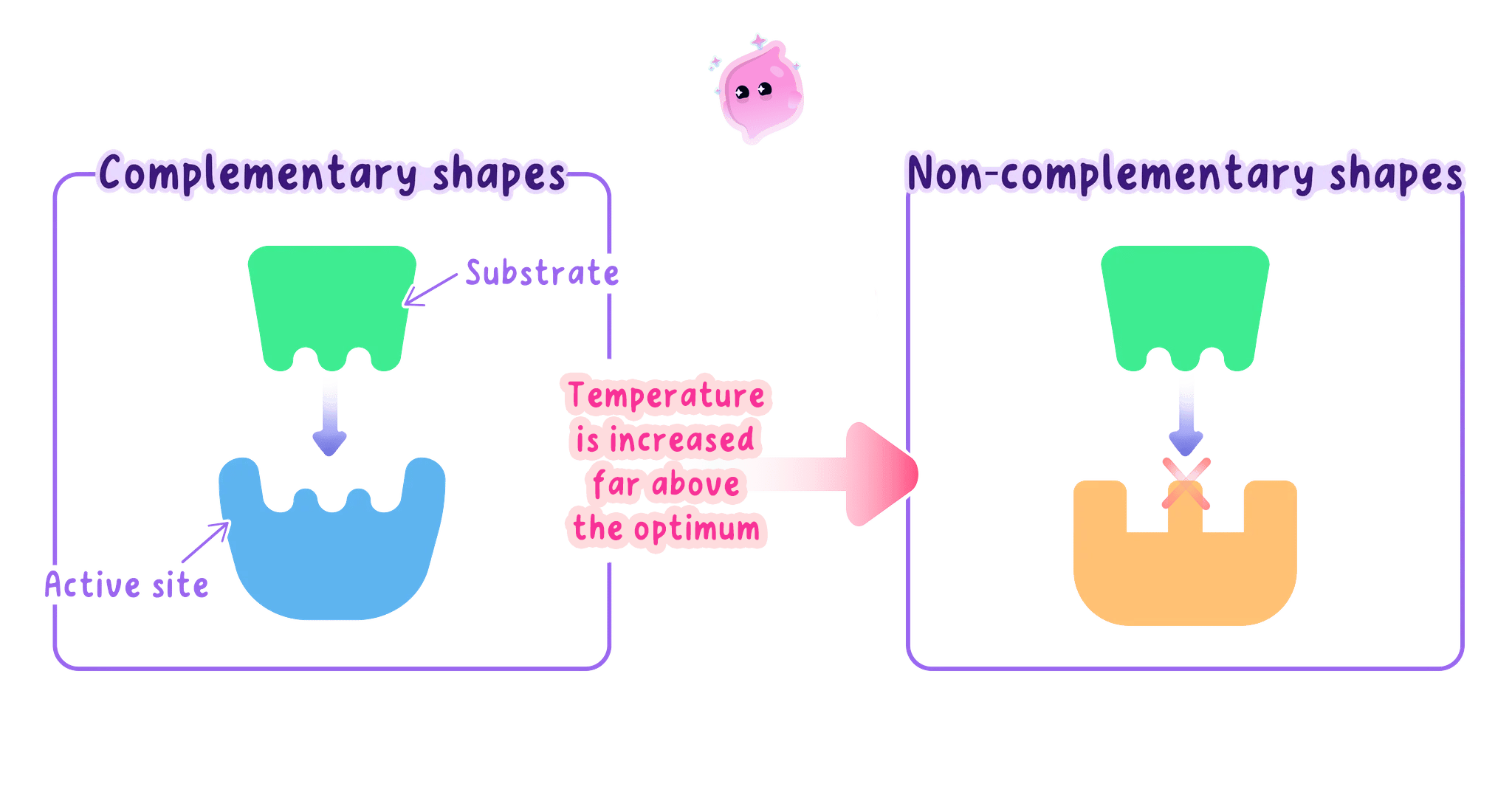
- The steep fall after the peak is caused by denaturation, in which the enzyme loses its folded shape and the substrate can no longer bind.
- Denaturation is not reversed by cooling the mixture down again, so a tube taken above the optimum stays slow for the rest of the run.
- Read the optimum from the peak of the curve rather than from the highest point you happened to test, because the true optimum can lie between two of your temperatures.
- Judging the colour change by eye is a source of error, because different people call the end point at slightly different moments.
- Sampling every 30 s30\ \mathrm{s}30 s means the true end point lies somewhere inside the last interval, so taking samples every 10 s10\ \mathrm{s}10 s improves the precision.
- A colorimeter removes the personal judgement altogether, because it measures the colour of the mixture as a number.
- Testing more values close to the peak gives a better estimate of the optimum than spreading the same number of readings across a wide range.
An enzyme heated above its optimum is denatured, not killed, because an enzyme is a molecule and was never alive.
Answering on an enzyme investigation
- Name the control variables individually rather than writing that everything else was kept the same, since the marks are given for the named variables.
- Say why a variable is controlled, for example that pH is buffered because a change in pH would change the rate as well.
- State whether a shorter time means a faster or a slower reaction, because the mark is often for interpreting the direction correctly.
- When asked for an improvement, give a change to the method and the reason it helps, rather than writing only that you would repeat the experiment.
- What colour is iodine solution with starch present, and what colour once the starch has gone?
- Name the independent, dependent and three control variables for the temperature investigation.
- Why are the enzyme and substrate left in the water bath before they are mixed?
- The starch disappears after 25 s25\ \mathrm{s}25 s. Calculate the rate using rate=1000t\text{rate} = \dfrac{1000}{t}rate=t1000.
- Give one source of error in the iodine method and one change that would reduce it.
1.2.6 Mechanism of enzyme action
Enzymes are the biological catalysts of metabolism
Enzyme
A protein that acts as a biological catalyst, speeding up a reaction in a living organism without being used up.
Catalyst
A substance that increases the rate of a chemical reaction without being changed or used up itself.
Metabolism
The sum of all the chemical reactions that take place in a cell or organism.
- Every chemical reaction needs a certain amount of energy before it will start, and at body temperature most reactions in a cell would run far too slowly to keep the organism alive.
- A catalyst speeds a reaction up by lowering the energy needed to start it, and it is not used up, so the same molecule works over and over again.
- An enzyme is a protein that acts as a biological catalyst, which means it is a catalyst made by and working inside a living organism.
- Metabolism is the whole set of chemical reactions taking place in a cell, and almost every one of them is controlled by its own enzyme.
- Enzymes let a cell run those reactions quickly at about 37 ∘C37\,^\circ\mathrm{C}37∘C, instead of needing the high temperatures a chemist would use to force the same reaction along.
- Some enzymes catalyse breaking-down reactions, splitting one large molecule into smaller ones, as happens when a sugar such as maltose is broken into glucose.
- Others catalyse building-up reactions, joining small molecules into a larger one, as happens when glucose molecules are joined to make starch in a plant cell.
- Because enzymes are proteins, they are themselves built by protein synthesis, so the genes a cell uses decide which reactions that cell can carry out.
An enzyme is not used up and is not alive, so describe it as a catalyst rather than as something the reaction consumes.
The substrate binds to the active site
Active site
The region of an enzyme with a shape complementary to its substrate, where the substrate binds and the reaction takes place.
Substrate
The molecule that an enzyme acts on.
Enzyme-substrate complex
The structure formed when a substrate is bound to the active site of an enzyme.
- Every enzyme has a pocket in its surface called the active site, which is formed by the way its chain of amino acids folds up.
- The molecule an enzyme acts on is called its substrate.
- Enzyme and substrate molecules move about randomly in solution, so a reaction can only begin when the two collide.
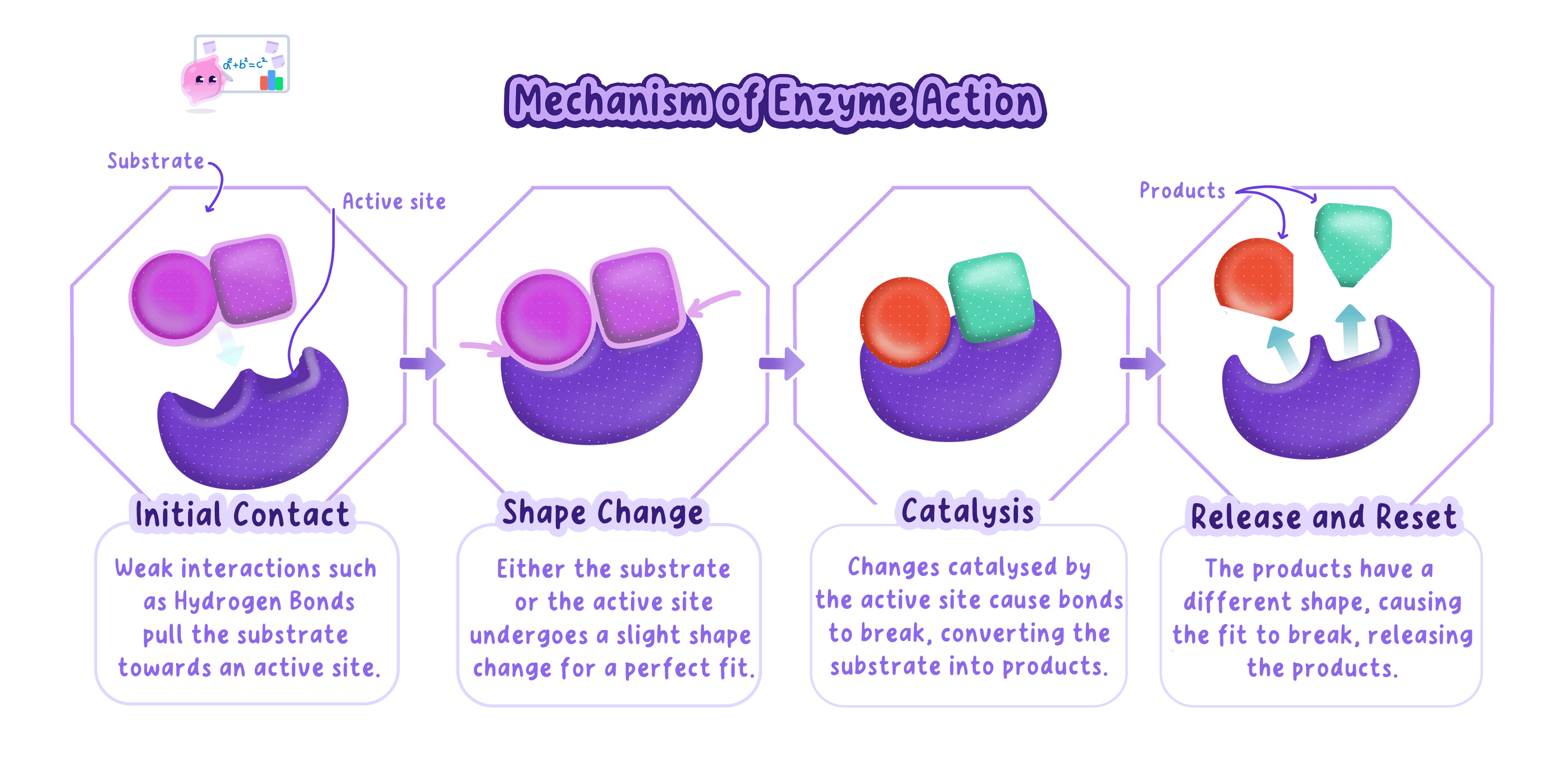
- If the substrate hits the active site the right way round, it binds and forms an enzyme-substrate complex.
- Holding the substrate in the active site puts strain on its bonds, and in a building-up reaction it holds two substrate molecules side by side in exactly the right position.
- Either way, less energy is needed for the reaction to happen, which is how the enzyme speeds it up.
- The reaction takes place while the substrate is held, turning it into the products.
- The products have a different shape from the substrate, so they no longer fit the active site and are released into the solution.
- The enzyme itself is left completely unchanged, so its active site is free at once to bind another substrate molecule.
- This is why a cell needs only a small quantity of each enzyme, since one molecule can catalyse the same reaction thousands of times.
An enzyme works like a stapler, which holds the sheets in exactly the right position, does the job in one movement and is ready for the next pair straight away.
Specificity comes from the shape of the active site
Enzyme specificity
The property of an enzyme by which it catalyses only one reaction, because only its own substrate fits the active site.
- The lock and key hypothesis explains enzyme action by treating the active site as a lock and the substrate as the only key that fits it.
- The shape of the active site is complementary to the shape of the substrate, meaning the two match each other the way a hand matches a glove.
- Only a substrate with the matching shape can bind, so each enzyme catalyses just one reaction, and this is called specificity.
- A molecule of the wrong shape cannot enter the active site, so no complex forms and the enzyme has no effect on it.
- Amylase breaks starch down into sugars, and it has no effect on protein or fat.
- Protease breaks protein down into amino acids by splitting the bonds between them.
- Lipase breaks lipids down into fatty acids and glycerol.
- Because every reaction has its own enzyme, a cell controls which reactions run simply by controlling which enzymes it makes and where it puts them.
Write that the substrate is complementary to the active site, not that it is the same shape as the active site, because the two shapes fit together rather than match.
Temperature, pH and concentration change the rate
Optimum
The temperature or pH at which an enzyme catalyses its reaction at the fastest rate.
Denaturation
A change in the shape of an enzyme's active site, caused by a high temperature or an extreme pH, so that the substrate can no longer bind.
- Raising the temperature gives the enzyme and substrate molecules more kinetic energy, so they move faster, collide more often and collide harder.
- More successful collisions with the active site means more enzyme-substrate complexes form each second, so the rate rises.
- Above the optimum temperature the enzyme vibrates so strongly that the bonds holding its folded shape break, and the active site changes shape.
- The enzyme is then denatured, the substrate no longer fits, and the rate falls steeply and does not recover when the mixture is cooled again.
- Most human enzymes have an optimum close to 37 ∘C37\,^\circ\mathrm{C}37∘C and are denatured above roughly 505050 to 60 ∘C60\,^\circ\mathrm{C}60∘C.
- Moving the pH away from the optimum changes the charges on the amino acids that hold the active site in shape, so the site is distorted and eventually denatured.
- A pH graph therefore has a peak at the optimum with the rate falling away on both the acidic and the alkaline side.
- Different enzymes have different optimum pH values to suit where they work, so amylase in the mouth works best near pH 777 while pepsin in the acidic stomach works best at about pH 222.
- Increasing the substrate concentration increases the rate, because collisions between substrate molecules and active sites become more frequent.
- Once every active site is occupied the rate levels off, because the number of enzyme molecules has become the limiting factor and extra substrate has to wait.
- Increasing the enzyme concentration increases the rate, because there are more active sites available for the substrate to collide with.
- If the substrate then runs short the rate levels off again, because the substrate has become the limiting factor instead.
Explaining a levelling-off in the rate
- A tube contains a fixed mass of catalase and the concentration of hydrogen peroxide is doubled from 222 to 444 units.
- The rate of oxygen production roughly doubles, because twice as many substrate molecules are colliding with the active sites.
- Doubling the concentration again from 444 to 888 units produces almost no further increase.
- Every active site is already occupied, so the number of enzyme molecules is now the limiting factor and only adding more catalase would speed the reaction up.
Explaining a change in enzyme rate
- Take the answer all the way through to the active site, because most explain marks are for the effect on binding rather than for naming the factor.
- Use collisions and enzyme-substrate complexes for the rising part of a curve, and denaturation for the falling part.
- Say which factor is limiting whenever a graph levels off, since that is the mark students most often miss.
- Name the exact temperature or pH from the graph when the question gives you one, rather than describing it as high or low.
Do not write that heat kills an enzyme, because an enzyme is a molecule and is denatured rather than killed.
- What is a biological catalyst, and why does a cell need them at 37 ∘C37\,^\circ\mathrm{C}37∘C?
- Describe the four steps from collision to the release of the products.
- Use the lock and key hypothesis to explain why amylase cannot digest protein.
- Explain why the rate falls above the optimum temperature but rises below it.
- Why does increasing the substrate concentration eventually stop increasing the rate?
