1.3.1 Cellular respiration supplies ATP
What cellular respiration is
Cellular respiration
The series of enzyme-controlled reactions that goes on continuously in every living cell, breaking down glucose to supply the ATP the cell needs.
- Cellular respiration is the series of enzyme-controlled reactions that breaks glucose down inside a cell so the energy held in its bonds can be transferred to ATP.
- It is a universal process, which means it goes on in every living cell of every living organism, from a single bacterium to an oak tree to you.
- It also runs continuously, day and night, awake and asleep, from the moment a cell is formed until the moment it dies.
- A cell keeps no useful reserve of ready energy, so if respiration paused for even a short time the cell would have nothing left to power its reactions.
- The breakdown is not one single reaction but a chain of many small steps, and each step has its own enzyme controlling it.
- Splitting the job into small steps lets the energy leave the glucose in small, usable amounts instead of all at once, which would damage the cell.
- Because enzymes run every step, the rate of respiration rises with temperature up to an optimum and falls away if the enzymes are denatured.
- Glucose is the main respiratory substrate, which is the name for the molecule that gets broken down.
- An animal cell receives glucose from digested food carried to it in the blood, while a plant cell makes its own glucose by photosynthesis and then respires it.
- Respiration is a chemical process happening inside cells, so it is a different thing from breathing, which simply moves air in and out of the lungs.
- Do not use the word respiration to mean breathing, because breathing moves air while respiration breaks down glucose inside cells.
- Do not write that respiration makes, creates or produces energy, because the energy already exists in the glucose and is only transferred to ATP.
- Do not restrict respiration to animals, because a plant cell respires every hour of the day and night just as yours do.
- Do not describe respiration as a single reaction, because it is a long sequence of steps, each one controlled by an enzyme.
How ATP stores and releases energy
ATP
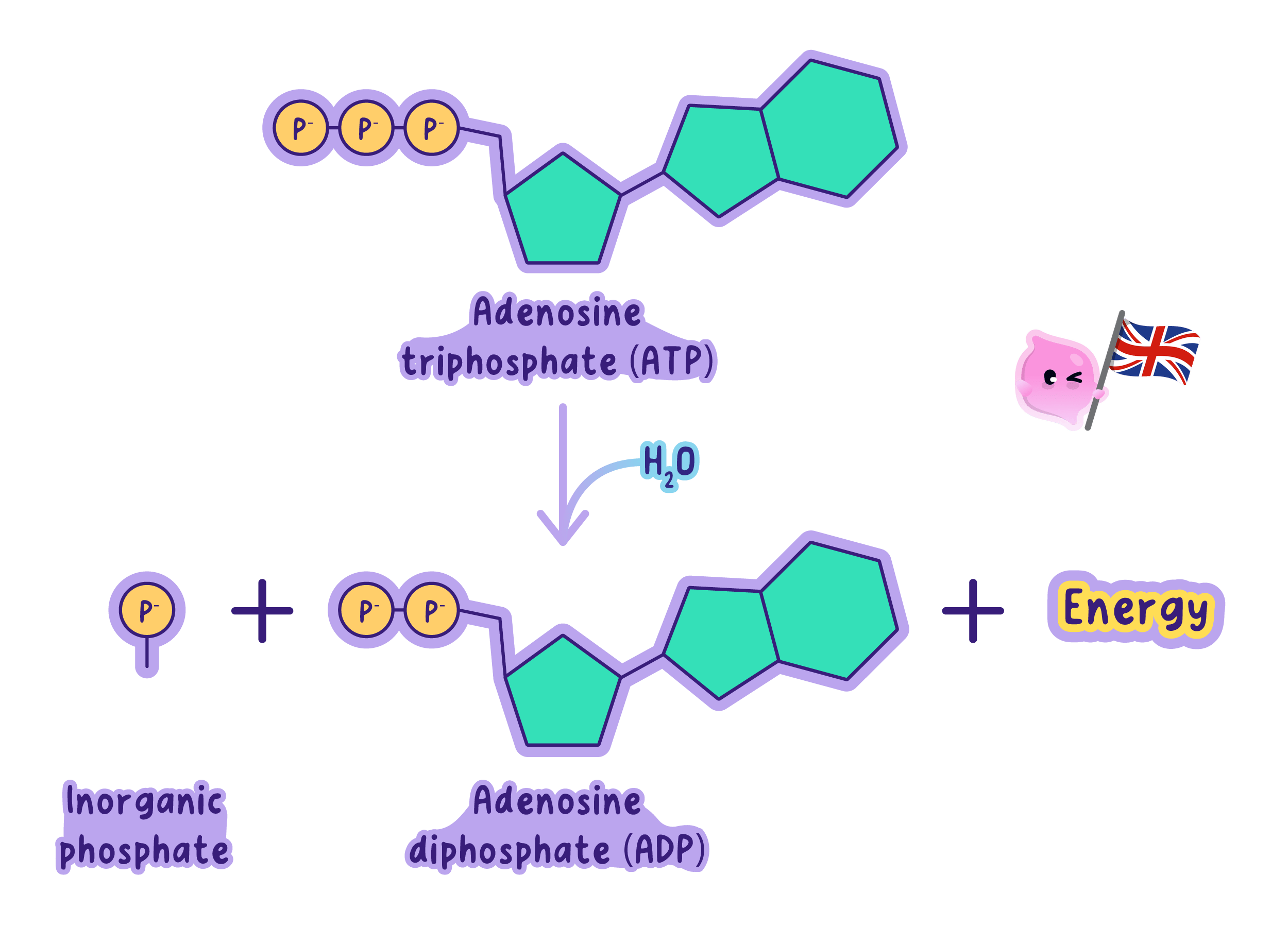
Adenosine triphosphate, the molecule made during respiration that carries energy around a cell and releases it when it is broken down to ADP and phosphate.
- ATP stands for adenosine triphosphate, and the name describes the molecule: an adenine base, a ribose sugar and a chain of three phosphate groups.
- Energy transferred by respiration is used to attach a third phosphate group onto ADP, which stands for adenosine diphosphate, and this builds a molecule of ATP.
- Building ATP can be written as ADP+Pi→ATP\text{ADP} + \text{P}_{\text{i}} \rightarrow \text{ATP}ADP+Pi→ATP, where Pi\text{P}_{\text{i}}Pi stands for an inorganic phosphate group.
- When a process in the cell needs energy, the bond holding that third phosphate group is broken instead, giving ATP→ADP+Pi\text{ATP} \rightarrow \text{ADP} + \text{P}_{\text{i}}ATP→ADP+Pi.
- Breaking that bond releases the stored energy at the exact place in the cell where the work is being done.
- The ADP and the phosphate group are not thrown away; they stay in the cell and are joined together again by the next round of respiration.
- A single ATP molecule is therefore spent and rebuilt over and over, so a cell needs a fast rate of respiration rather than a large store of ATP.
- ATP is called the cell's energy currency because every process that needs energy is paid for in ATP, whatever fuel the energy originally came from.
- Glucose cannot power a reaction directly, because one glucose molecule holds far more energy than any single reaction needs, and ATP breaks that store into small packets.
Recharging ATP in a working muscle
- A muscle fibre holds only enough ATP to keep contracting for a second or two.
- As the fibre contracts, ATP is broken down to ADP and phosphate, and the energy released slides the muscle filaments past one another.
- The ADP and phosphate stay inside the fibre and are rebuilt into ATP straight away using energy from respiration.
- One ATP molecule can be spent and rebuilt many times a minute, so a muscle that works harder does not store more ATP; it respires faster.
What cells spend ATP on
- Muscle contraction is powered by ATP, so every movement an animal makes depends on a supply of it.
- Synthesis of large molecules from smaller ones needs ATP, because joining subunits together does not happen on its own.
- Amino acids are joined into proteins, glucose molecules are joined into starch or glycogen, and nucleotides are joined into DNA.
- Active transport needs ATP, because moving a substance against its concentration gradient can only happen if energy is supplied.
- Cell division needs ATP to copy the DNA and to pull the chromosomes to opposite ends of the cell.
- Transmission of nerve impulses needs ATP to pump ions back across the membrane after each impulse has passed.
- In mammals and birds, part of the energy transferred by respiration warms the body and helps hold the internal temperature steady.
- The list of jobs is almost the same in a plant cell as in an animal cell, apart from holding a constant body temperature.
- A cell that carries out more of these jobs needs a faster supply of ATP, and so has to respire faster.
Respiration as an exothermic reaction
Exothermic reaction
A reaction that transfers energy out to its surroundings, so the surroundings become warmer.
- An exothermic reaction transfers energy out to its surroundings, so the surroundings end up warmer than they started.
- The bonds in glucose hold more energy than the bonds in the products of respiration, so there is a surplus every time a glucose molecule is broken down.
- Only part of that surplus is captured in ATP, and the rest leaves the cell as heat, which makes respiration exothermic.
- Because respiration never stops, this heat is being released all the time, in every cell of every organism.
- A tissue that respires quickly releases heat quickly, so it warms up more than a tissue that is resting.
- Contracting muscles respire faster during exercise, which is why you feel hot after sprinting for a bus.
- A large number of respiring organisms packed together warms its surroundings noticeably, which is why the middle of a compost heap or a bag of damp grass cuttings feels hot.
- In a mammal or bird, this steady release of heat is what makes a constant internal body temperature possible even when the air outside is cold.
- A plant releases heat from respiration too, but it has no way of holding its temperature steady, so that heat is simply lost to the air around it.
Heat released by germinating seeds
- Aim: to show that living, respiring tissue releases heat, and therefore that respiration is exothermic.
- Apparatus: two vacuum flasks, two thermometers or temperature probes with a data logger, cotton wool plugs, soaked mung bean or cress seeds, disinfectant solution, a boiling water bath, beakers, a measuring cylinder and a clamp stand.
- Variables: whether the seeds are alive or dead is the independent variable, the temperature inside the flask is the dependent variable, and the mass of seeds, the volume of disinfectant, the size of flask, the thickness of the cotton wool plug and the position in the room are all controlled.
- Method, preparing the seeds:
- Soak two equal masses of seeds in water for about a day so that they start to germinate and respire rapidly.
- Kill one batch by boiling it for roughly ten minutes, then leave it to cool until it is back at room temperature so both batches start from the same point.
- Rinse both batches in disinfectant for a few minutes and then in clean water, because microorganisms living on the seed coats would respire and release heat of their own.
- Method, setting up:
- Pack the living seeds into one vacuum flask and the boiled seeds into the second, filling both flasks to the same level.
- Push a loose plug of cotton wool into each neck so that air can still reach the seeds while heat is trapped inside.
- Push a thermometer through each plug until its bulb sits in the middle of the seeds, then clamp both flasks upright side by side.
- Method, taking readings:
- Record the starting temperature inside both flasks.
- Leave both flasks undisturbed in the same place and record both temperatures every few hours for four or five days.
- Plot temperature against time for both flasks on the same pair of axes so the two curves can be compared directly.
- Results: the flask holding the living seeds warms by several degrees over the following days, while the flask of boiled seeds stays close to room temperature throughout.
- Maths: find the temperature rise in each flask using ΔT=Tfinal−Tstart\Delta T = T_{\text{final}} - T_{\text{start}}ΔT=Tfinal−Tstart, and read the gradient of the steepest part of the living-seed curve to find when respiration was fastest.
- Watch out: the boiled seeds are the control, and without them any temperature rise could be blamed on a warm room rather than on respiration. Missing out the disinfectant lets bacteria and fungi respire on the seed coats, which warms both flasks and hides the real result. A tight stopper instead of cotton wool cuts off the oxygen supply and slows respiration in the living seeds.
- Safety: wear eye protection when handling disinfectant and boiling water, keep clear of the hot water bath, and wash your hands after touching the seeds.
Writing about respiration and ATP
- Say that respiration transfers energy from glucose to ATP, because answers claiming energy is made or produced are not credited.
- Name ATP instead of writing energy on its own when a question asks what respiration supplies to the cell.
- Give a named use of ATP, such as muscle contraction or active transport, whenever a question asks why a cell has to respire.
- Use the word exothermic and then add that energy is transferred to the surroundings, since the term on its own rarely earns the second mark.
- For the seed investigation, always mention the boiled seeds as the control and state that they show the rise is caused by living tissue.
- State what is meant by cellular respiration and name the molecule it supplies.
- Explain why respiration has to go on continuously in every living cell.
- Describe how ATP is built from ADP and how it releases its energy again.
- Explain why a cell relies on ATP rather than using glucose directly to power a reaction.
- Explain what the boiled seeds show in an investigation into the heat released by germinating seeds.
1.3.2 Aerobic and anaerobic respiration
Aerobic respiration
Aerobic respiration
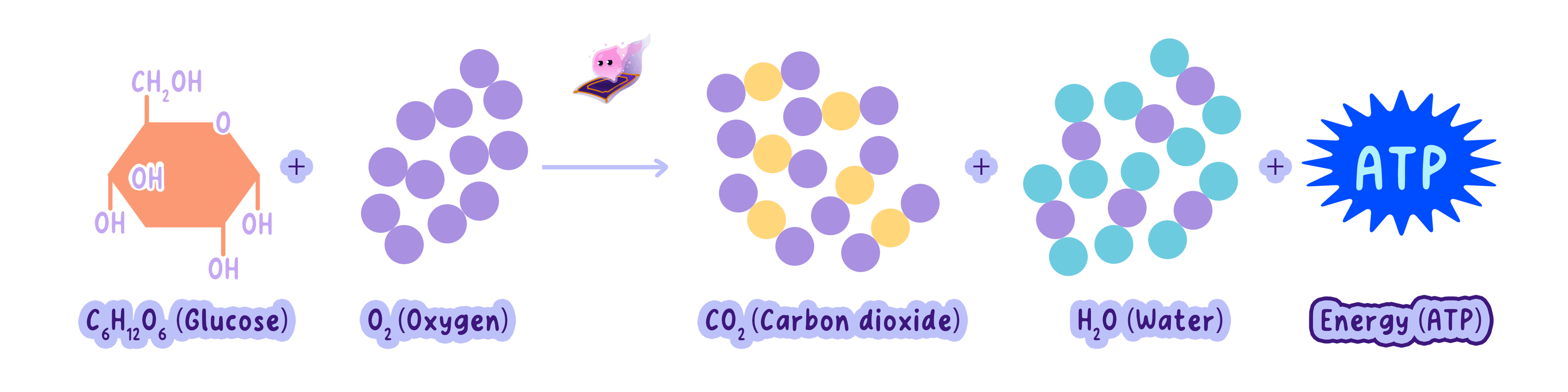
Respiration that uses oxygen to break glucose down completely into carbon dioxide and water, transferring enough energy to make a large yield of ATP.
Mitochondrion
The organelle that contains the enzymes for aerobic respiration and is where most of a cell's energy is released.
- Aerobic respiration is respiration that uses oxygen, and it is the pathway a cell uses whenever enough oxygen is reaching it.
- The substrate is glucose, and because oxygen is available the glucose is broken down completely.
- Complete breakdown means every carbon atom in the glucose ends up in carbon dioxide and every hydrogen atom ends up in water, so none of the chemical energy is left locked in a leftover molecule.
- The word equation is glucose + oxygen →\rightarrow→ carbon dioxide + water.
- The balanced symbol equation is C6H12O6+6O2→6CO2+6H2OC_6H_{12}O_6 + 6O_2 \rightarrow 6CO_2 + 6H_2OC6H12O6+6O2→6CO2+6H2O.
- Check the balancing by counting atoms: there are 666 carbon, 121212 hydrogen and 181818 oxygen atoms on each side of the arrow.
- The first steps take place in the cytoplasm, and the reactions that need oxygen are completed inside the mitochondria.
- A cell with a heavy demand for ATP, such as a muscle fibre or a liver cell, is therefore packed with mitochondria.
- Because the glucose is used up completely, aerobic respiration gives a large yield of ATP, roughly thirty molecules of ATP from each molecule of glucose.
- Oxygen has to be delivered continuously by the blood, so the maximum rate of aerobic respiration is set by how fast the heart and lungs can supply it.
- Do not give heat or energy as a product in the equation, because the products are carbon dioxide and water and the energy is transferred to ATP.
- Do not write that aerobic respiration happens only in mitochondria, because the first stage takes place in the cytoplasm.
- Do not forget the large numbers in the symbol equation, since an unbalanced equation earns no mark.
Anaerobic respiration in animal cells
Anaerobic respiration
Respiration that breaks glucose down incompletely without using oxygen, giving a much smaller yield of ATP.
- Anaerobic respiration is respiration without oxygen, and an animal cell switches to it when oxygen is being used faster than the blood can deliver it.
- The clearest example is a muscle during vigorous exercise, when the heart and lungs cannot keep up with the demand of the working fibres.
- The substrate is still glucose, but without oxygen the glucose is broken down only incompletely.
- The word equation is glucose →\rightarrow→ lactic acid.
- All of these reactions happen in the cytoplasm, because the stages that use the mitochondria cannot run without oxygen.
- The yield of ATP is small, only about two molecules of ATP per molecule of glucose, which is roughly fifteen times less than the aerobic pathway gives.
- The yield is small because lactic acid still holds a great deal of unreleased chemical energy in its bonds.
- The advantage of the pathway is speed, because it supplies ATP quickly enough to keep a muscle contracting during a short burst of hard effort.
- The disadvantage is that lactic acid builds up in the muscle and the blood, causing muscle fatigue and pain, so the pathway can only be used for a short time.
- The lactic acid is later broken down once oxygen is available again, which is why heavy breathing continues after the exercise has stopped.
- Do not name carbon dioxide or water as products of anaerobic respiration in an animal cell, because the only product is lactic acid.
- Do not say the muscle runs out of oxygen completely, since anaerobic respiration takes over when oxygen supply falls behind demand.
- Do not claim anaerobic respiration releases no energy, because it still transfers enough to make a small amount of ATP.
Anaerobic respiration in plant and fungal cells
Fermentation
Anaerobic respiration in plant and yeast cells, in which glucose is broken down into ethanol and carbon dioxide.
- In plant cells and in fungi such as yeast, anaerobic respiration follows a different route and is called fermentation.
- The conditions are the same, which is an absence of oxygen, and the substrate is again glucose broken down incompletely.
- The word equation is glucose →\rightarrow→ ethanol + carbon dioxide.
- These reactions also take place entirely in the cytoplasm, and the yield is the same small amount of about two molecules of ATP per glucose.
- The energy that is not transferred stays locked in the bonds of the ethanol, which is why ethanol burns so readily.
- Plant roots ferment when the soil becomes waterlogged, because water fills the air spaces and no oxygen can reach them.
- Yeast ferments whenever it is sealed away from air, which is what makes it useful for making bread and for brewing.
Fermentation in a loaf and in a brewery
- A baker mixes yeast into dough, where the yeast ferments the sugars in the flour.
- The carbon dioxide released is trapped as bubbles in the stretchy dough, which is what makes the loaf rise.
- The small amount of ethanol produced evaporates in the heat of the oven, so the baked bread contains none.
- A brewer keeps yeast in a sealed vessel of sugary liquid so that no oxygen gets in and fermentation continues.
- Here it is the ethanol that is wanted and the carbon dioxide that bubbles away, which is the same reaction being used for the opposite product.
Comparing the pathways
- Conditions
- Aerobic respiration needs a supply of oxygen, while both forms of anaerobic respiration run only when oxygen is absent or in short supply.
- Substrate
- All three pathways start with glucose, so the substrate is not what makes them different.
- Extent of breakdown
- Aerobic respiration breaks the glucose down completely, whereas anaerobic respiration leaves an energy-rich product behind.
- Products
- Aerobic respiration gives carbon dioxide and water, an animal cell respiring anaerobically gives lactic acid, and a plant or yeast cell gives ethanol and carbon dioxide.
- Site in the cell
- Aerobic respiration begins in the cytoplasm and is completed in the mitochondria, while anaerobic respiration is confined to the cytoplasm.
- Relative yield of ATP
- Aerobic respiration gives roughly thirty ATP per glucose and anaerobic respiration only about two, so the aerobic pathway is around fifteen times more productive.
- A cell will always use the aerobic pathway when it can, because using glucose anaerobically wastes most of the energy the molecule holds.
How much more ATP the aerobic pathway gives
- A muscle fibre respires 121212 molecules of glucose aerobically.
- At about 303030 molecules of ATP per glucose, that gives 12×30=36012 \times 30 = 36012×30=360 molecules of ATP.
- The same 121212 molecules of glucose respired anaerobically give only 12×2=2412 \times 2 = 2412×2=24 molecules of ATP.
- The ratio is 36024=15\dfrac{360}{24} = 1524360=15, so the fibre would need fifteen times as much glucose to do the same work without oxygen.
Comparing the two types of respiration
- Compare the pathways point by point on the same features: oxygen, extent of breakdown, products, site and ATP yield.
- Use comparative wording such as more ATP than or less complete than, because two separate descriptions with no link do not answer a compare question.
- Name lactic acid for animal cells and ethanol with carbon dioxide for plant and yeast cells, since the marks are usually split between the two.
- Write about a relatively large or relatively small yield of ATP if you are unsure of the figures, because the comparison is what is being assessed.
- Balance the symbol equation before moving on, and keep the state of every substance consistent across the arrow.
- Write the balanced symbol equation for aerobic respiration and check that it balances.
- State where in a cell each stage of aerobic respiration takes place.
- Give the word equation for anaerobic respiration in a muscle cell and name the product.
- Give the word equation for fermentation in yeast and name both products.
- Explain why anaerobic respiration transfers so much less energy from each glucose molecule than aerobic respiration does.
1.3.3 Sugars and carbohydrates
Monomers and polymers
Monomer
A small molecule that can be joined to many others of the same kind to build a polymer.
Polymer
A large molecule built from many monomers joined together in a long chain.
Carbohydrate
A biological molecule made of carbon, hydrogen and oxygen only, built from sugar monomers and used mainly to release or store energy.
- A monomer is a small molecule that can be joined to many others of the same kind, and a polymer is the long chain that results.
- Cells build almost every large molecule this way, because it needs only a small set of subunits and one joining reaction to make an enormous variety of products.
- A carbohydrate is a molecule made of carbon, hydrogen and oxygen only, and its monomers are simple sugars.
- Glucose, the commonest of those sugars, has the formula C6H12O6C_6H_{12}O_6C6H12O6, so its ratio of carbon to hydrogen to oxygen is 1:2:11:2:11:2:1.
- Every carbohydrate keeps roughly that ratio, which is why carbohydrates hold so much oxygen compared with the other groups of biological molecule.
- The same joining reaction builds a carbohydrate from sugars, and the reverse reaction takes it apart again when the cell needs the sugars back.
- The word sugar covers both the single units and the small molecules made from two of them joined together.
- A polymer is not a mixture of different molecules; it is one molecule made of many repeats of the same kind of subunit.
Sugars as the monomers of carbohydrates
Monosaccharide
A single sugar unit, such as glucose or fructose, which is the monomer of every carbohydrate.
Disaccharide
A sugar made of two monosaccharides joined together by a condensation reaction, such as maltose or sucrose.
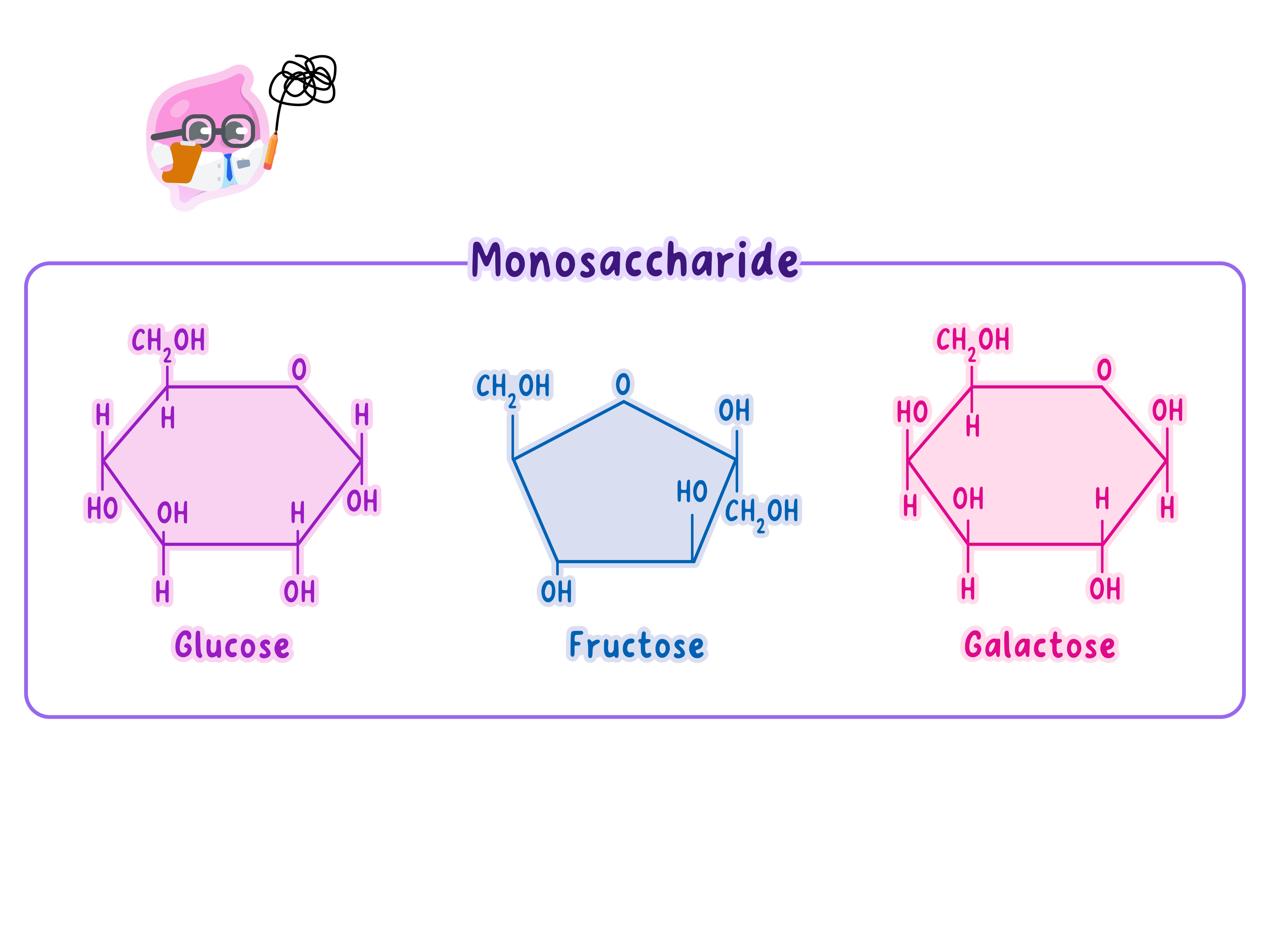
- A monosaccharide is a single sugar unit, and it is the monomer from which every carbohydrate is assembled.
- Glucose, fructose and galactose are the monosaccharides you need to recognise, and all three share the formula C6H12O6C_6H_{12}O_6C6H12O6.
- They share a formula but not a shape, because their atoms are arranged differently, so they taste different and enzymes treat them differently.
- Glucose and galactose form six-sided rings while fructose forms a five-sided ring.
- A plant cell makes its own glucose by photosynthesis, while an animal cell receives glucose from digested food carried in the blood.
- A disaccharide is made when two monosaccharides are joined together.
- Maltose is glucose joined to glucose, sucrose is glucose joined to fructose, and lactose is glucose joined to galactose.
- Sucrose is the sugar a plant moves around in its phloem, and lactose is the sugar in milk.
- Both monosaccharides and disaccharides are soluble in water and taste sweet, which is what everyday use of the word sugar refers to.
Building and breaking carbohydrates
Condensation reaction
A reaction in which two smaller molecules join together and one molecule of water is released.
Hydrolysis
A reaction in which a large molecule is split into smaller ones by adding a molecule of water at each bond broken.
- A condensation reaction joins two sugars together and releases one molecule of water as the new bond forms.
- The water comes from the two sugars themselves, because a hydrogen atom is taken from one and a hydroxyl group from the other.
- Building a long chain means repeating that reaction, so joining nnn monomers into one polymer releases n−1n-1n−1 molecules of water.
- The reactions are controlled by enzymes and driven by energy from ATP, which is why a growing cell needs a fast supply of it.
- Hydrolysis is the reverse reaction, in which a molecule of water is added at each bond to break the chain back into its monomers.
- Hydrolysis is what happens when a carbohydrase enzyme digests a carbohydrate, so amylase hydrolyses starch and maltase hydrolyses maltose.
- Hydrolysis is essential because a polymer is far too large to cross a cell membrane, while a single sugar is small enough to be absorbed.
- Taken together, the two reactions let a cell store glucose safely when it is plentiful and release it again the moment it is needed.
Counting the water molecules released
- A plant cell joins 500500500 glucose molecules into one chain of starch.
- Each new bond releases one molecule of water, and a chain of 500500500 units contains 499499499 bonds.
- The number of water molecules released is therefore 500−1=499500 - 1 = 499500−1=499.
- Hydrolysing that chain back to single glucose molecules would use up the same 499499499 molecules of water.
- Do not describe condensation as adding water, because water is released when the bond forms and used up when it is broken.
- Do not treat glucose, fructose and galactose as the same molecule just because they share a formula, since their atoms are arranged differently.
- Do not call starch a sugar, because sugars are the small soluble molecules and starch is the insoluble polymer built from them.
The three polysaccharides
Polysaccharide
A carbohydrate polymer made of many monosaccharides joined in a long chain, such as starch, glycogen or cellulose.
Starch
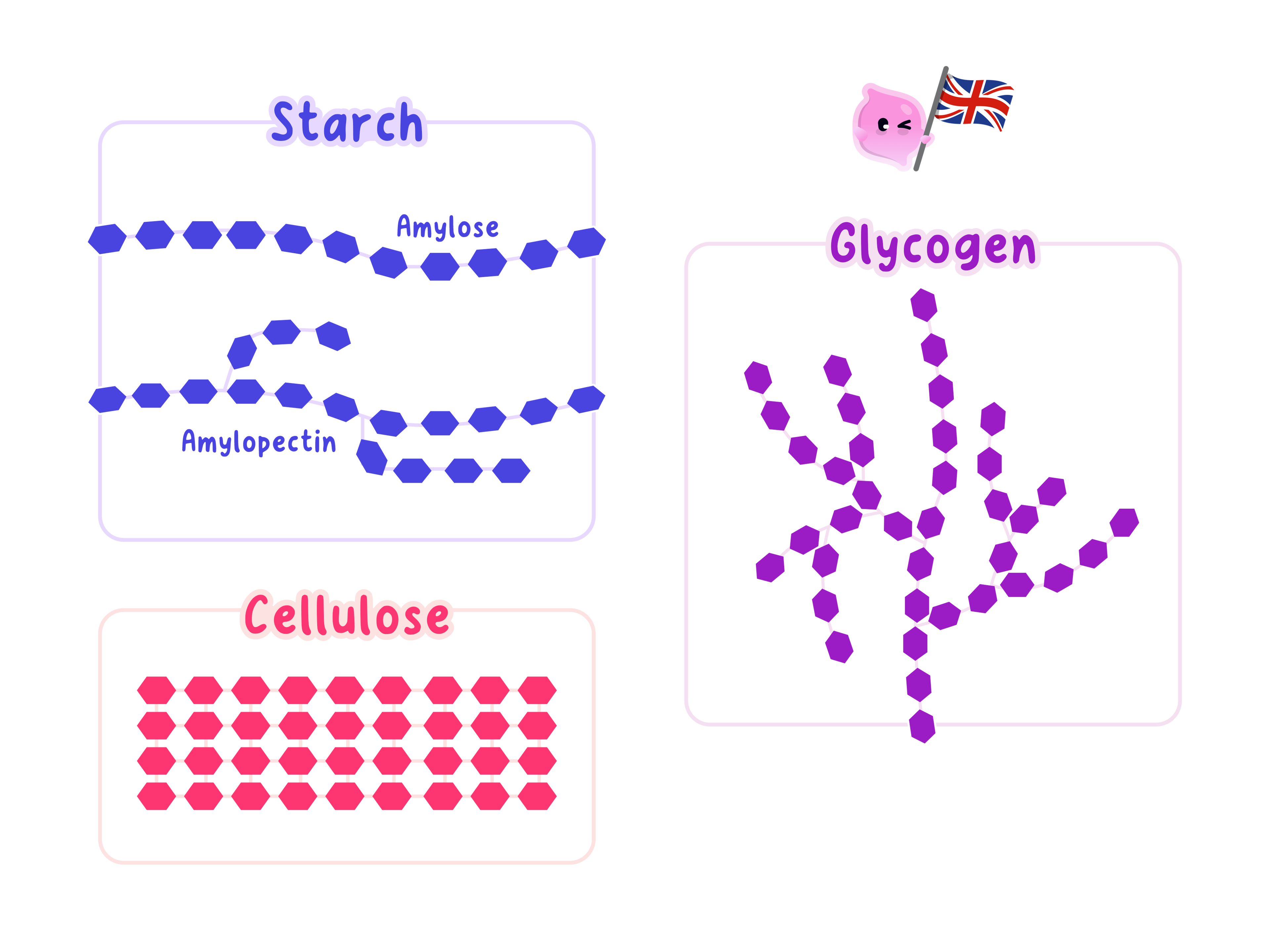
The coiled, partly branched polysaccharide of glucose monomers that plants use to store glucose.
Glycogen
The highly branched polysaccharide of glucose monomers that animals and fungi use to store glucose, held mainly in the liver and muscles.
Cellulose
The polysaccharide of straight glucose chains, cross-linked into strong fibres, that forms the cell wall of a plant cell.
- A polysaccharide is a carbohydrate polymer of many monosaccharides joined in a long chain.
- Starch is the polysaccharide a plant uses to store glucose, and it is built from glucose monomers alone.
- Its chains are coiled, and some of them branch, which packs a very large number of glucose units into a small space inside a cell.
- Starch is insoluble, so it does not dissolve in the cytoplasm and does not draw water into the cell by osmosis the way stored glucose would.
- A plant lays down starch in its leaves during the day and in storage organs such as potato tubers and seeds for the longer term.
- Glycogen is the equivalent store in animals and fungi, and it is also built from glucose monomers alone.
- Its chains are much more highly branched than those of starch, which means many chain ends are exposed at once.
- Every exposed end is a place an enzyme can start hydrolysing, so glycogen can be broken back down to glucose very quickly when demand rises.
- That matters because an animal can move suddenly and needs glucose released within seconds, which is why glycogen is stored in the liver and muscles.
- Cellulose is not a store at all; it is a structural polysaccharide, and it too is built from glucose.
- Its glucose units are joined so that the chains stay straight rather than coiling, and neighbouring chains are then cross-linked to one another.
- Bundles of cross-linked chains form strong fibres that are laid down in layers to make the cell wall of a plant cell.
- Those fibres are what let a plant cell resist the outward pressure of the water inside it without bursting, and what makes celery stringy and wood strong.
- All three are made from the same monomer, so it is the arrangement of the chains, not the subunit, that decides what each polysaccharide can do.
Linking a polysaccharide to its job
- Name the monomer as glucose for starch, glycogen and cellulose alike, because all three are built from it.
- Follow a structural feature with the consequence it has, for example that heavy branching gives many ends for enzymes to work on.
- Say insoluble rather than does not dissolve well when you explain why starch is a safe store inside a cell.
- Use the word condensation for building and hydrolysis for breaking down, and state whether water is released or used.
- Give a plant example and an animal example when a question asks about storage, since a single example often limits the marks available.
- State what is meant by a monomer and by a polymer.
- Name the three monosaccharides and give the formula they share.
- Describe what happens to a molecule of water when two sugars are joined by a condensation reaction.
- Explain why glycogen can be broken down to glucose faster than starch can.
- Explain how the arrangement of cellulose chains suits the job of a plant cell wall.
1.3.4 Amino acids and proteins
Amino acids as the monomers of proteins
Amino acid
The monomer from which every protein is built; there are about twenty different amino acids and they can be joined in any order.
Polymer
A large molecule built from many monomers joined together in a long chain.
- An amino acid is the monomer from which every protein is built, and a protein is the polymer that results from joining them.
- Amino acids contain carbon, hydrogen, oxygen and nitrogen, and a few of them contain sulfur as well.
- Nitrogen is what sets proteins apart from carbohydrates and lipids, which contain no nitrogen at all.
- There are about twenty different amino acids available to a cell, and each one has a different side group attached to the same basic structure.
- Because the basic structure is the same in every amino acid, any one of them can be joined to any other, in any order.
- The sequence, meaning the order in which the amino acids are joined, is different for every different protein.
- A short chain is called a polypeptide, and a protein is one or more of those chains folded into its finished shape.
- Even a small protein of a hundred amino acids can be assembled in an almost unimaginable number of different orders, which is why one set of twenty monomers can build every protein a body needs.
- A plant makes all its own amino acids by combining sugars with nitrates taken up from the soil, while an animal has to obtain most of its from protein in food.
- The sequence of amino acids in a protein is set by the order of bases in the gene that codes for it.
- Change one amino acid in the sequence and the protein that is built is a different molecule, even though it is the same length.
Building and breaking proteins
Condensation reaction
A reaction in which two smaller molecules join together and one molecule of water is released.
Hydrolysis
A reaction in which a large molecule is split into smaller ones by adding a molecule of water at each bond broken.
- Amino acids are joined by condensation reactions, and each new bond releases one molecule of water.
- Joining nnn amino acids into a single chain therefore forms n−1n-1n−1 bonds and releases n−1n-1n−1 molecules of water.
- The joining happens on the ribosomes, and the energy needed for it comes from ATP supplied by respiration.
- Hydrolysis breaks a protein back down, adding one molecule of water at each bond to release the individual amino acids again.
- Protease enzymes hydrolyse the protein in food during digestion, because a whole protein molecule is far too large to be absorbed.
- The amino acids released are absorbed into the blood and delivered to cells, which then join them together in a completely new order to build the proteins that body needs.
- A protein eaten in a meal is therefore not used as it is; it is taken apart into its monomers and those monomers are reassembled.
- Amino acids cannot be stored, so any that are surplus to requirements are broken down in the liver rather than kept for later.
- Proteins in the body are also being hydrolysed and rebuilt all the time, which is why a steady supply of amino acids is needed even in an adult who is no longer growing.
Counting the water released when a protein is built
- A cell joins 124124124 amino acids into a single polypeptide chain.
- A chain of 124124124 units is held together by 124−1=123124 - 1 = 123124−1=123 bonds.
- Each bond forms in a condensation reaction that releases one molecule of water, so 123123123 molecules of water are released.
- Hydrolysing the same chain right back to single amino acids would use up those same 123123123 molecules of water.
Folding gives each protein its shape
Protein
A polymer made of one or more chains of amino acids folded into a specific three-dimensional shape that suits the job it does.
- Once the chain has been assembled it does not stay stretched out; it folds into a particular three-dimensional shape.
- The folded shape is held in place by bonds between different parts of the same chain, formed wherever two side groups come close enough to attract one another.
- Which side groups end up close together depends entirely on the sequence, so the sequence determines the shape.
- A different sequence brings different side groups together, folds into a different shape, and therefore produces a protein that does a different job.
- Most proteins work by binding to another molecule, and binding only happens when the two shapes are complementary, which means they fit together.
- An enzyme is a protein whose folded shape leaves a pocket called the active site, and only a substrate with a matching shape will fit into it.
- The same principle explains why an antibody binds to one pathogen and not another, and why a receptor in a cell membrane responds to one hormone only.
- Structural proteins are shaped for strength instead of binding, which is how collagen makes tendons tough and keratin makes hair and nails hard.
- Carrier proteins in a cell membrane are folded so that a channel runs right through them, which is what lets particular substances pass into and out of the cell.
What happens when a protein loses its shape
Denaturation
The permanent change in the folded shape of a protein, caused by a high temperature or an extreme pH, which stops the protein working.
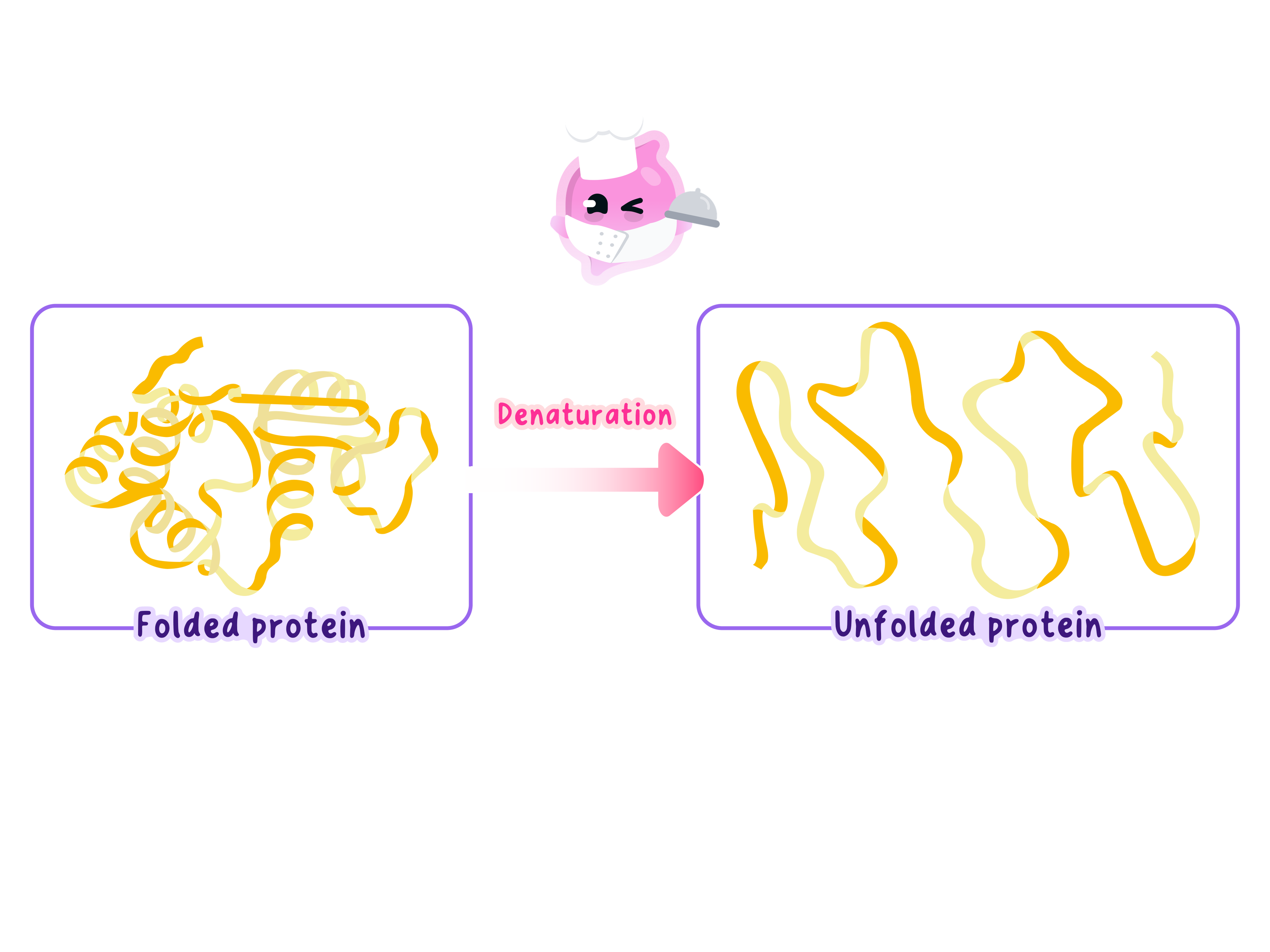
- Denaturation is the permanent change in a protein's folded shape that happens when the bonds holding the fold together are broken.
- A high temperature breaks those bonds because the chain vibrates so strongly that the weak attractions between side groups cannot hold.
- An extreme pH breaks them because it changes the charge on the side groups, so groups that were attracting each other no longer do.
- Once the fold is lost the chain takes up a different shape, and the binding site it used to carry no longer fits the molecule it was built for.
- The sequence of amino acids is not affected, because the bonds joining the amino acids into a chain are much stronger than the ones holding the fold.
- Denaturation is not reversible, so a denatured protein cannot be cooled or neutralised back into working order.
- You see it happen every time an egg is fried, because the clear runny protein in the white turns solid and white as it denatures and does not turn back.
- Do not say an enzyme is killed by heat, because an enzyme is a molecule and was never alive; the correct word is denatured.
- Do not write that the amino acid sequence changes when a protein denatures, because only the folding is lost.
- Do not treat denaturation as temporary, since a denatured protein does not refold when the conditions are put back to normal.
- Do not describe a protein as simply a chain of amino acids when a question asks about function, because it is the folded shape that does the work.
Writing about protein structure and function
- Run the chain of reasoning in order when you explain function: sequence, then folding, then shape, then the molecule it binds.
- Use the word complementary for two shapes that fit together, rather than saying they are the same shape.
- Name the reaction as condensation when proteins are built and hydrolysis when they are digested, and say whether water is released or used.
- Give a specific protein and its job when a question asks for an example, because enzymes, antibodies and collagen all do different things.
- Say denatured, then add that the shape of the binding site has changed, since the term on its own seldom gains the explanation mark.
- Name the monomer of a protein and state which four elements it always contains.
- Explain how many molecules of water are released when 606060 amino acids are joined into one chain.
- Explain why the sequence of amino acids decides what a protein can do.
- Describe two conditions that cause a protein to become denatured.
- Explain why a protein eaten in food has to be hydrolysed before the body can use it.
1.3.5 Fatty acids and lipids
The two building blocks of a lipid
Lipid
A biological molecule made of one glycerol molecule joined to three fatty acids, used as a concentrated energy store and as insulation.
Glycerol
The small three-carbon molecule that forms the backbone of every lipid, holding three fatty acids.
Fatty acid
A molecule with a long chain of carbon and hydrogen atoms that joins to glycerol to build a lipid.
- A lipid is built from two different kinds of subunit, which makes it unlike a carbohydrate or a protein.
- Glycerol is the small three-carbon molecule that acts as the backbone, and there is exactly one of it in every lipid molecule.
- A fatty acid is a long chain of carbon and hydrogen atoms with an acid group at one end, and three of them are attached to each glycerol.
- The ratio of subunits is therefore 1:31:31:3, one glycerol to three fatty acids, and a lipid built this way is called a triglyceride.
- Because there are two kinds of subunit rather than one repeating monomer, a lipid is not a polymer in the way that starch and a protein are.
- A lipid molecule is also a fixed size, since it always contains four subunits, whereas a polymer chain can be any length.
- Lipids contain carbon, hydrogen and oxygen like carbohydrates, but the long fatty acid chains hold a far smaller proportion of oxygen.
- Less oxygen means more carbon to hydrogen bonds per molecule, and that is exactly why a lipid releases so much more energy per gram than a carbohydrate.
- The three fatty acids attached to one glycerol do not have to be identical, which is one reason different lipids have different properties.
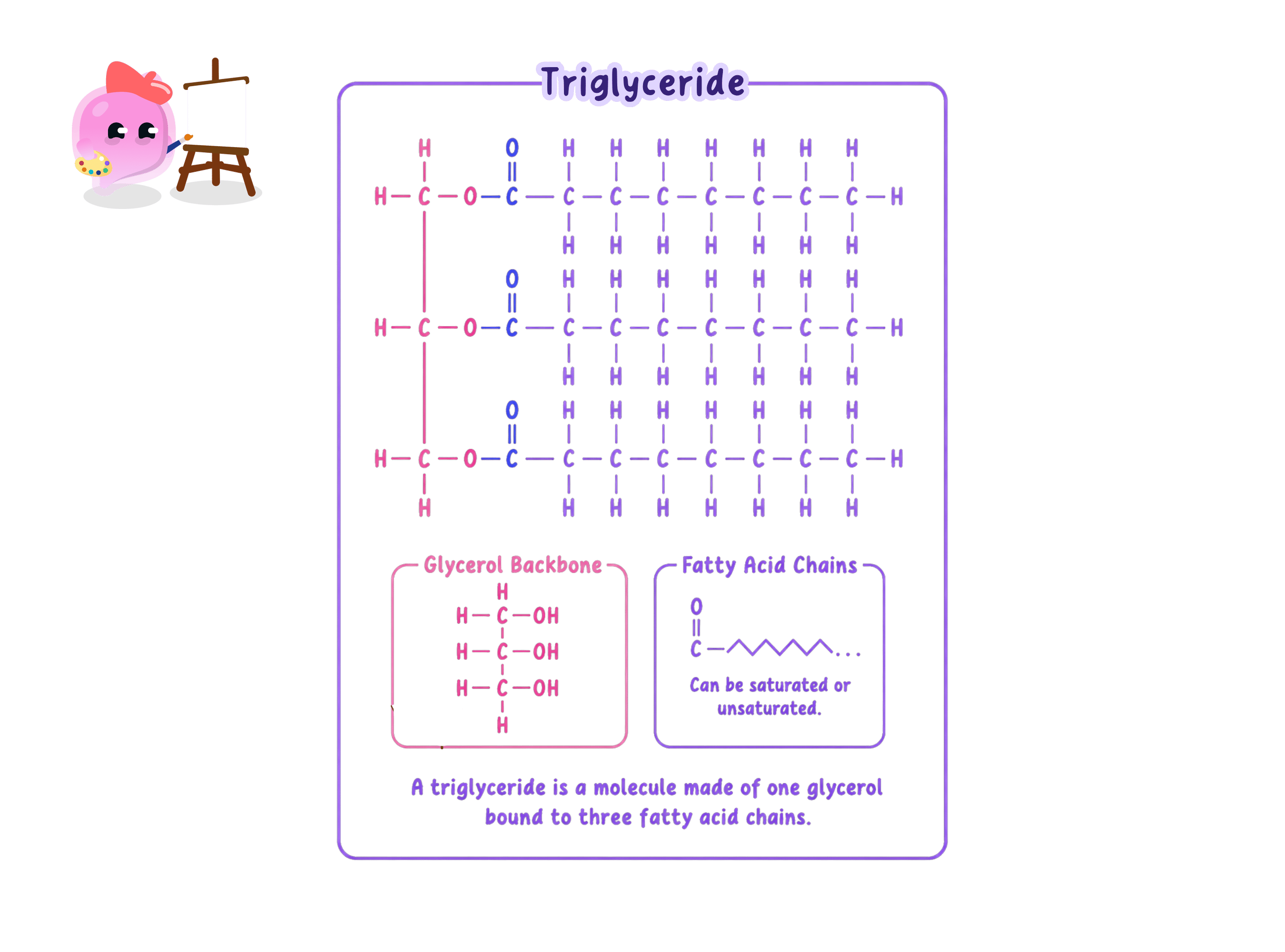
- Fatty acids and glycerol are the subunits a lipid is built from and also the products released when it is broken down.
- Any lipid that is solid at room temperature is called a fat, and any lipid that is liquid is called an oil.
Building and breaking lipids
Condensation reaction
A reaction in which two smaller molecules join together and one molecule of water is released.
Hydrolysis
A reaction in which a large molecule is split into smaller ones by adding a molecule of water at each bond broken.
- Each fatty acid is attached to the glycerol by a condensation reaction, and each of those reactions releases one molecule of water.
- Since three fatty acids are attached to each glycerol, building one lipid molecule releases three molecules of water.
- The reactions are controlled by enzymes and need energy from ATP, in the same way that building any large molecule does.
- Hydrolysis reverses the process, adding one molecule of water at each of the three bonds to release the glycerol and the three fatty acids.
- Lipase is the enzyme that hydrolyses lipids, and it does this in the small intestine so that the products are small enough to be absorbed.
- Once absorbed, the fatty acids and glycerol are rejoined to build the particular lipids that body needs, including the lipids of its cell membranes.
- A cell also hydrolyses its own stored lipid whenever it needs the energy, releasing fatty acids that can be respired.
- This is why a body that has used up its stored carbohydrate begins to lose stored fat instead.
Counting the water released when lipids are built
- A cell builds 202020 lipid molecules from glycerol and fatty acids.
- Every lipid molecule needs three fatty acids attached, so three condensation reactions are needed for each one.
- The number of water molecules released is 20×3=6020 \times 3 = 6020×3=60.
- Hydrolysing those 202020 lipid molecules back to their subunits would use up the same 606060 molecules of water.
What cells use lipids for
- A lipid is a concentrated energy store, releasing roughly twice as much energy per gram as a carbohydrate does.
- That matters for an animal that has to carry its store around, because the same amount of energy can be stored in half the mass.
- Lipids are also insoluble in water, so a large store can sit in a cell without dragging water in by osmosis.
- A layer of fat under the skin gives thermal insulation, because fat conducts heat poorly and so slows the rate at which heat is lost.
- Fat packed around organs such as the kidneys and the heart acts as protection, cushioning them against knocks.
- Lipids form part of every cell membrane, which is why even a cell that stores no fat at all still has to make them.
- Plant seeds store lipid rather than starch when they need a compact energy reserve, which is why sunflower and rapeseed are pressed for oil.
- Carbohydrate is the store a cell reaches for first because it can be hydrolysed quickly, while lipid is the longer-term reserve.
- A lipid store therefore does two jobs at once in a mammal, holding energy and reducing heat loss.
Saturated and unsaturated fatty acids
Saturated fatty acid
A fatty acid whose carbon chain contains no carbon to carbon double bonds, so the chain is straight and packs together closely.
Unsaturated fatty acid
A fatty acid whose carbon chain contains one or more carbon to carbon double bonds, which put a kink in the chain and keep the molecules further apart.
- The three fatty acids attached to the glycerol can be saturated or unsaturated, and this changes the properties of the whole lipid.
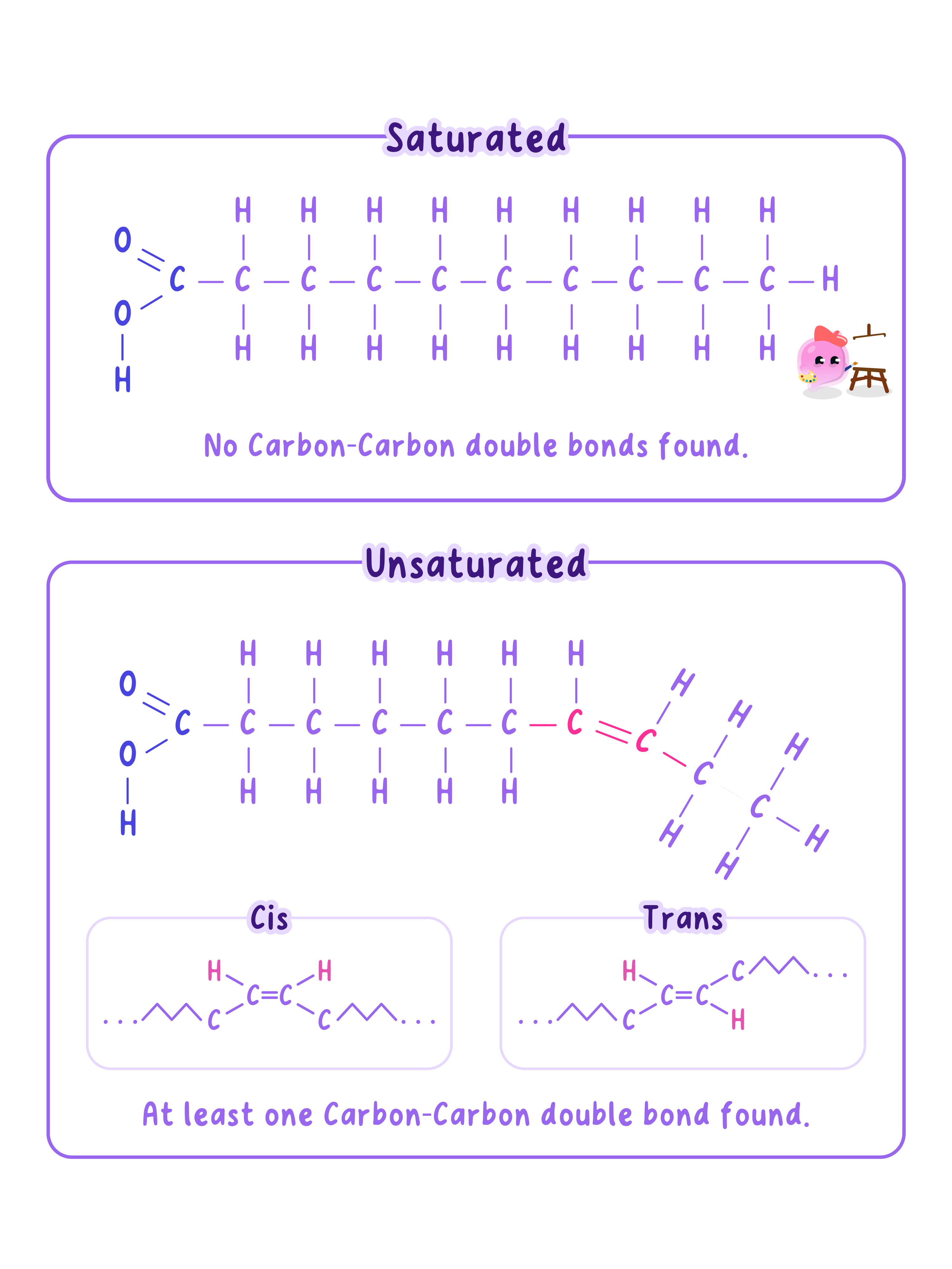
- A saturated fatty acid has no carbon to carbon double bonds in its chain, so every carbon holds as many hydrogen atoms as it can.
- With no double bonds the chain stays straight, so neighbouring molecules pack closely together and attract one another strongly.
- Close packing means more energy is needed to separate the molecules, so lipids rich in saturated fatty acids are usually solid fats at room temperature.
- An unsaturated fatty acid has one or more carbon to carbon double bonds, written as C=C\text{C=C}C=C.
- Each double bond puts a kink in the chain, which stops the molecules packing neatly and weakens the attraction between them.
- Loose packing means less energy is needed to separate them, so lipids rich in unsaturated fatty acids are usually liquid oils at room temperature.
- Saturated fatty acids come mainly from animal sources such as butter, cheese, lard and fatty meat.
- Unsaturated fatty acids come mainly from plant and fish sources such as olive oil, sunflower oil, nuts and oily fish.
- Both kinds are still lipids, so both release about the same amount of energy per gram when they are respired.
- Do not treat unsaturated as meaning low in energy, because an oil holds just as much energy per gram as a solid fat.
- Do not say a lipid is a polymer of fatty acids, because it contains only three of them joined to one glycerol.
- Do not write that two molecules of water are released per lipid, since there are three bonds to form and therefore three molecules of water.
Writing about lipids and their subunits
- Name both subunits every time, because an answer that gives only fatty acids misses the glycerol mark.
- Quote the ratio as one glycerol to three fatty acids when a question asks about the structure of a lipid.
- Say condensation and three molecules of water for building, and hydrolysis for breaking down, rather than describing the change in general terms.
- Link a use to a property, for example that lipids are insoluble so a large store can be held without water being drawn in.
- Explain a difference in melting behaviour through the shape of the chains and how closely they pack, not just by naming the double bond.
- Name the two kinds of subunit in a lipid and state how many of each there are in one molecule.
- State how many molecules of water are released when a single lipid molecule is built.
- Name the enzyme that hydrolyses lipids and give the two products it releases.
- Give three uses of lipids in the body apart from storing energy.
- Explain why a lipid rich in unsaturated fatty acids is a liquid at room temperature.
