Cadmium is a heavy metal often released in industrial wastewater. It accumulates in aquatic ecosystems and can enter food chains. Inside cells, catalase is a crucial enzyme that breaks down hydrogen peroxide (H2O2H_2O_2H2O2), a toxic byproduct of metabolism, into water and oxygen. Scientists are concerned that cadmium contamination might harm cell function by inhibiting catalase activity.
Catalase activity depends on the specific tertiary structure of the enzyme. Which two statements explain how cadmium ions (Cd2+Cd^{2+}Cd2+) could affect catalase activity?
- Cadmium ions bind to the enzyme and cause its active site to change shape.
- Cadmium ions will increase the temperature of the solution and cause the substrate to denature.
- Cadmium ions will decrease the pH and cause the substrate to change shape.
- The enzyme will not fit into the active site of the substrate.
- The substrate will denature and prevent any enzyme interaction.
- The substrate will not fit into the active site of the enzyme.
Students suspend yeast cells in nutrient solutions containing different concentrations of cadmium chloride (CdCl2CdCl_2CdCl2). They then measure the catalase activity of the cells by measuring the volume of oxygen gas produced. The graph shows their results:
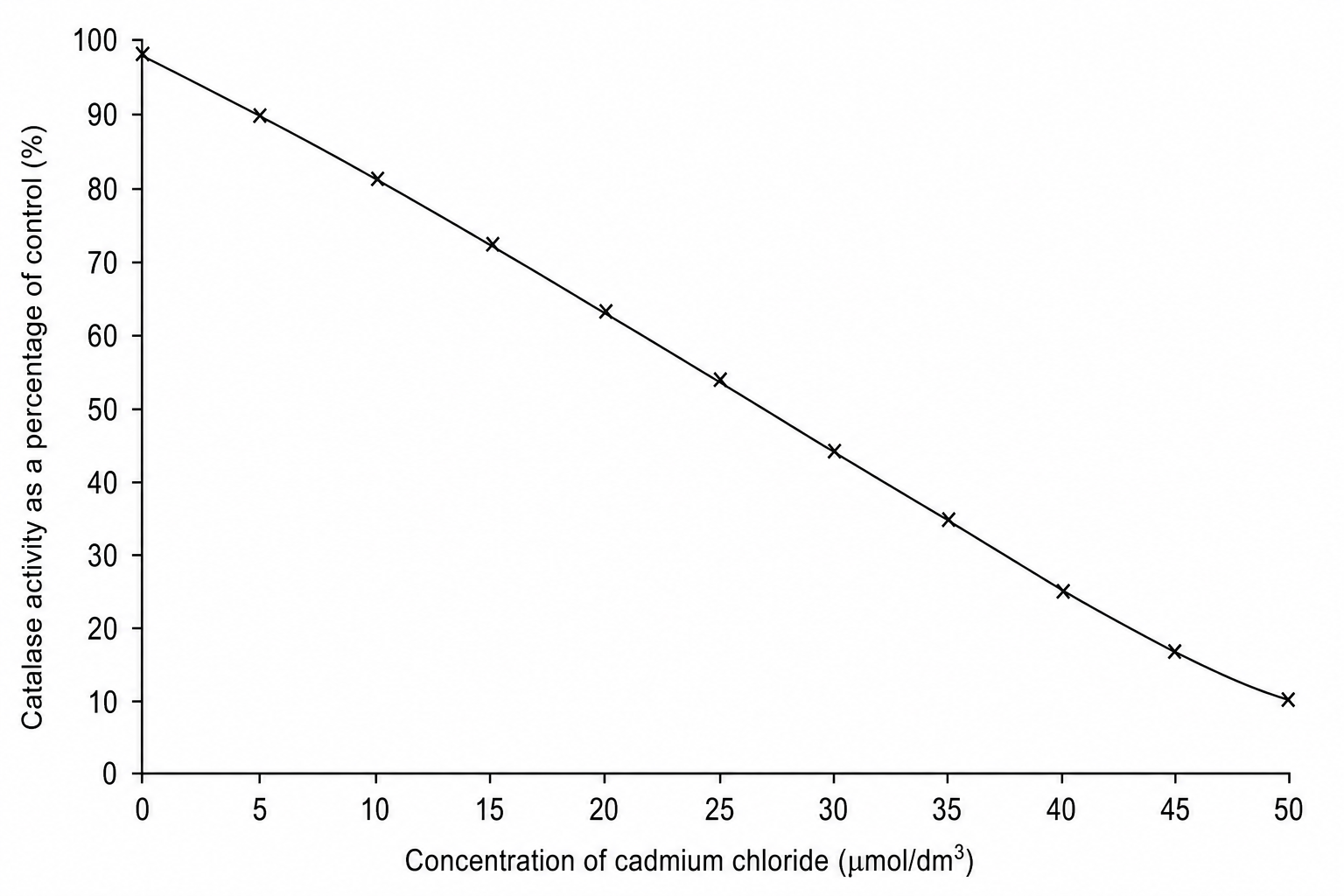
The students plotted the catalase activity as a percentage of the activity in a control experiment. The control experiment involved yeast cells in a solution containing no cadmium chloride. Suggest what substance the students used in the control experiment instead of the cadmium chloride solution.
One of the students makes this conclusion: 'The results of our experiment show that cadmium chloride is toxic to yeast cells, and this toxicity is entirely due to the inhibition of catalase.' Discuss whether this is a reasonable conclusion to make from the students' results.
Suggest how the students could modify their experiment to prove that the reduction in catalase activity is specifically caused by the cadmium ions (Cd2+Cd^{2+}Cd2+) and not the chloride ions (Cl−Cl^-Cl−).