Mutations produce variants
Definition
Mutation
A mutation is a change in the base sequence of DNA.
Definition
Allele
An allele is an alternative version of a gene.
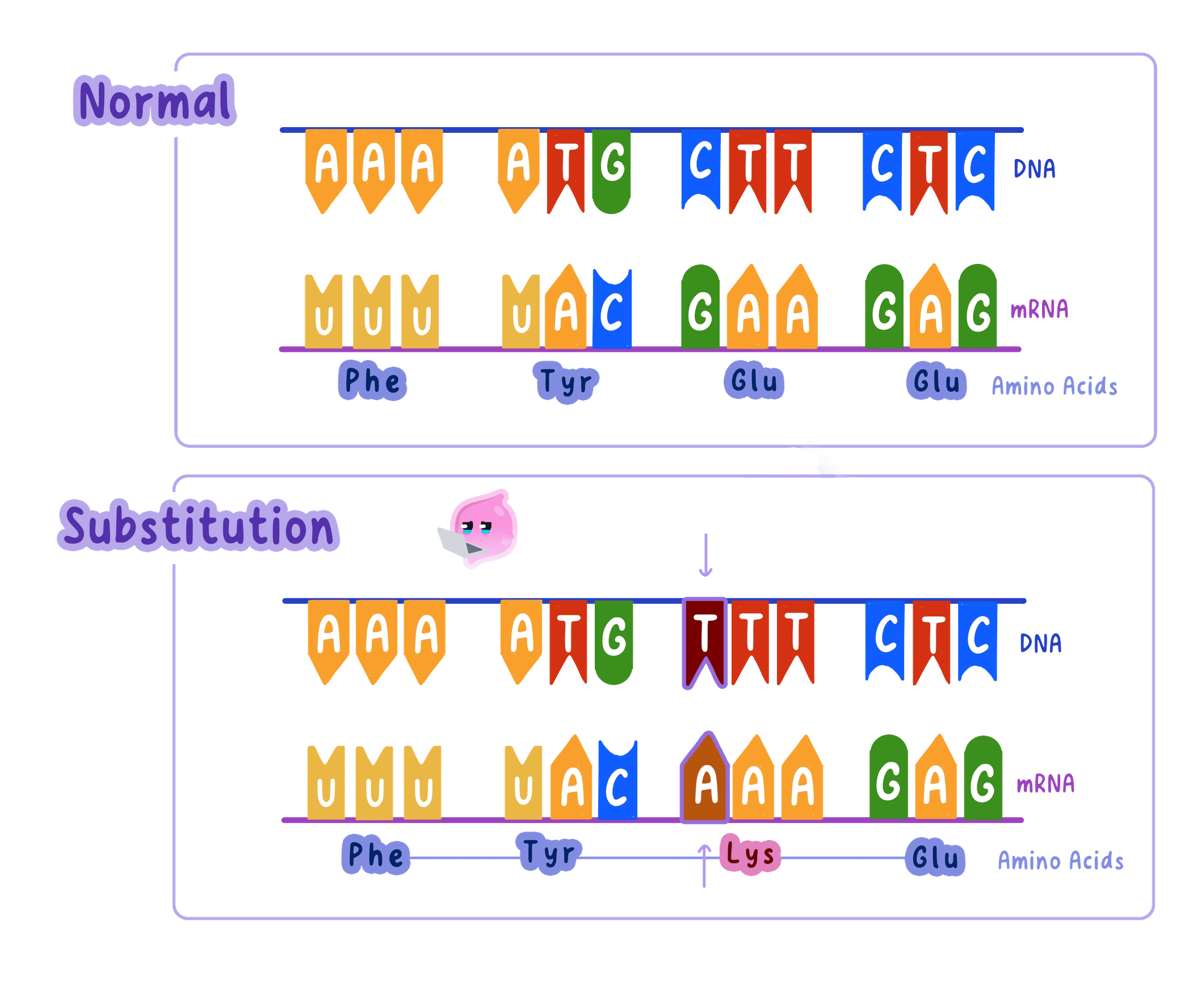
- A mutation changes the sequence of bases in DNA and can create a genetic variant.
- A variant within a gene may form a different allele of that gene.
- All genetic variants originate through mutations, although an individual may inherit a variant that first arose many generations earlier.
- Mutations can arise spontaneously, for example when DNA is copied, rather than occurring because an organism needs a useful characteristic.
- Some environmental agents, including ionising radiation and certain chemicals, increase the frequency of mutations.
- A substitution replaces a base, an insertion adds a base, and a deletion removes a base from a DNA sequence.
Common Mistake
A mutation is a change in DNA, whereas a change in appearance caused by diet or exercise does not by itself demonstrate a mutation.
Variants have different effects
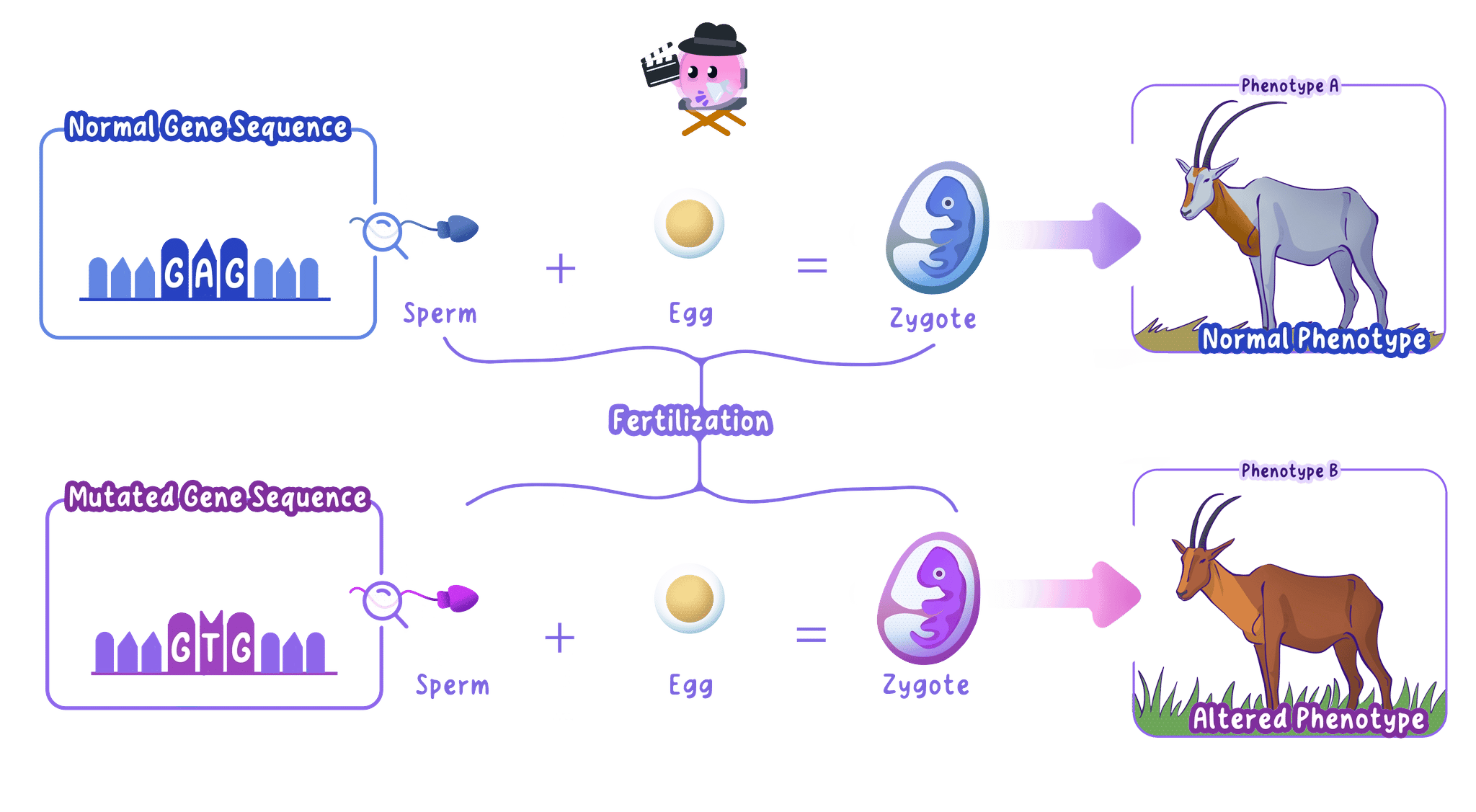
- Most variants produce no detectable change in phenotype, so a DNA difference does not necessarily produce a visible difference.
- Some variants influence a characteristic without deciding it completely, because other genetic and environmental factors also contribute.
- Very few variants have an effect large enough to determine a particular characteristic.
- A variant may be harmful, beneficial or neutral, depending on its effect and the environment in which the organism lives.
- A harmful effect can reduce survival or reproduction, whereas a beneficial effect can increase survival or reproduction in particular conditions.
Example
- A DNA change with no detectable effect on growth or appearance illustrates a neutral variant.
- A variant that slightly changes growth illustrates an influence on phenotype.
- A variant that prevents a pigment from being produced can determine whether that pigment is present.
Passing a variant to offspring
- If a cell carrying a variant divides, its DNA can be copied into its descendant cells.
- In sexual reproduction, a variant can be inherited when it is present in a gamete that contributes to fertilisation.
- A mutation confined to an ordinary body cell is not normally passed to offspring through sexual reproduction.
- Sexual reproduction brings existing alleles into new combinations, while mutation is the original source of new variants.
Exam technique
Distinguish the origin of a variant, a mutation, from its inheritance, the transmission of that variant from a parent.
Interpreting evidence
- When DNA sequences are supplied, compare corresponding positions to identify the changed base or an added or missing base.
- Use the reported characteristic to decide whether the variant has no detected effect, influences the phenotype or determines the feature being considered.
- A sequence difference alone is insufficient evidence that the organism will be harmed.
Self review
- What changes during a mutation?
- What is the original source of genetic variants?
- What effect do most variants have on phenotype?
- When can a variant be inherited through sexual reproduction?
- Why does a new variant not necessarily harm an organism?
