Coding variants affect proteins
Definition
Coding DNA
Coding DNA is a DNA sequence that specifies the amino acid sequence of a protein.
- A gene's base sequence determines the amino acid sequence of the protein it codes for.
- A variant in coding DNA may change the base sequence copied into messenger RNA, written mRNA\mathrm{mRNA}mRNA.
- When the message is translated at a ribosome, the changed sequence may cause a different amino acid to be added to the protein.
- The amino acid sequence affects how the chain folds into its specific three-dimensional shape.
- A change in folding can alter the protein's structure and therefore its activity.
- The resulting effect on a cell's processes may change the organism's phenotype.
Common Mistake
Use may when describing the effect of a coding variant, because a changed DNA sequence does not always alter the protein's function.
Changes to an enzyme's active site
- An enzyme binds its substrate at an active site with a complementary shape.
- If a coding variant changes an amino acid important to folding, the enzyme's active site may change shape.
- The substrate may then bind less effectively or fail to bind, so fewer enzyme-substrate complexes form.
- The enzyme-controlled reaction may slow down or stop, changing the amount of product made.
- If that product is a pigment, a reduced supply can change the colour of a tissue.
Example
- A plant has an enzyme that catalyses the formation of a purple pigment.
- A coding variant changes the enzyme's amino acid sequence and the shape of its active site.
- Its substrate no longer binds effectively, so less pigment is made and the flower is paler.
Protein changes can alter cells
- The same reasoning applies to proteins other than enzymes, including transport proteins and structural proteins.
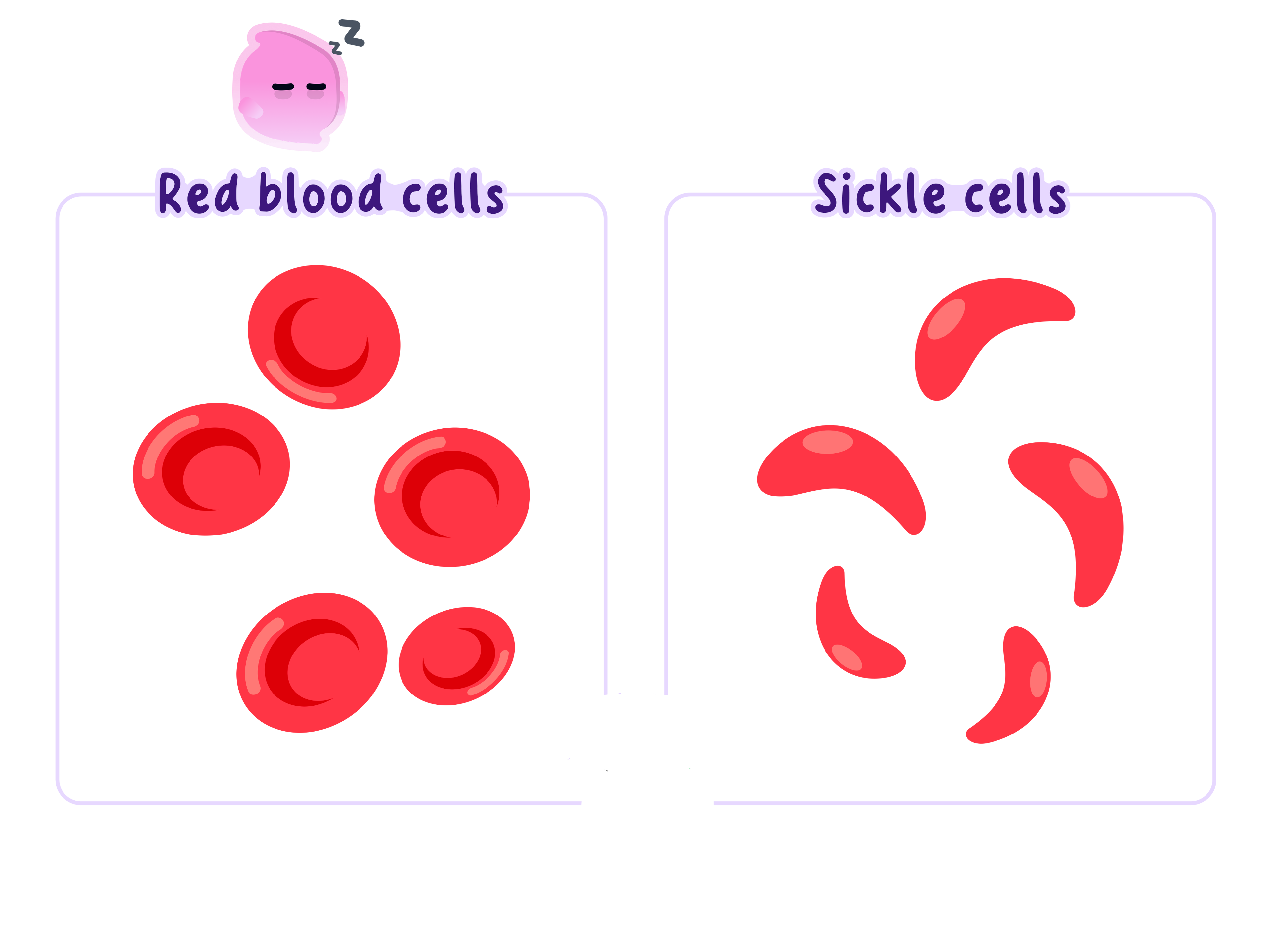
- A variant affecting haemoglobin can alter how haemoglobin molecules behave and can cause red blood cells to become sickle-shaped under low-oxygen conditions.
- The example links a DNA difference to a protein difference and then to a change in cell properties.
Exam technique
- For a coding variant, connect the base sequence, amino acid sequence, protein shape, protein activity and resulting characteristic.
- For an enzyme, name the active site and explain the effect on substrate binding rather than saying only that the enzyme changes.
Non-coding variants affect expression
Definition
Non-coding DNA
Non-coding DNA is DNA that does not specify the amino acid sequence of a protein.
Definition
Gene expression
Gene expression is the use of information in a gene to make its functional product, such as a protein.
- Some non-coding DNA regulates whether a gene is used and how much of its product is made.
- A variant in a regulatory region can prevent the gene from being transcribed.
- If transcription is prevented, no mRNA\mathrm{mRNA}mRNA copy of that gene is produced.
- Without the mRNA\mathrm{mRNA}mRNA message, ribosomes cannot make that protein from the affected copy of the gene.
- Other regulatory changes may increase or decrease transcription, altering the amount of protein produced.
- A non-coding variant can therefore change phenotype even when the protein-coding sequence itself has not changed.
Example
- A flower-colour gene codes for an enzyme needed to make pigment.
- A variant in non-coding regulatory DNA prevents transcription of the gene, so its mRNA\mathrm{mRNA}mRNA is not made.
- The enzyme is not produced from that gene copy, reducing pigment production without needing to change the enzyme's amino acid sequence.
Distinguishing the two mechanisms
- A coding variant can change what the protein is like and how effectively it works.
- A non-coding regulatory variant can change whether, when or how much of a protein is made.
- Both routes can affect the same characteristic, but the explanation must identify the route supported by the information given.
- A variant outside an important coding or regulatory sequence may have no detectable phenotypic effect.
Self review
- How can a coding variant alter a protein's shape?
- Why can an altered active site reduce enzyme activity?
- How can non-coding DNA affect gene expression?
- What happens to protein production if transcription is prevented?
- How does changing protein activity differ from changing protein amount?
