What a potometer measures
Definition
Potometer
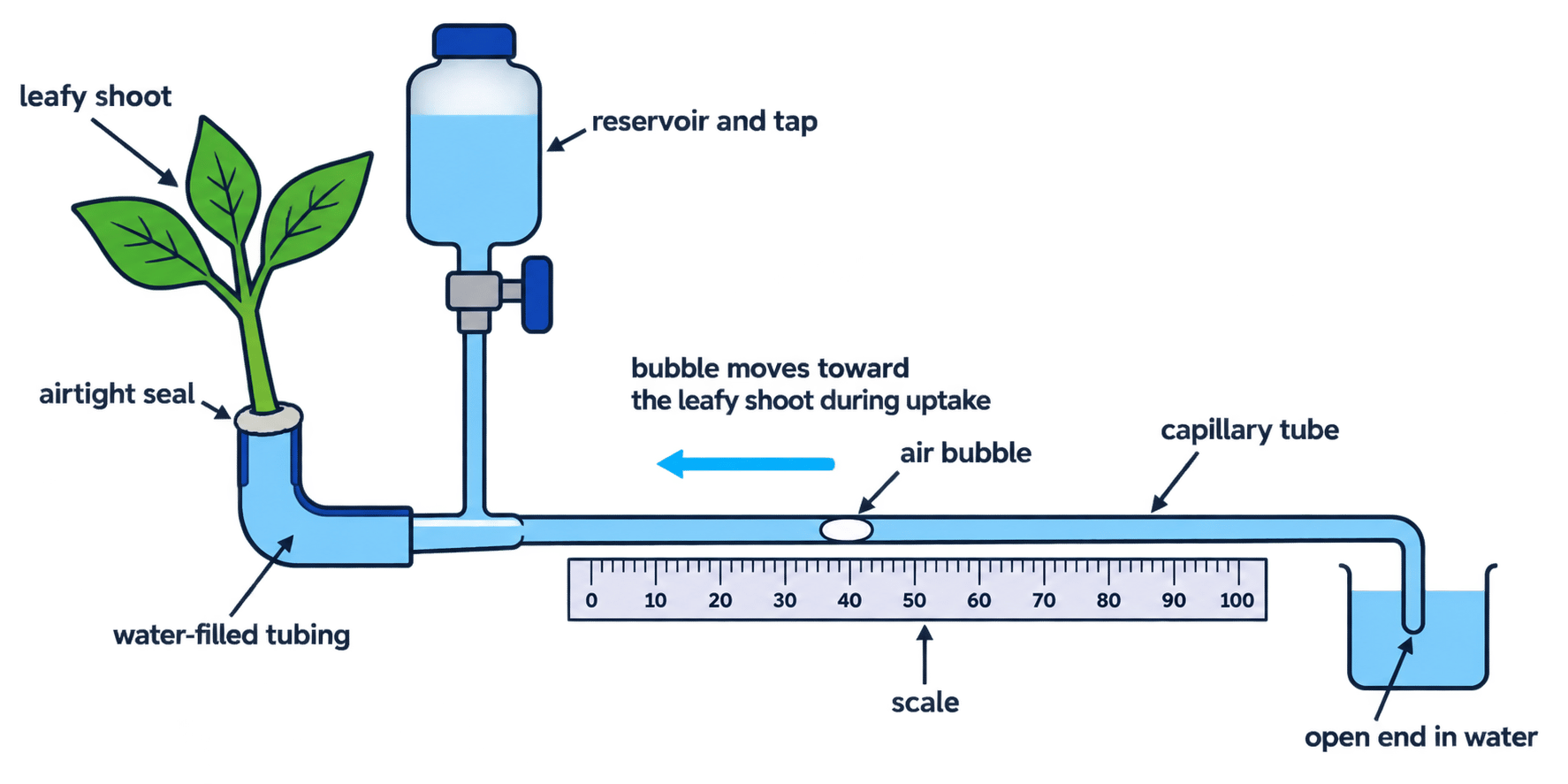
A potometer is an apparatus that measures the rate at which a leafy shoot takes up water, used as an estimate of its transpiration rate.
Definition
Transpiration rate
The transpiration rate is the volume of water a plant loses as vapour in a given time.
- Water vapour leaving a leaf cannot be seen or collected easily, so transpiration is measured indirectly by measuring how much water the plant takes in.
- A potometer does exactly that, by holding a cut leafy shoot in a sealed column of water and watching that column move.
- The simplest form is a bubble potometer: a shoot sealed into rubber tubing that is joined to a horizontal capillary tube marked with a scale.
- A single air bubble is introduced into the capillary tube, and as the shoot draws water up, the bubble is pulled along behind it.
- The distance the bubble travels in a given time is therefore a direct measure of the volume of water the shoot has taken up.
- A reservoir with a tap, or a syringe, is fitted so the bubble can be pushed back to the start of the scale for the next reading.
- The whole apparatus has to be airtight and watertight, because any leak lets the bubble move for reasons that have nothing to do with the plant.
- Strictly it measures water uptake rather than water loss, because a small amount of the water taken in is used in photosynthesis and held inside the cells.
- That difference is under one part in a hundred, so uptake is treated as a good estimate of the transpiration rate.
Calculating the rate of water uptake
- When only a comparison between conditions is needed, the rate can be quoted straight from the scale as rate=distance movedtime\text{rate}=\dfrac{\text{distance moved}}{\text{time}}rate=timedistance moved
- That gives an answer in millimetres per minute, which is enough to say which condition produced faster uptake.
- For a true volume, the bubble sweeps out a cylinder of capillary tube, so the volume taken up is V=πr2dV=\pi r^{2}dV=πr2d
- In that equation rrr is the internal radius of the capillary tube and ddd is the distance the bubble has moved.
- The rate of water uptake is then rate=Vt\text{rate}=\dfrac{V}{t}rate=tV usually written in mm3\text{mm}^{3}mm3 per minute or converted to cm3\text{cm}^{3}cm3 per hour.
- The conversion needed is 1 cm3=1000 mm31\ \text{cm}^{3}=1000\ \text{mm}^{3}1 cm3=1000 mm3, and both lengths in the volume equation must be in the same unit before multiplying.
- Comparing two shoots fairly means dividing by the total leaf area, because a shoot with more leaves will always take up more water.
Example
Rate of uptake from a bubble reading
- A bubble travels 60 mm60\ \text{mm}60 mm in 5.05.05.0 minutes along a capillary tube of internal radius 0.50 mm0.50\ \text{mm}0.50 mm.
- The volume of water taken up is V=πr2dV=\pi r^{2}dV=πr2d.
- Substituting gives V=π×(0.50)2×60=π×0.25×60=47.1 mm3V=\pi\times(0.50)^{2}\times60=\pi\times0.25\times60=47.1\ \text{mm}^{3}V=π×(0.50)2×60=π×0.25×60=47.1 mm3.
- The rate is 47.15.0=9.4 mm3 per minute\dfrac{47.1}{5.0}=9.4\ \text{mm}^{3}\text{ per minute}5.047.1=9.4 mm3 per minute.
- Over an hour that is 9.4×60=564 mm39.4\times60=564\ \text{mm}^{3}9.4×60=564 mm3, which converts to 5641000=0.56 cm3 per hour\dfrac{564}{1000}=0.56\ \text{cm}^{3}\text{ per hour}1000564=0.56 cm3 per hour.
Practical
Investigating water uptake with a bubble potometer
- Aim: to set up a simple potometer and use it to compare the rate of water uptake by a leafy shoot in still air, in moving air, in bright light and at a raised temperature.
- Apparatus: a bubble potometer with a scaled capillary tube, rubber tubing and a reservoir tap or syringe, a leafy shoot, a large bowl of water, a scalpel, a white tile, petroleum jelly, a stopclock, a fan, a bench lamp, a thermometer, a ruler, paper towel and eye protection.
- Variables: the environmental factor being changed is the independent variable and the rate of water uptake is the dependent variable, while the same shoot, the same number and area of leaves, the settling time, the time interval and every factor not being tested are controlled.
- Method, assembling the potometer:
- Fill the whole potometer with water while holding it under the surface of the bowl, working every air bubble out of the capillary tube and the rubber tubing.
- Cut the shoot from the plant under water with a sharp scalpel, and make the cut at a slant so a larger area of xylem is exposed.
- Keep the cut end under water at all times, because an air bubble drawn into the xylem breaks the water column and the shoot then takes up nothing.
- Push the stem firmly into the rubber tubing while both are still submerged, then lift the assembled apparatus out and dry the outside.
- Seal the joint between the stem and the tubing with petroleum jelly so that no air leaks in and no water escapes.
- Blot the leaves dry, because water sitting on a leaf surface evaporates and makes the reading too high.
- Method, taking readings:
- Leave the shoot for about five minutes so that its rate of uptake becomes steady before any reading is taken.
- Lift the open end of the capillary tube out of its beaker for a moment to draw a single air bubble in, then return it to the water.
- Line the bubble up with a mark on the scale and start the stopclock.
- Record the distance the bubble travels in a fixed time such as five minutes, reading the same edge of the bubble each time.
- Open the reservoir tap or press the syringe to push the bubble back to the start, then repeat twice more and take a mean.
- Method, changing one factor at a time:
- For air movement, set a fan a fixed distance away on a low setting and leave everything else unchanged.
- For light intensity, move a bench lamp to set distances and place a glass tank of water between the lamp and the shoot so the lamp does not also heat it.
- For temperature, move the whole apparatus into a warmer or cooler room and record the temperature with a thermometer beside the shoot.
- For humidity, enclose the shoot loosely in a clear plastic bag and leave it long enough for the air inside to become damp.
- Allow five minutes for the shoot to settle after every change before taking the next set of readings.
- Results: the bubble moves fastest with the fan running and under bright light, more slowly in still air at room temperature, and slowest inside the plastic bag or in a cool dark place.
- Maths: convert each mean distance to a volume with V=πr2dV=\pi r^{2}dV=πr2d, divide by the time for a rate, and plot rate against the factor being changed; strip the leaves afterwards, draw round them on squared paper and divide each rate by the total leaf area to compare different shoots fairly.
- Watch out: a leaking joint, a stem cut in air, wet leaves, a shoot that has not settled and a lamp that heats as well as lights are the usual causes of unreliable readings, and the bubble must be reset to the same starting mark before every repeat.
- Safety: wear eye protection, cut on a tile away from your fingers, keep water well clear of the lamp and any electrical socket, and handle the glass capillary tube carefully because it snaps easily.
Measuring water loss as a change in mass
Definition
Percentage change in mass
The percentage change in mass is the change in the mass of a sample expressed as a percentage of its starting mass.
- A second way to follow transpiration is to weigh the plant, because water leaving as vapour makes the plant lighter.
- A whole potted plant is used with its pot and soil sealed inside a plastic bag, so the only water leaving is the water lost through the leaves.
- The plant is weighed on a balance at the start and at set intervals, and each mass is recorded to the same number of decimal places.
- The change in mass is the final mass minus the starting mass, so a loss of water gives a negative value.
- Because plants differ in size, results are compared as a percentage change in mass rather than as a raw number of grams.
- The equation is percentage change=change in massstarting mass×100\text{percentage change}=\dfrac{\text{change in mass}}{\text{starting mass}}\times100percentage change=starting masschange in mass×100
- The same equation is used for a percentage gain, and the sign of the answer says which has happened.
- The mass method is simpler to set up than a potometer but far less sensitive, so it needs hours rather than minutes to give a measurable change.
Example
Percentage loss of mass by a shoot
- A sealed leafy shoot has a mass of 24.0 g24.0\ \text{g}24.0 g at the start and 21.6 g21.6\ \text{g}21.6 g after two hours.
- The change in mass is 21.6−24.0=−2.4 g21.6-24.0=-2.4\ \text{g}21.6−24.0=−2.4 g.
- The percentage change is −2.424.0×100=−10.0%\dfrac{-2.4}{24.0}\times100=-10.0\%24.0−2.4×100=−10.0%, which is a 10.0%10.0\%10.0% loss.
- The rate of loss is 2.42.0=1.2 g per hour\dfrac{2.4}{2.0}=1.2\ \text{g per hour}2.02.4=1.2 g per hour.
- A second shoot losing 1.2 g1.2\ \text{g}1.2 g from a starting mass of 8.0 g8.0\ \text{g}8.0 g has lost 15.0%15.0\%15.0%, so it is transpiring faster for its size even though it lost fewer grams.
Exam technique
Answering potometer questions
- Write water uptake rather than water loss when describing what the apparatus measures, because that distinction is regularly worth a mark.
- Name a control variable precisely, so temperature held constant beats keeping conditions the same.
- Show the equation before substituting in a rate or percentage calculation, since the working carries credit even when the arithmetic slips.
- Give a percentage change with its sign or with the word loss, because a bare number does not say which way the mass moved.
- For an improvement question, name the change and then its effect, such as cutting the stem under water so no air bubble enters the xylem.
Common Mistake
- Do not say a potometer measures the rate of transpiration directly, because it measures uptake and some of that water stays in the plant.
- Do not divide by the final mass when calculating a percentage change, because the starting mass is always the denominator.
- Do not change two conditions at once, because a fan that also cools the shoot leaves you unable to say which factor caused the change.
- Do not forget to convert units before using V=πr2dV=\pi r^{2}dV=πr2d, because a radius in millimetres with a distance in centimetres gives an answer out by a factor of ten.
Self review
- Describe how a bubble potometer is used to measure the rate of water uptake by a leafy shoot.
- Explain why the shoot must be cut under water and why the joints must be sealed.
- A bubble moves 45 mm45\ \text{mm}45 mm in 3.03.03.0 minutes along a tube of radius 0.40 mm0.40\ \text{mm}0.40 mm. Calculate the rate of uptake in mm3\text{mm}^{3}mm3 per minute.
- A plant falls from 50.0 g50.0\ \text{g}50.0 g to 47.5 g47.5\ \text{g}47.5 g. Calculate the percentage change in mass.
- Give two control variables you would keep constant when comparing the rate of uptake in still and moving air.