The root hair cell
Definition
Root hair cell
A root hair cell is an epidermal cell of a root with a long, narrow extension that absorbs water and mineral ions from the soil.
- A plant takes in all its water and all its mineral ions through the roots, not through the leaves.
- The absorbing surface is the epidermis, the single outer layer of cells covering the root.
- Many of those epidermal cells grow a long, narrow extension out into the soil, and a cell with such an extension is a root hair cell.
- The hair is an outgrowth of one cell, so it has no cross wall and no nucleus of its own.
- The long, thin shape gives a very large surface area, so a great many water molecules and ions can enter at the same time.
- It also pushes between the soil particles into gaps a smooth root surface could never reach, so it touches far more of the water film clinging to those particles.
- The wall and the membrane are thin, which keeps the diffusion distance for water and ions extremely short.
- The cell contains many mitochondria, because moving mineral ions inwards needs a continuous supply of energy from respiration.
- It has a large permanent vacuole holding cell sap, a concentrated solution of sugars and salts that keeps the inside of the cell more concentrated than the soil water.
- It has no chloroplasts, because it lives underground where there is no light to photosynthesise with.
- Root hairs are found only in a band a few millimetres behind the growing tip, and each one lives for a matter of days before being replaced as the root grows on into fresh soil.
Example
How much surface area a root hair adds
- Treat one root hair as a cylinder of length l=0.50 mml=0.50\ \text{mm}l=0.50 mm and diameter d=0.010 mmd=0.010\ \text{mm}d=0.010 mm.
- The curved surface area of a cylinder is A=πdlA=\pi d lA=πdl.
- Substituting gives A=π×0.010×0.50=0.0157 mm2A=\pi\times0.010\times0.50=0.0157\ \text{mm}^{2}A=π×0.010×0.50=0.0157 mm2 for a single hair.
- A square millimetre of root epidermis carries roughly 200200200 hairs, adding 200×0.0157=3.14 mm2200\times0.0157=3.14\ \text{mm}^{2}200×0.0157=3.14 mm2.
- The absorbing area of that patch rises from 1 mm21\ \text{mm}^{2}1 mm2 to about 4.1 mm24.1\ \text{mm}^{2}4.1 mm2, roughly four times as much surface from the same volume of root.
Taking up water by osmosis
Definition
Osmosis
Osmosis is the net movement of water molecules from a dilute solution to a concentrated solution through a partially permeable membrane.
Definition
Partially permeable membrane
A partially permeable membrane is a membrane that allows small molecules such as water to pass through it but not larger dissolved particles.
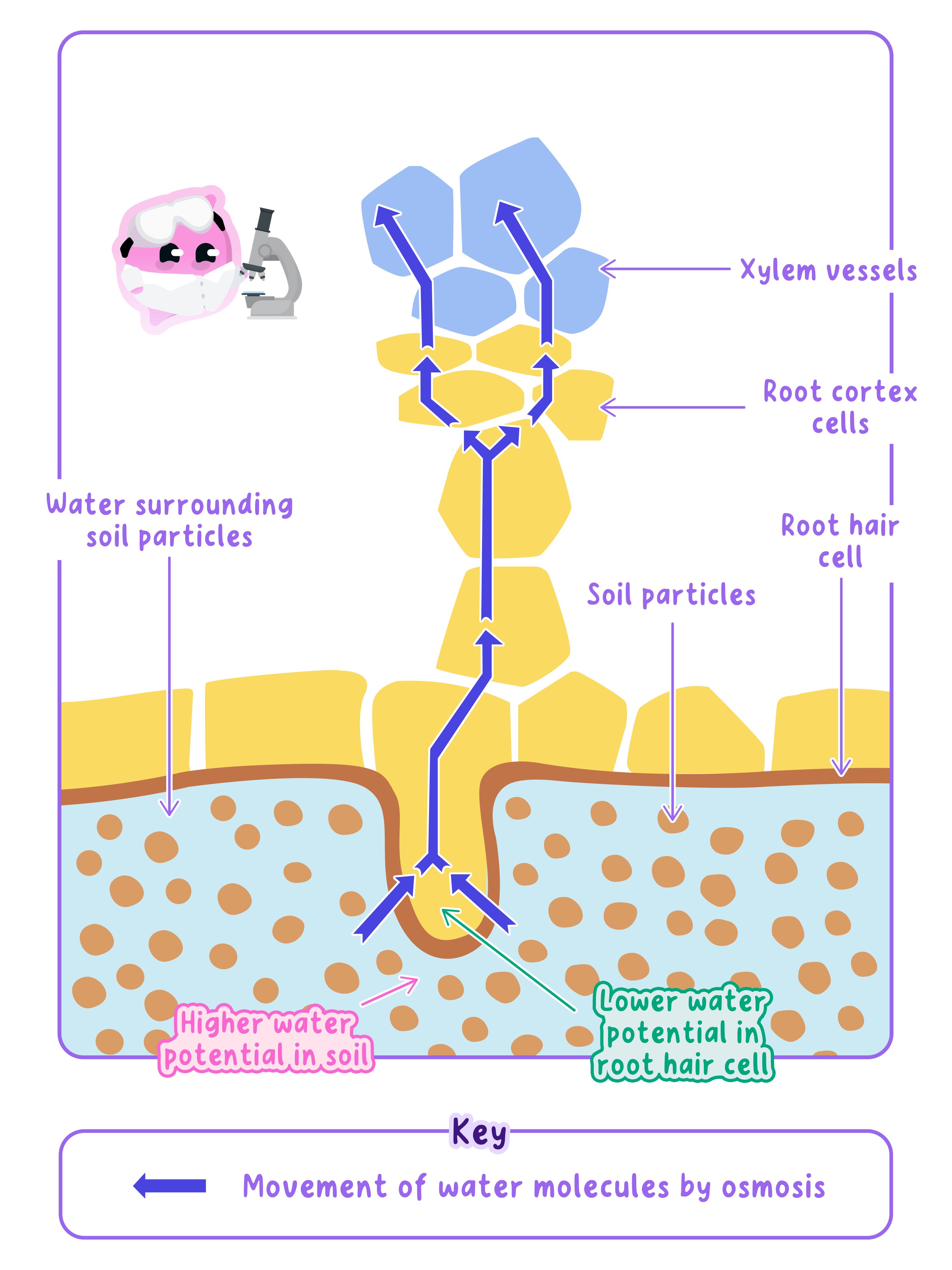
- Soil water is a very dilute solution, so it has a high concentration of water molecules and only a trace of dissolved salts.
- The cell sap inside the root hair cell is a concentrated solution, so it has a lower concentration of water molecules.
- The cell membrane is partially permeable, so water molecules can pass through it but the dissolved solutes largely cannot.
- Water therefore moves into the cell by osmosis, down a water potential gradient from the dilute soil solution to the concentrated cell sap.
- Osmosis is a passive process, so it needs no energy from respiration.
- Water then passes from that cell into the next along the same kind of gradient, moving steadily across the root towards the centre.
- The gradient is maintained because water is drawn out of the centre of the root and up the stem, so the cells nearer the middle never become saturated.
- Uptake slows and then stops if the soil dries out or is heavily salted, because the soil solution becomes as concentrated as the cell sap and the gradient disappears.
- In very salty soil water moves out of the root cells instead of in, which is why a plant watered with sea water dies.
Taking up mineral ions by active transport
Definition
Active transport
Active transport is the movement of a substance against its concentration gradient using energy released by respiration.
Definition
Concentration gradient
A concentration gradient is the difference in the concentration of a substance between two regions.
- Mineral ions such as nitrate, magnesium and potassium are present in the soil solution at very low concentrations.
- Their concentration inside the root hair cell is already higher than their concentration outside it.
- Diffusion would therefore move them out of the cell rather than in, because diffusion only runs down a concentration gradient.
- The cell instead uses active transport, which moves ions against the gradient, from the lower concentration to the higher one.
- Carrier proteins in the cell membrane pick up a particular ion on the outside, change shape and release it on the inside.
- That change of shape needs energy released by respiration, which is why the cell is packed with mitochondria.
- Each carrier protein handles one kind of ion, so the plant can take up the particular ions it needs and leave the rest.
- Anything that stops respiration therefore stops mineral uptake, so a waterlogged soil with no oxygen leaves a plant short of nitrate even though the nitrate is there.
- Water uptake and ion uptake happen through the same cell at the same time, but by two different processes, one passive and one requiring energy.
Practical
Growing and examining root hairs
- Aim: to germinate cress or radish seeds, find the root hairs on the young roots and examine them under a light microscope, relating the shape of a root hair cell to its job of absorbing water and mineral ions.
- Apparatus: cress or radish seeds, a Petri dish, filter paper, distilled water in a dropping pipette, forceps, a scalpel, a white tile, microscope slides, cover slips, a mounted needle, dilute methylene blue or iodine solution, filter paper for blotting, a light microscope, a ruler, a sharp pencil and eye protection.
- Variables: this is an observational study, so there is no independent variable, and the seedlings are all grown at the same temperature on paper kept equally damp so their roots reach a comparable stage.
- Method, growing the seedlings:
- Line a Petri dish with filter paper and wet it with distilled water until it is damp all over but not flooded.
- Space about twenty seeds across the paper so their roots will not tangle, put the lid on and leave the dish in a warm place for three or four days.
- Add water each day to keep the paper damp, because a root that dries out even briefly loses its hairs.
- Method, preparing the slide:
- Lift a seedling with forceps by holding the seed, never the root, so the hairs are not torn away.
- Hold the root against a dark background: the hairs show as a white fuzz in a band a few millimetres behind the tip, with the tip itself and the older root both bare.
- Cut about 1 cm1\ \text{cm}1 cm of root that includes the band, and lay it in a drop of water in the centre of a slide.
- Hold a cover slip at about 45∘45^{\circ}45∘ on a mounted needle and lower it slowly so the water spreads sideways and the air is driven out.
- If the hairs are hard to see, place a drop of dilute stain at one edge of the cover slip and draw it underneath with filter paper touched to the opposite edge.
- Method, viewing and recording:
- Focus at low power first, find the band of hairs, then move to ×10\times10×10 and ×40\times40×40 using the fine focus only.
- Trace one hair back to the epidermal cell it grows from, to confirm it is an outgrowth of a single cell rather than a separate cell.
- Estimate the length of several hairs against the width of the field of view and record the range.
- Draw one root hair cell with single unbroken pencil lines and label the cell wall, the cell membrane, the cytoplasm, the vacuole and the nucleus.
- Results: the hairs appear only in a band behind the growing tip, each is many times longer than it is wide, and together they turn a smooth root surface into a dense fringe reaching between the soil particles.
- Maths: estimate the extra surface a single hair provides from the curved surface of a cylinder, A=πdlA=\pi d lA=πdl, then multiply by the number of hairs counted in one field of view.
- Watch out: seedlings pulled from soil arrive with their hairs already stripped off, a root left on the bench shrivels within minutes, and pressing on the cover slip crushes the hairs flat against the root.
- Safety: wear eye protection, cut on a tile away from your fingers, treat the stains as chemicals that mark skin and clothing, and wash your hands after handling seeds and damp paper.
Exam technique
Answering on uptake by roots
- Name the process before describing it, so write osmosis for water and active transport for mineral ions, because the two are marked separately.
- State the direction relative to the gradient, so water moves down a gradient and ions move against one.
- Mention energy from respiration whenever active transport is involved, since that is the point separating it from diffusion.
- For a structure question, pair each feature of the cell with the process it serves, so many mitochondria goes with active transport and a large surface area goes with faster uptake.
Common Mistake
- Do not say mineral ions enter by osmosis, because osmosis moves water only.
- Do not describe osmosis as needing energy, because it is passive and only active transport requires energy from respiration.
- Do not call a root hair a separate cell, because it is a long extension of one epidermal cell.
- Do not write that water moves from a high concentration to a low concentration without saying concentration of what, because in osmosis it is the concentration of water that matters.
Self review
- Give three features of a root hair cell and state how each one helps it absorb substances.
- Explain how water moves from the soil into a root hair cell.
- Explain why mineral ions cannot be taken up by diffusion.
- State why a root hair cell contains a large number of mitochondria.
- Predict what happens to water uptake when a plant is watered with a concentrated salt solution, and explain why.
