Transpiration
Transpiration
Transpiration is the loss of water vapour from the leaves and stems of a plant, mainly through the stomata.
Transpiration stream
The transpiration stream is the continuous flow of water up the xylem from the roots to the leaves that replaces the water lost by transpiration.
- Water travels up a plant in a continuous stream, and almost all of it leaves again as vapour from the leaves.
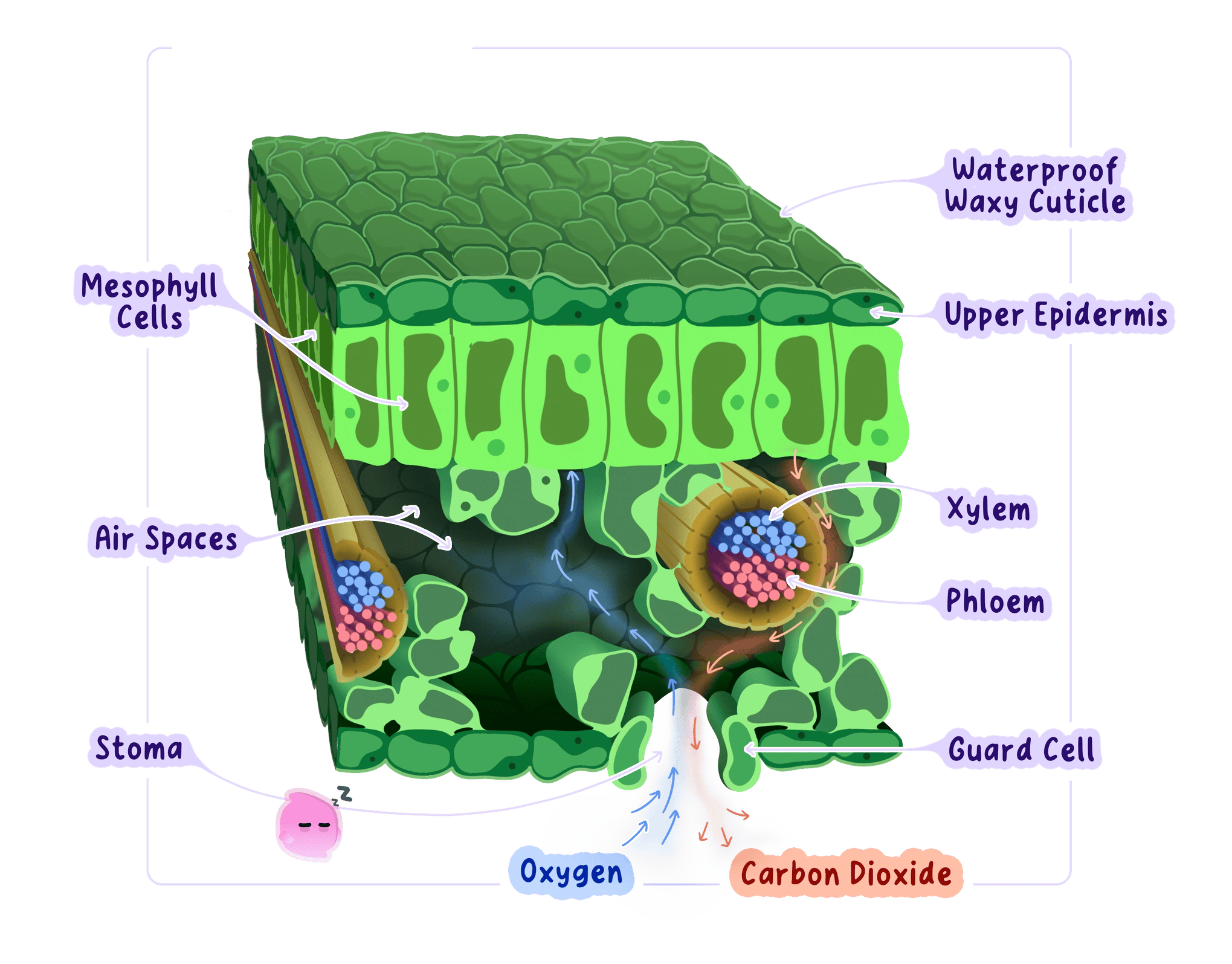
- Inside a leaf the cells are loosely packed with air spaces between them, and every cell surface facing those spaces is wet.
- Water evaporates from those wet cell walls, so the air spaces fill with water vapour.
- The air inside the leaf therefore holds far more water vapour than the air outside it.
- Water vapour then diffuses out through the stomata down that concentration gradient, and this loss is transpiration.
- Transpiration is therefore two steps: evaporation inside the leaf, then diffusion out of it.
- As water leaves a mesophyll cell, that cell draws replacement water from the cell next to it, and so on back to the nearest xylem vessel.
- That pull is passed all the way down the water in the xylem to the roots, producing the transpiration stream.
- The column of water holds together because water molecules attract one another, an effect called cohesion, so pulling at the top drags the whole column upwards.
- The plant spends no energy on this, because the energy that drives the evaporation comes from the sun.
- Transpiration is useful as well as unavoidable: it delivers water for photosynthesis, carries dissolved mineral ions up to the leaves, cools the leaf as water evaporates, and keeps cells firm with water so soft stems stay upright.
Stomata and guard cells
Stoma
A stoma is a pore in the epidermis of a leaf through which gases enter and leave and water vapour is lost.
Guard cell
A guard cell is one of a pair of sausage-shaped cells that changes shape to open or close a stoma.
- A leaf is covered by a waxy cuticle that is waterproof, so gases and water vapour cannot pass freely through the surface.
- The stomata are the controlled openings through it, and the singular of the word is stoma.
- Each stoma is a pore held between two sausage-shaped guard cells.
- Carbon dioxide diffuses in through the open pore for photosynthesis, oxygen diffuses out, and water vapour is lost at the same time.
- Most stomata are on the lower surface of a broad leaf, which is shaded and cooler, so less water evaporates than would be lost from the hot upper surface.
- Guard cells are the only epidermal cells of a leaf that contain chloroplasts, and they photosynthesise in the light.
- The wall of a guard cell is thicker on the side facing the pore and thinner on the outer side, and that uneven thickness is what makes the pore open.
Opening and closing a stoma
- In the light the guard cells take in water by osmosis and become turgid, which means swollen and firm.
- The thin outer wall stretches more easily than the thick inner wall, so each cell curves away from the pore.
- The two cells bow apart and the stoma opens, letting carbon dioxide in while the plant is photosynthesising.
- In the dark the guard cells lose water, become flaccid and straighten, so the two cells meet and the stoma closes.
- Closing at night costs the plant nothing, because there is no photosynthesis in the dark and so no need for carbon dioxide.
- Stomata also close during the day when the plant is short of water, which saves the plant even though photosynthesis stops.
The cost of opening the stomata
- A plant cannot let carbon dioxide in without letting water vapour out, because both use the same pore.
- Transpiration is therefore an unavoidable consequence of gas exchange rather than a process the plant carries out on purpose.
- Keeping the stomata open maximises photosynthesis but risks losing water faster than the roots can replace it.
- Closing them saves water but starves the leaf of carbon dioxide, so photosynthesis and growth stop.
- Guard cells settle that compromise minute by minute, opening the pores when water is plentiful and shutting them when it is not.
Taking a stomatal peel from a leaf
- Aim: to take an impression of a leaf surface with clear nail varnish, view the stomata and guard cells under a light microscope, and compare the number of stomata on the upper and lower surfaces.
- Apparatus: a broad-leaved plant such as a busy Lizzie or a laurel, clear nail varnish, transparent sticky tape, forceps, microscope slides, a light microscope, a stage micrometer or a transparent ruler, a stopclock, a sharp pencil and eye protection.
- Variables: the leaf surface, upper or lower, is the independent variable; the number of stomata in one field of view is the dependent variable; the same leaf, the same plant, the same magnification, the same field size and the same counting rule are controlled.
- Method, making the peel:
- Choose a healthy, fully expanded leaf and leave it attached to the plant, because a picked leaf begins to wilt and its stomata close.
- Paint a patch of clear nail varnish about 1 cm1\ \text{cm}1 cm square on the lower surface, keeping clear of the thick midrib.
- Time about ten minutes and check that the patch is completely dry and no longer tacky before touching it.
- Press a piece of clear sticky tape firmly over the dried patch, then peel the tape off in one steady movement so the varnish film comes with it.
- Stick the tape flat on a slide, film side upwards, smoothing out air bubbles with a finger.
- Repeat the whole process on the upper surface of the same leaf and label both slides clearly.
- Method, counting the stomata:
- Focus at low power to find the film, then move to ×40\times40×40 using the fine focus only.
- Each stoma shows as a small slit between two curved guard cells, set among the irregular jigsaw outlines of the other epidermal cells.
- Count every stoma in one whole field of view, counting those touching two chosen edges of the field and ignoring those touching the other two.
- Move to a fresh field of view and repeat for at least five fields on each surface.
- Draw a single stoma with its two guard cells, labelling the pore, the thick inner wall, the thin outer wall and the chloroplasts.
- Results: a typical broad leaf shows many stomata on the lower surface and very few on the upper surface, which fits the pattern of losing less water from the cooler, shaded side.
- Maths: calculate the mean count per field for each surface, measure the field diameter with a stage micrometer, find the field area from A=πr2A=\pi r^{2}A=πr2, then give the density as stomata per square millimetre using density=mean countfield area\text{density}=\dfrac{\text{mean count}}{\text{field area}}density=field areamean count.
- Watch out: varnish peeled before it is dry tears and shows nothing, an air bubble under the tape puts part of the film out of focus, a peel taken over the midrib gives an unrepresentative count, and the two surfaces cannot be compared unless the same edge rule is used every time.
- Safety: wear eye protection, use the nail varnish in a well ventilated room because its solvent vapour is flammable and irritating, keep it well away from any flame, and wash your hands afterwards.
Translocation
Translocation
Translocation is the movement of dissolved sugars and amino acids through the phloem from a source to a sink.
Source
A source is a part of a plant that makes or releases sugars into the phloem, such as a photosynthesising leaf.
Sink
A sink is a part of a plant that removes sugars from the phloem in order to use them or store them, such as a growing root tip.
- Photosynthesis makes glucose in the leaves, but every other part of the plant needs it too.
- Glucose is converted to sucrose for the journey, because sucrose is soluble but far less reactive, so it can be moved without being used up on the way.
- The movement of sucrose and amino acids through the phloem is called translocation.
- It runs from a source, where sugars are loaded in, to a sink, where they are taken out.
- A photosynthesising leaf is the usual source, and growing root tips, flowers, developing fruits and storage organs are the usual sinks.
- At a sink the sugar is respired for energy, built into cellulose for new cell walls, or stored as insoluble starch.
- Translocation moves in either direction, upwards to a growing shoot and downwards to a root, depending on where the sinks are at the time.
- The same part can switch role through the year, so a potato tuber is a sink while it is filling in summer and a source when it sprouts in spring.
- Loading sugar into the phloem needs energy from respiration, so translocation is an active process, unlike transpiration.
- That is why translocation slows or stops when a plant is starved of oxygen, while the transpiration stream keeps flowing.
Keeping the two processes apart
- Say what is being moved before you say where, because transpiration moves water and translocation moves dissolved food.
- Give both steps when describing transpiration, so evaporation from the cell surfaces inside the leaf and then diffusion out through the stomata.
- Use the words source and sink for translocation, and name a real example of each so the answer is not left general.
- State that translocation needs energy and transpiration does not, because that contrast is a common two-mark question on its own.
- Do not describe transpiration as the movement of water up the plant, because that is the transpiration stream and transpiration itself is the loss of water vapour.
- Do not write that water is lost through the stomata by evaporation, because it evaporates inside the leaf and then diffuses out.
- Do not say translocation only travels downwards, because sugars move to whichever parts are acting as sinks.
- Do not say guard cells open the stoma by contracting like a muscle, because they open it by taking in water and becoming turgid.
- Describe the two steps by which water is lost from a leaf during transpiration.
- Explain how a guard cell changes shape to open a stoma.
- State why most stomata are found on the lower surface of a leaf.
- Define translocation and give one example of a source and one of a sink.
- Explain why a plant cannot photosynthesise quickly without also losing water.
