Xylem
Xylem
Xylem is the plant tissue made of dead, hollow, lignified vessels that carries water and mineral ions from the roots to the leaves.
Lignin
Lignin is the hard, waterproof substance laid down in xylem walls that strengthens them and stops them collapsing.
- Xylem carries water and dissolved mineral ions from the roots to the stem and leaves, and it carries them in one direction only, upwards.
- A xylem vessel begins as a column of living cells, which then die and lose their cytoplasm, nucleus and organelles.
- The end walls between them break down completely, so the whole column becomes one continuous hollow tube running the length of the plant.
- An empty tube with no cross walls offers almost no resistance, so water flows through it far faster than it could pass from cell to cell.
- The walls are thickened with lignin, laid down in rings and spirals along the inside of the tube.
- Water in the xylem is under tension because it is being pulled from above, so without that thickening the tube would collapse inwards like a drinking straw sucked too hard.
- Lignin is also waterproof, so water is not lost sideways on the way up.
- Gaps in the thickening called pits let water leave the vessel where it is needed, at the roots and in the leaves.
- The tubes are narrow, which helps the column of water hold together as it is pulled upwards.
- Because it is dead and hollow, xylem uses no energy at all, and the pull that drives the flow comes from evaporation at the leaves.
- Lignified xylem also gives the plant support, and the accumulated xylem of a tree trunk is what we call wood.
Phloem
Phloem
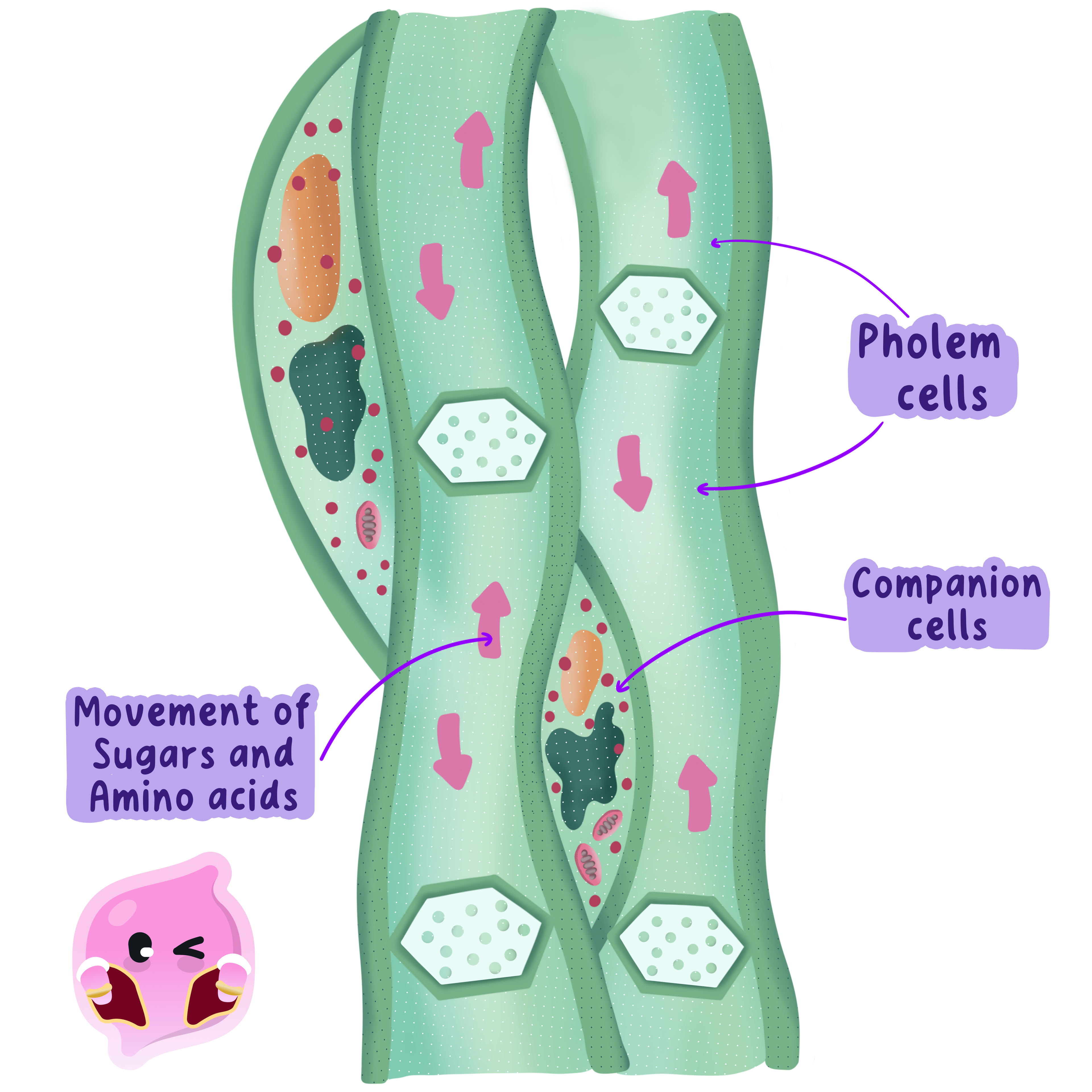
Phloem is the living plant tissue made of sieve tubes and companion cells that carries dissolved sugars and amino acids around the plant.
Sieve tube element
A sieve tube element is one of the living phloem cells joined end to end by perforated sieve plates to form a continuous tube.
Companion cell
A companion cell is a cell alongside a sieve tube element that supplies the energy needed to move sugars through the phloem.
- Phloem carries dissolved sugars and amino acids, and it carries them in both directions, to whichever parts of the plant need them.
- Unlike xylem, phloem is made of living cells, because moving sugars requires energy.
- The transport cells are sieve tube elements, joined end to end into a long tube.
- Their end walls are not removed but perforated with pores, forming sieve plates that let the sugary sap flow from one cell into the next.
- A sieve tube element loses most of its contents, including its nucleus, leaving only a thin layer of cytoplasm around the edge so the tube stays as clear as possible.
- With no nucleus it cannot control itself, so each one is paired with a companion cell lying alongside it.
- The companion cell keeps its nucleus and is packed with mitochondria, so it supplies the energy that loads sugar into the tube.
- The two are linked by fine strands of cytoplasm through the wall between them, so materials pass freely from one to the other.
- Phloem walls carry no lignin, which is why phloem gives the plant no support and why it can be crushed easily.
Where the two tissues lie in the plant
Vascular bundle
A vascular bundle is a strand of xylem and phloem running together through a root, stem or leaf.
- Xylem and phloem run side by side through the whole plant in strands called vascular bundles.
- Running together means water reaches the sugar-loading cells and the two systems can exchange water between them along the way.
- In a root the vascular tissue lies in the centre, which anchors the root against the pull of the plant being tugged upwards.
- In a stem the bundles are arranged in a ring near the outside, where they resist bending in the same way as the walls of a tube.
- In each stem bundle the xylem lies on the inside and the phloem on the outside.
- In a leaf the bundles form the midrib and the network of veins, which carry water out to the mesophyll and carry sugars away from it.
- The veins branch finely enough that no photosynthesising cell is far from a supply, and they also stiffen the thin blade of the leaf.
- Because the phloem sits outside the xylem in a stem, stripping a ring of bark from a tree removes the phloem and starves the roots while the leaves still receive water.
Tracing the xylem with a dye
- Aim: to stand a cut stem in coloured dye so the xylem is stained, then cut and examine sections to show where the vascular bundles lie and how the xylem is arranged inside them.
- Apparatus: fresh celery stalks with their leaves attached or white carnations, a beaker, red food dye or eosin solution, a scalpel, a white tile, a ruler, a stopclock, forceps, microscope slides, cover slips, a mounted needle, a dropping pipette, a light microscope, paper towel and eye protection.
- Variables: the time the stem spends in the dye is the independent variable and the height the colour reaches is the dependent variable, with stalk thickness, dye concentration, temperature, light intensity and air movement all kept the same.
- Method, staining the stem:
- Half fill a beaker with water and add enough dye to colour it strongly.
- Cut about 2 cm2\ \text{cm}2 cm off the base of the stalk while it is held under water, working on a tile and drawing the blade away from your fingers.
- Cutting under water matters, because a bubble drawn into a vessel in air breaks the column of water and the dye then stops rising.
- Stand the freshly cut stalk in the dye with its leaves still on, and start the stopclock.
- Leave it somewhere bright and airy, because faster transpiration pulls the dye up faster.
- Measure how far the colour has travelled up the stalk every ten minutes, holding the ruler against the outside from the surface of the dye.
- Method, cutting and viewing sections:
- After about an hour, lift the stalk out, blot it and cut a clean transverse slice a few centimetres above the base.
- Look at the cut face with the naked eye: the dye shows as a ring of small coloured dots, and each dot is the xylem inside one vascular bundle.
- Cut the thinnest freehand transverse sections you can manage and float them in a drop of water on a slide.
- Lower a cover slip at about 45∘45^{\circ}45∘ on a mounted needle so the water spreads and the air is driven out.
- Focus at low power, then move to ×10\times10×10 and ×40\times40×40 with the fine focus only, and identify the dyed xylem, the paler phloem outside it and the packing tissue around both.
- Cut a longitudinal section as well, in which the dyed xylem appears as long unbroken coloured lines rather than dots.
- Results: only a ring of small bundles takes up the dye, which shows water travels in narrow separate channels rather than through the whole stem, and the unbroken lines in longitudinal section show those channels are continuous tubes.
- Maths: calculate the rate of rise using rate=distancetime\text{rate}=\dfrac{\text{distance}}{\text{time}}rate=timedistance then plot distance against time, where a straight line through the origin shows a steady rate.
- Watch out: a stem cut in air draws in a bubble and stops taking up dye, a stalk with its leaves removed transports far less, sections cut too thickly stack cells on top of one another and cannot be focused, and a stalk left in dye overnight stains everything and hides the pattern.
- Safety: wear eye protection, cut on a tile away from your fingers with a sharp blade, treat eosin and food dye as chemicals that stain skin and clothing, and wash your hands and the bench afterwards.
Calculating the rate the dye rises
- The dye reaches 18 mm18\ \text{mm}18 mm up a celery stalk after 101010 minutes and 54 mm54\ \text{mm}54 mm after 303030 minutes.
- The distance travelled in that interval is 54−18=36 mm54-18=36\ \text{mm}54−18=36 mm.
- The time taken is 30−10=2030-10=2030−10=20 minutes.
- The rate is 3620=1.8 mm per minute\dfrac{36}{20}=1.8\ \text{mm per minute}2036=1.8 mm per minute.
- Since 1810\dfrac{18}{10}1018 also gives 1.81.81.8, the rate has stayed constant, so a graph of distance against time is a straight line through the origin.
Comparing xylem and phloem in an answer
- Match each feature to the job it does, so hollow dead tubes go with fast unresisted water flow and living cells with companion cells go with sugar loading.
- Write about the same feature on both sides when you compare, so dead against living and no end walls against perforated sieve plates.
- Give lignin two credits by mentioning both what it does, preventing collapse and keeping the tube waterproof, and where it is, in the xylem wall.
- State the direction of travel for each tissue, since one way up for xylem and either way for phloem is a routine marking point.
- Do not say xylem cells are alive, because they are dead and empty, which is exactly what lets water flow freely.
- Do not write that phloem has no end walls, because it keeps them and they are perforated into sieve plates.
- Do not describe xylem as pumping water, because the pull comes from evaporation at the leaves and the tissue itself uses no energy.
- Do not confuse the companion cell with the sieve tube element, because the sugar travels in the sieve tube and the companion cell supplies the energy.
- Give three features of a xylem vessel and state how each helps it carry water.
- Explain why xylem vessels are thickened with lignin.
- Describe the structure of a sieve tube element and state what a sieve plate does.
- Explain why phloem needs companion cells but xylem needs no living cells at all.
- State where the vascular bundles are found in a root and in a stem, and give one advantage of each arrangement.
